Graduate School of Frontier Biosciences, Osaka University, Suita, Osaka, Japan.
RIKEN Center for Biosystems Dynamics Research, Suita, Osaka, Japan.
mBio. 2019 Apr 2;10(2):e00079-19. doi: 10.1128/mBio.00079-19.
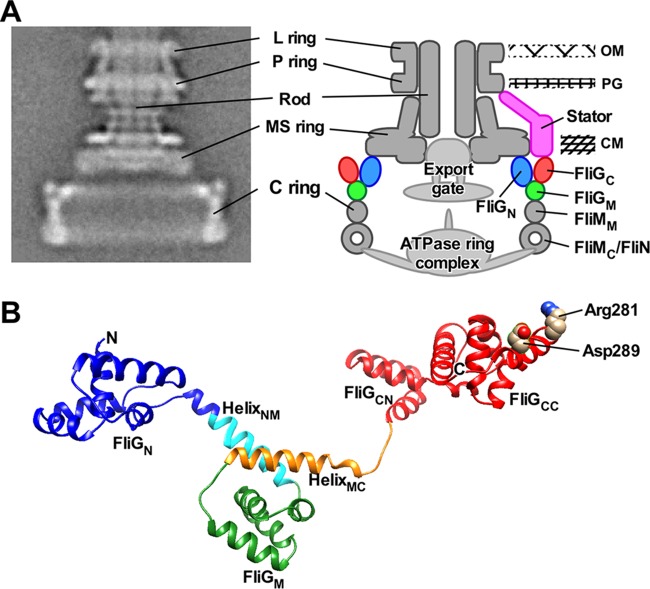
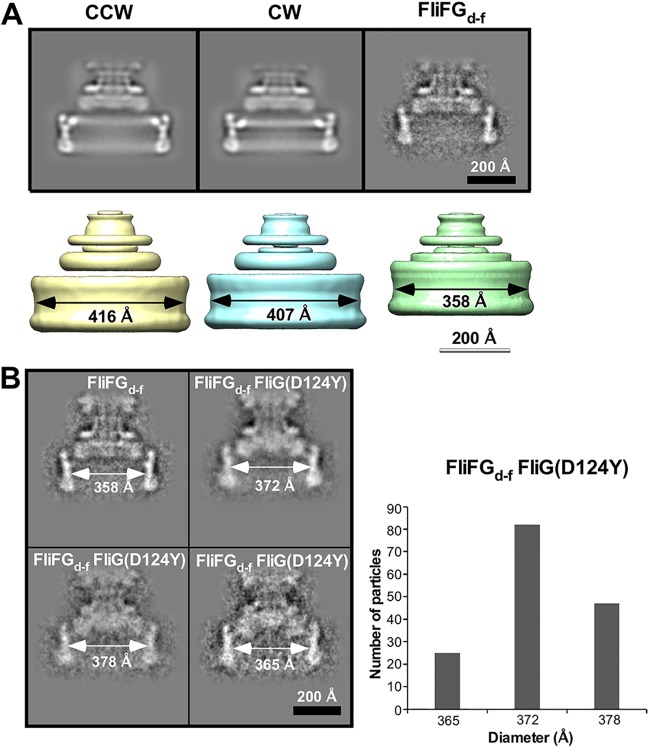
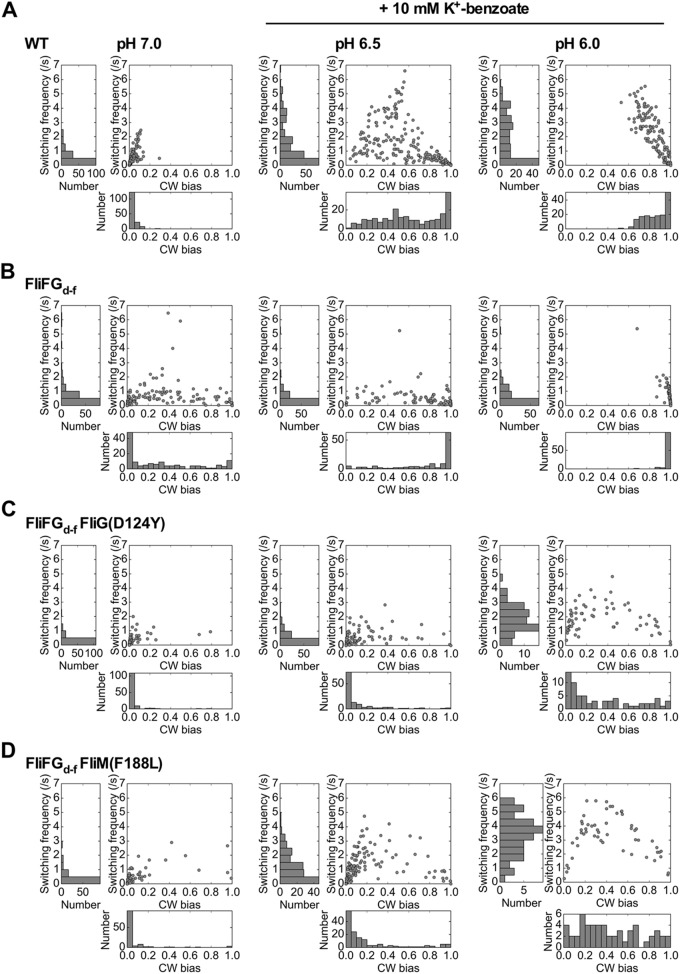
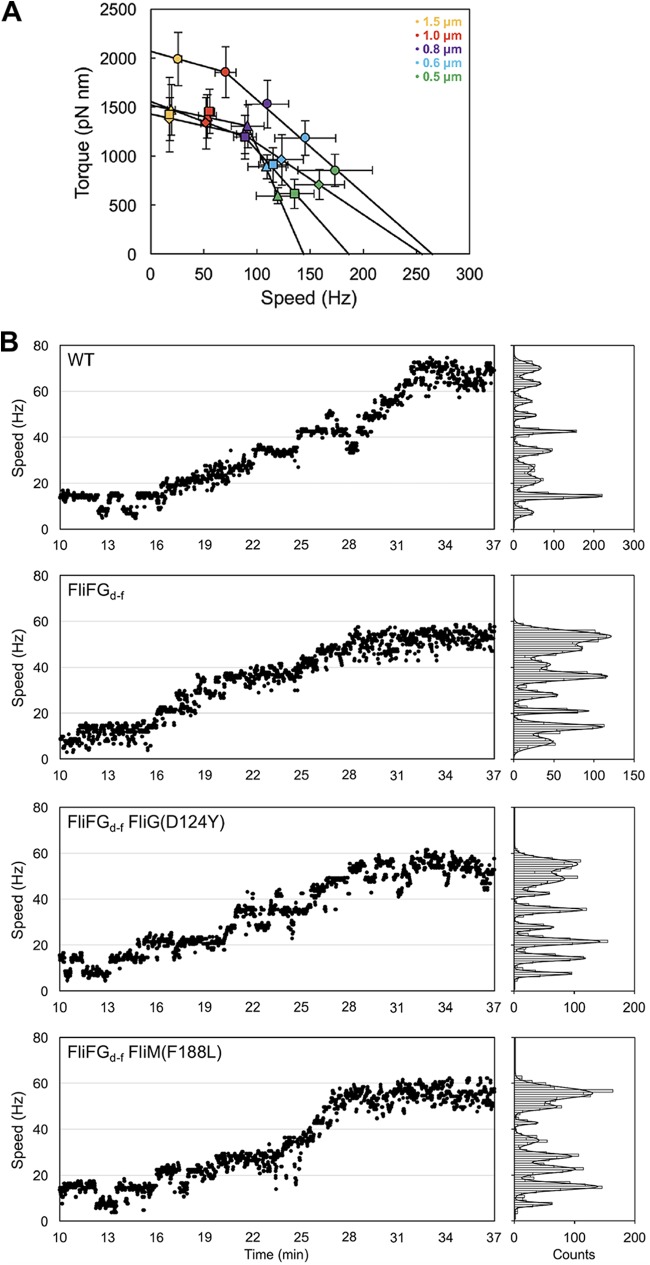
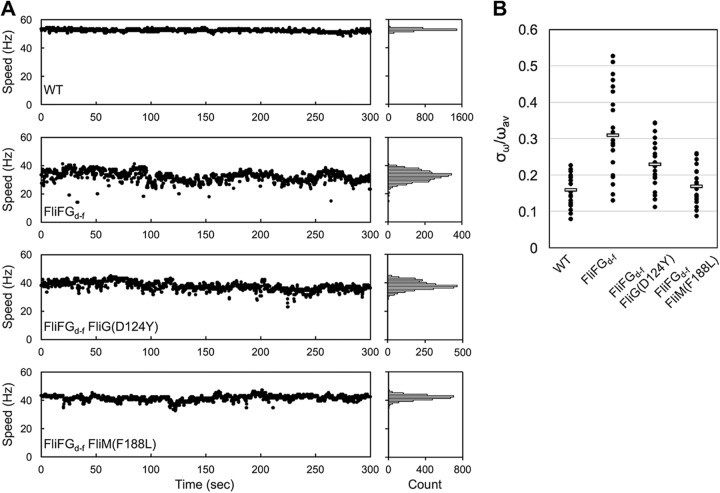
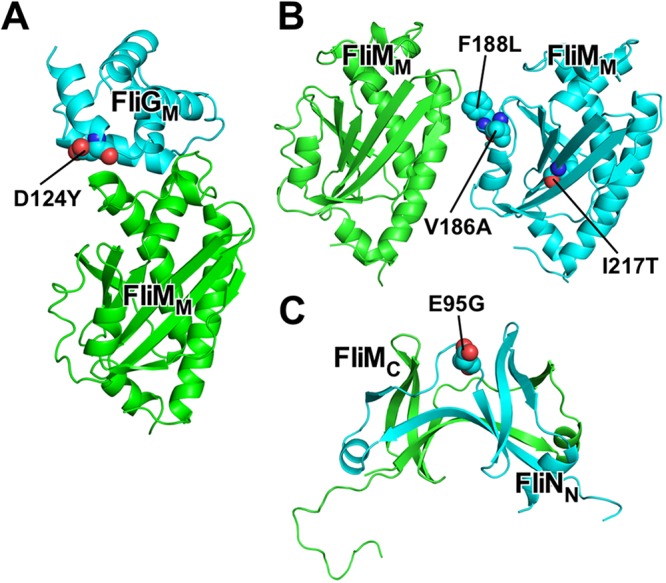
The flagellar motor can spin in both counterclockwise (CCW) and clockwise (CW) directions. The flagellar motor consists of a rotor and multiple stator units, which act as a proton channel. The rotor is composed of the transmembrane MS ring made of FliF and the cytoplasmic C ring consisting of FliG, FliM, and FliN. The C ring is directly involved in rotation and directional switching. The FliF-FliG deletion fusion motor missing 56 residues from the C terminus of FliF and 94 residues from the N terminus of FliG keeps a domain responsible for the interaction with the stator intact, but its motor function is reduced significantly. Here, we report the structure and function of the FliF-FliG deletion fusion motor. The FliF-FliG deletion fusion not only resulted in a strong CW switch bias but also affected rotor-stator interactions coupled with proton translocation through the proton channel of the stator unit. The energy coupling efficiency of the deletion fusion motor was the same as that of the wild-type motor. Extragenic suppressor mutations in FliG, FliM, or FliN not only relieved the strong CW switch bias but also increased the motor speed at low load. The FliF-FliG deletion fusion made intersubunit interactions between C ring proteins tighter compared to the wild-type motor, whereas the suppressor mutations affect such tighter intersubunit interactions. We propose that a change of intersubunit interactions between the C ring proteins may be required for high-speed motor rotation as well as direction switching. The bacterial flagellar motor is a bidirectional rotary motor for motility and chemotaxis, which often plays an important role in infection. The motor is a large transmembrane protein complex composed of a rotor and multiple stator units, which also act as a proton channel. Motor torque is generated through their cyclic association and dissociation coupled with proton translocation through the proton channel. A large cytoplasmic ring of the motor, called C ring, is responsible for rotation and switching by interacting with the stator, but the mechanism remains unknown. By analyzing the structure and function of the wild-type motor and a mutant motor missing part of the C ring connecting itself with the transmembrane rotor ring while keeping a stator-interacting domain for bidirectional torque generation intact, we found interesting clues to the change in the C ring conformation for the switching and rotation involving loose and tight intersubunit interactions.
鞭毛马达可以沿逆时针(CCW)和顺时针(CW)方向旋转。鞭毛马达由一个转子和多个定子单元组成,作为质子通道。转子由由 FliF 组成的跨膜 MS 环和由 FliG、FliM 和 FliN 组成的细胞质 C 环组成。C 环直接参与旋转和方向切换。缺失 FliF 和 FliG 的 C 端 56 个残基和 N 端 94 个残基的 FliF-FliG 缺失融合马达保持与定子相互作用的结构域完整,但马达功能显著降低。在这里,我们报告了 FliF-FliG 缺失融合马达的结构和功能。FliF-FliG 缺失融合不仅导致强烈的 CW 切换偏置,而且还影响与质子通过定子单元质子通道一起转运相关的转子-定子相互作用。缺失融合马达的能量偶联效率与野生型马达相同。FliG、FliM 或 FliN 的外源抑制突变不仅减轻了强烈的 CW 切换偏置,而且还提高了低负载下的马达速度。与野生型马达相比,FliF-FliG 缺失融合使 C 环蛋白之间的亚基相互作用更加紧密,而抑制突变则影响这种更紧密的亚基相互作用。我们提出,C 环蛋白之间亚基相互作用的改变可能是高速马达旋转以及方向切换所必需的。细菌鞭毛马达是一种用于运动和趋化性的双向旋转马达,它在感染中经常发挥重要作用。该马达是一种由转子和多个定子单元组成的大型跨膜蛋白复合物,也作为质子通道。通过质子通道的周期性结合和解离以及质子转运,产生马达扭矩。马达的一个大细胞质环称为 C 环,通过与定子相互作用负责旋转和切换,但机制尚不清楚。通过分析野生型马达和缺失部分与跨膜转子环相连的 C 环的突变体马达的结构和功能,同时保持双向扭矩产生的定子相互作用结构域完整,我们发现了有关 C 环构象变化的有趣线索,该变化涉及松散和紧密的亚基相互作用,与切换和旋转有关。