Institute of Medical Sociology, Health Services Research, and Rehabilitation Science (IMVR), Faculty of Human Sciences and Faculty of Medicine, University of Cologne, Cologne, Germany.
Institute for Health Economics and Clinical Epidemiology, University Hospital Cologne (AöR), Cologne, Germany.
BMJ Open. 2019 Apr 1;9(4):e027591. doi: 10.1136/bmjopen-2018-027591.
Health and social care systems, organisations and providers are under pressure to organise care around patients' needs with constrained resources. To implement patient-centred care (PCC) successfully, barriers must be addressed. Up to now, there has been a lack of comprehensive investigations on possible determinants of PCC across various health and social care organisations (HSCOs). Our qualitative study examines determinants of PCC implementation from decision makers' perspectives across diverse HSCOs.
Qualitative study of n=24 participants in n=20 semistructured face-to-face interviews conducted from August 2017 to May 2018.
Decision makers were recruited from multiple HSCOs in the region of the city of Cologne, Germany, based on a maximum variation sampling strategy varying by HSCOs types.
The qualitative interviews were analysed using an inductive and deductive approach according to qualitative content analysis. The Consolidated Framework for Implementation Research was used to conceptualise determinants of PCC.
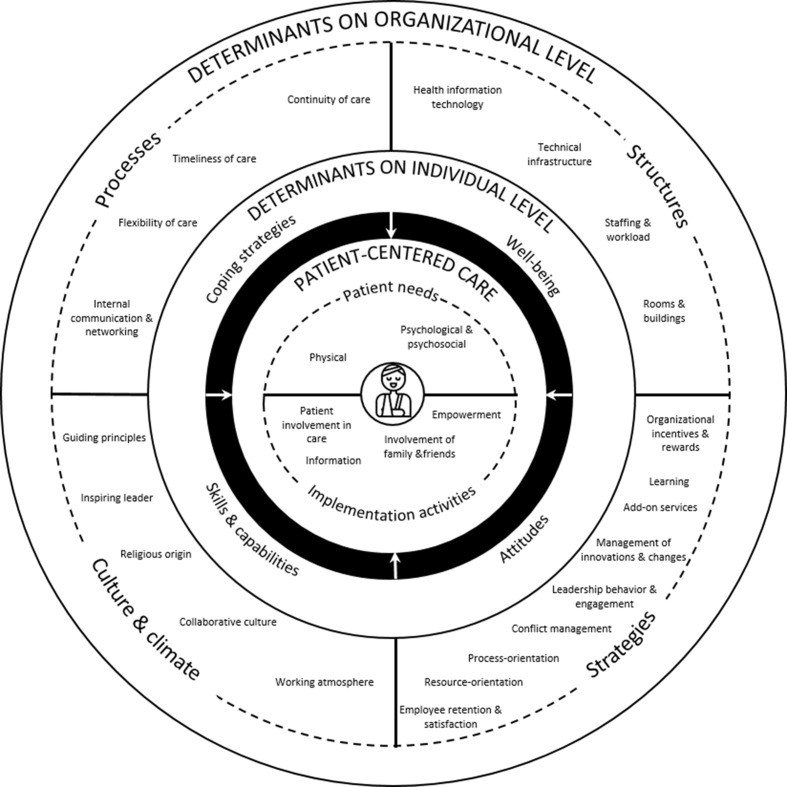
Decision makers identified similar determinants facilitating or obstructing the implementation of PCC in their organisational contexts. Several determinants at the HSCO's inner setting and the individual level (eg, communication among staff and well-being of employees) were identified as crucial to overcome constrained financial, human and material resources in order to deliver PCC.
The results can help to foster the implementation of PCC in various HSCOs contexts. We identified possible starting points for initiating the tailoring of interventions and implementation strategies and the redesign of HSCOs towards more patient-centredness.
在资源有限的情况下,医疗保健系统、组织和服务提供者需要围绕患者的需求来组织护理,这给他们带来了压力。为了成功实施以患者为中心的护理(PCC),必须解决障碍。到目前为止,对于各种医疗保健和社会护理组织(HSCO)中 PCC 实施的可能决定因素,还缺乏全面的调查。我们的定性研究从不同 HSCO 的决策者的角度考察了 PCC 实施的决定因素。
对 2017 年 8 月至 2018 年 5 月期间进行的 20 次半结构化面对面访谈中的 24 名参与者进行了定性研究。
根据最大变异抽样策略,根据 HSCO 类型的不同,从德国科隆市地区的多个 HSCO 中招募决策者。
采用定性内容分析的归纳和演绎方法对定性访谈进行分析。采用实施研究综合框架来概念化 PCC 的决定因素。
决策者在其组织环境中确定了相似的决定因素,这些因素促进或阻碍了 PCC 的实施。确定了几个 HSCO 内部环境和个人层面的决定因素(例如,员工之间的沟通和员工的幸福感)对于克服有限的财务、人力和物质资源以提供 PCC 至关重要。
这些结果有助于促进各种 HSCO 环境中 PCC 的实施。我们确定了可能的起点,以便开始定制干预措施和实施策略,并重新设计 HSCO 以实现更加以患者为中心。