Vennedey Vera, Hower Kira Isabel, Hillen Hendrik, Ansmann Lena, Kuntz Ludwig, Stock Stephanie
Institute for Health Economics and Clinical Epidemiology, University Hospital Cologne, Cologne, Nordrhein-Westfalen, Germany
Institute of Medical Sociology, Health Services Research and Rehabilitation Science (IMVR), Faculty of Human Sciences and Faculty of Medicine, University of Cologne, Cologne, Nordrhein-Westfalen, Germany.
BMJ Open. 2020 May 5;10(5):e033449. doi: 10.1136/bmjopen-2019-033449.
Previous studies on patient-centred care (PCC) and its facilitators and barriers usually considered specific patient groups, healthcare settings and aspects of PCC or focused on expert perspectives. The objective of this study was to analyse patients' perspectives of facilitators and barriers towards implementing PCC.
We conducted semistructured individual interviews with chronically ill patients. The interviewees were encouraged to share positive and negative experiences of care and the related facilitators and barriers in all settings including preventive, acute and chronic health issues. Interview data were analysed based on the concept of content analysis.
Interviews took place at the University Hospital Cologne, nursing homes, at participants' homes or by telephone.
Any person with at least one chronic illness living in the region of Cologne was eligible for participation. 25 persons with an average age of 60 years participated in the interviews. The participants suffered from various chronic conditions including mental health problems, oncological, metabolic, neurological diseases, but also shared experiences related to acute health issues.
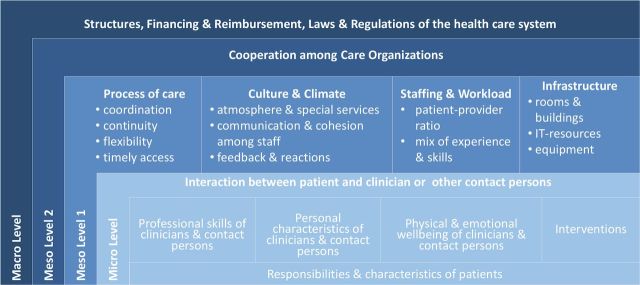
Participants described facilitators and barriers of PCC on the microlevel (eg, patient-provider interaction), mesolevel (eg, health and social care organisation, HSCO) and macrolevel (eg, laws, financing). In addition to previous concepts, interviewees illustrated the importance of being an active patient by taking individual responsibility for health. Interviewees considered functioning teams and healthy staff members a facilitator of PCC as this can compensate stressful situations or lack of staff to some degree. A lack of transparency in financing and reimbursement was identified as barrier to PCC.
Individual providers and HSCOs can address many facilitators and barriers of PCC as perceived by patients. Large-scale changes such as reduction of administrative barriers, the expansion of care networks or higher mandatory nurse to patient ratios require political action and incentives.
DRKS00011925.
以往关于以患者为中心的护理(PCC)及其促进因素和障碍的研究通常针对特定患者群体、医疗环境以及PCC的某些方面,或者侧重于专家观点。本研究的目的是分析患者对实施PCC的促进因素和障碍的看法。
我们对慢性病患者进行了半结构化的个人访谈。鼓励受访者分享在包括预防、急性和慢性健康问题在内的所有环境中护理的正面和负面经历以及相关的促进因素和障碍。访谈数据基于内容分析的概念进行分析。
访谈在科隆大学医院、养老院、参与者家中或通过电话进行。
居住在科隆地区的任何患有至少一种慢性病的人都有资格参与。25名平均年龄为60岁的人参与了访谈。参与者患有各种慢性病,包括心理健康问题、肿瘤、代谢、神经疾病,也分享了与急性健康问题相关的经历。
参与者描述了PCC在微观层面(如患者与提供者的互动)、中观层面(如健康和社会护理组织,HSCO)和宏观层面(如法律、融资)的促进因素和障碍。除了以往的概念,受访者还说明了通过对健康承担个人责任成为积极患者的重要性。受访者认为运作良好的团队和健康的工作人员是PCC的促进因素,因为这可以在一定程度上缓解压力情况或弥补人员不足。融资和报销缺乏透明度被确定为PCC的障碍。
个体提供者和HSCO可以解决患者所认为的PCC的许多促进因素和障碍。诸如减少行政障碍、扩大护理网络或提高护士与患者的强制比例等大规模变革需要政治行动和激励措施。
DRKS00011925。