Departamento de Biologia Geral, Instituto de Ciências Biológicas, Universidade Federal de Minas Gerais, Belo Horizonte, Minas Gerais, Brazil.
Departamento de Bioquímica-Imunologia, Instituto de Ciências Biológicas, Universidade Federal de Minas Gerais, Belo Horizonte, Minas Gerais, Brazil.
PLoS One. 2019 Apr 3;14(4):e0214075. doi: 10.1371/journal.pone.0214075. eCollection 2019.
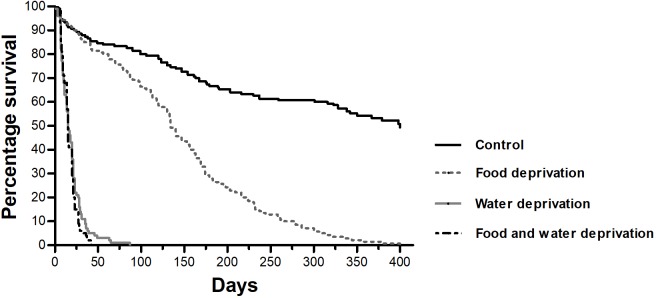
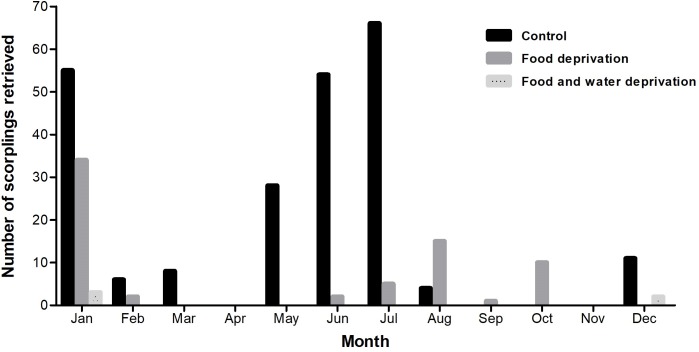
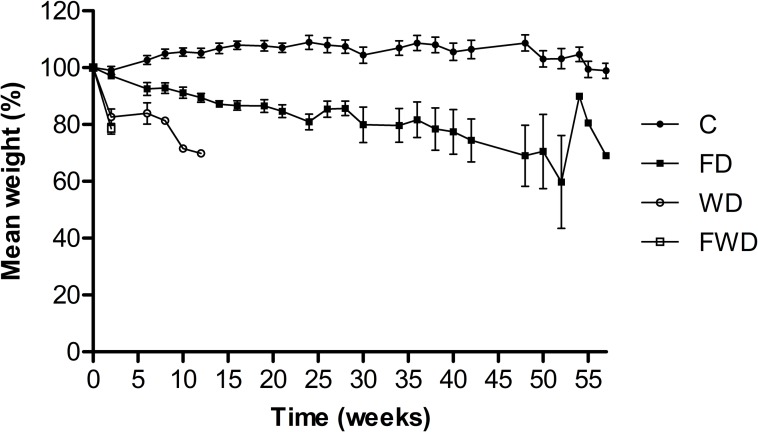
Annually, more than 1.2 million scorpion stings and more than 3,000 deaths occur worldwide. Tityus serrulatus Lutz and Mello, 1922 (Scorpiones, Buthidae) is the most medically relevant species in Brazil where it is spreading rapidly and causing over 90,000 cases of envenomation yearly. We monitored T. serrulatus longevity and ability to reproduce under conditions of food and/or water deprivation. We found that T. serrulatus is highly tolerant to food deprivation, with individuals enduring up to 400 days without food. On the other hand, access to water played a pivotal role in T. serrulatus survival. Food and water deprived scorpions showed weight reduction. Reproduction occurred throughout the year for food-deprived scorpions and controls, but not in the water-deprived groups. Remarkably, food-deprived animals were able to give birth after 209 days of starvation. Tityus serrulatus resistance to food and water deprivation is likely to be an additional factor underlying this species' geographic expansion and the difficulties encountered in controlling it.
每年,全球有超过 120 万例蝎子蜇伤和超过 3000 人死亡。Tityus serrulatus Lutz 和 Mello, 1922(蝎子,Buthidae)是巴西最具医学相关性的物种,它在巴西迅速传播,每年导致超过 9 万例中毒病例。我们监测了 T. serrulatus 在食物和/或水剥夺条件下的寿命和繁殖能力。我们发现 T. serrulatus 对食物剥夺具有很强的耐受性,个体可以忍受长达 400 天没有食物。另一方面,水的获取对 T. serrulatus 的生存起着关键作用。食物和水剥夺的蝎子体重减轻。食物剥夺的蝎子和对照组全年都能繁殖,但在缺水组则不能。值得注意的是,食物剥夺的动物在饥饿 209 天后能够生育。Tityus serrulatus 对食物和水的耐受力可能是该物种地理扩张和控制困难的另一个因素。