Department of Physics, University of Illinois at Urbana-Champaign, Urbana, IL, 61801, USA.
Carl R. Woese Institute for Genomic Biology, University of Illinois at Urbana-Champaign, Urbana, IL, 61801, USA.
Nat Commun. 2021 Nov 18;12(1):6661. doi: 10.1038/s41467-021-27023-y.
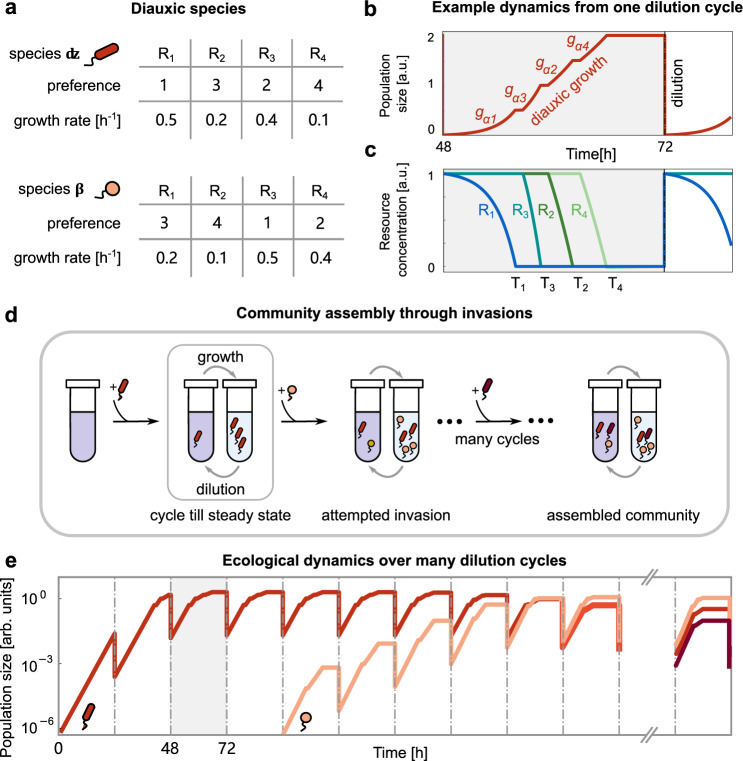
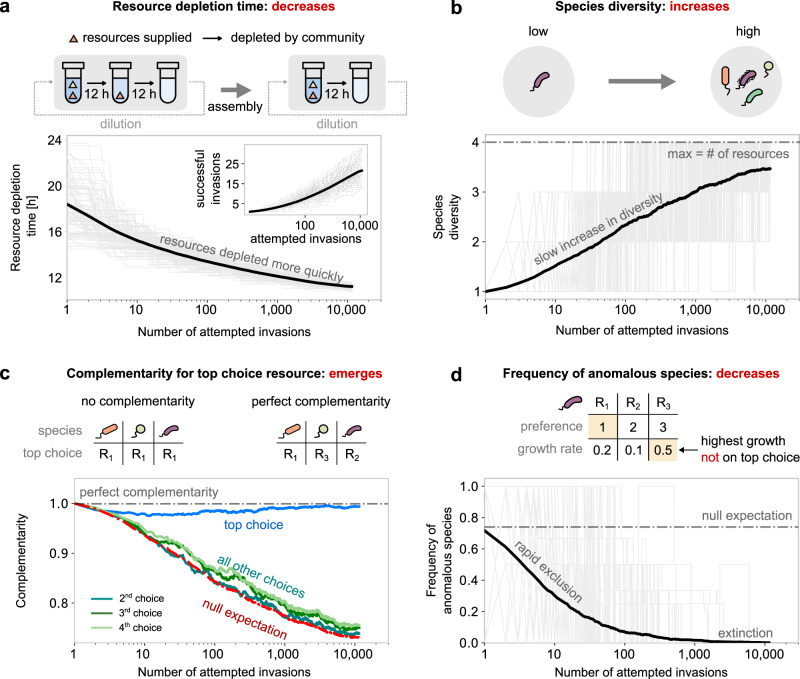
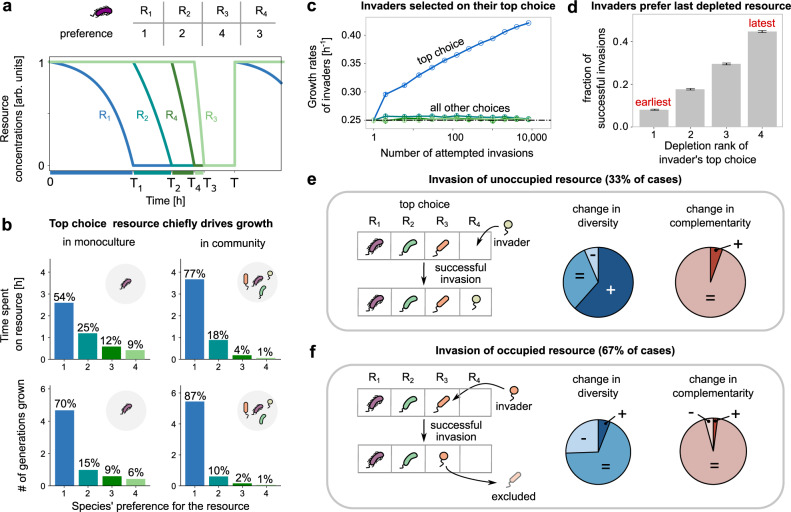
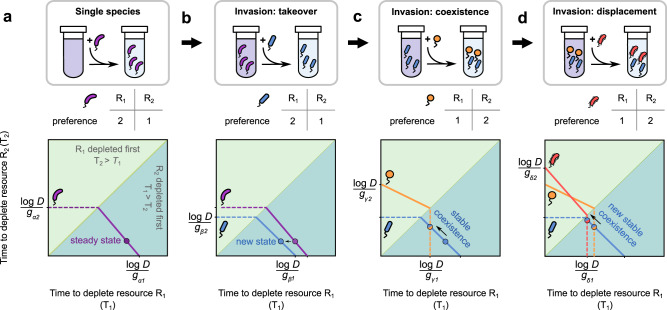
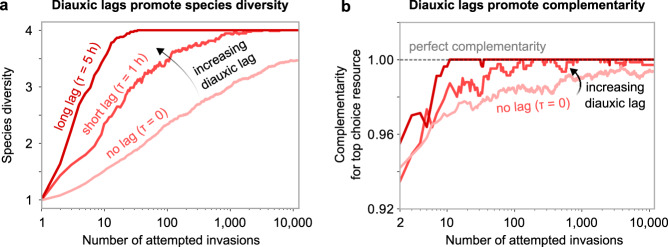
Many microbes grow diauxically, utilizing the available resources one at a time rather than simultaneously. The properties of communities of microbes growing diauxically remain poorly understood, largely due to a lack of theory and models of such communities. Here, we develop and study a minimal model of diauxic microbial communities assembling in a serially diluted culture. We find that unlike co-utilizing communities, diauxic community assembly repeatably and spontaneously leads to communities with complementary resource preferences, namely communities where species prefer different resources as their top choice. Simulations and theory explain that the emergence of complementarity is driven by the disproportionate contribution of the top choice resource to the growth of a diauxic species. Additionally, we develop a geometric approach for analyzing serially diluted communities, with or without diauxie, which intuitively explains several additional emergent community properties, such as the apparent lack of species which grow fastest on a resource other than their most preferred resource. Overall, our work provides testable predictions for the assembly of natural as well as synthetic communities of diauxically shifting microbes.
许多微生物以兼性方式生长,一次利用一种可用资源,而不是同时利用多种资源。兼性生长微生物群落的特性仍然知之甚少,主要是因为缺乏此类群落的理论和模型。在这里,我们开发并研究了一种在连续稀释培养中组装兼性微生物群落的最小模型。我们发现,与共同利用的群落不同,兼性群落的组装会重复且自发地导致具有互补资源偏好的群落,即物种将不同的资源作为首选的群落。模拟和理论解释了互补性的出现是由首选资源对兼性物种生长的不成比例贡献所驱动的。此外,我们开发了一种用于分析连续稀释群落的几何方法,无论是否存在兼性,该方法直观地解释了几个额外的新兴群落特性,例如明显缺乏在除最偏好资源之外的资源上生长最快的物种。总的来说,我们的工作为自然和合成的兼性微生物群落的组装提供了可测试的预测。