Zeng Jianyong, Zheng Caixia, Li Hua
Department of Infectious Diseases.
Department of Gastroenterology, First Affiliated Hospital of Xiamen University, Fujian Province, China.
Medicine (Baltimore). 2019 Apr;98(14):e15092. doi: 10.1097/MD.0000000000015092.
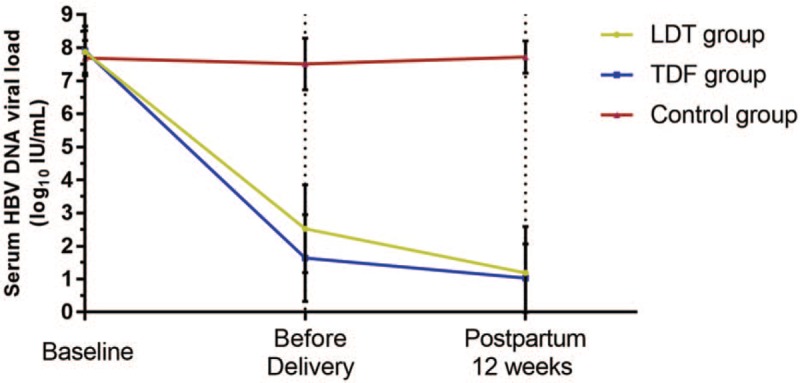
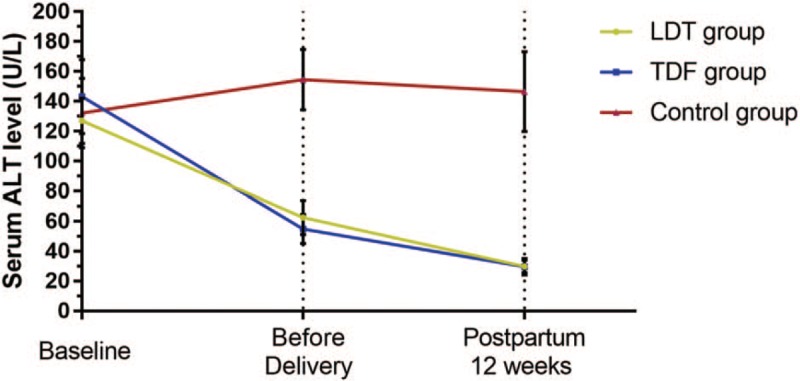
To evaluate the efficacy and safety of telbivudine (LdT) and tenofovir (TDF) for preventing hepatitis B virus (HBV) vertical transmission for HBV-positive pregnant women.Pregnant women (n = 145) from January 2013 to June 2017 were enrolled when they met inclusion criteria, which included HBV DNA ≥1.0 × 10 copies/mL and increased alanine aminotransferase (ALT) levels. Groups A (n = 58) and B (n = 51) were treated with LdT and TDF, respectively. Group C (n = 36) received no antiviral treatment. All infants were vaccinated with hepatitis B immunoglobulin and HBV vaccine. Vertical transmission of HBV was indicated by the presence of hepatitis B surface antigen (HBsAg) in infants 6 months and 12 months after birth.There is no difference of clinical characteristics of patients among the 3 groups. Serum HBV DNA levels of the 3 groups were similar at baseline (Group A vs. Group B vs. Group C, 7.88 ± 0.65 vs. 7.91 ± 0.75 vs. 7.69 ± 0.53 P = .25). In addition, the after anti-HBV treatment in Groups A and B were significantly decreased. Also, the serum HBV DNA levels in both Groups A and B were lower than that of Group C (P < .01, both). The HBV infection rate in Group A treated with LdT was not different from Group B treated with TDF. The dynamic changes of serum ALT level were similar. ALT levels were similar among the 3 Groups (P = .171), while there is statistically significant difference between A and C, and between B and C before delivery (P < .01). For the infants, there were no significant differences among body weight, height, head circumference, or Apgar score. However, the HBsAg positivity rates of infants in Groups A, B, C at postpartum 24 weeks and 48 weeks was 0%, 0%, and 11.1%, respectively (P < .001).Administration of LdT or TDF to HBV-infected mothers are effective and safe to block mother-to-infant HBV transmission.
评估替比夫定(LdT)和替诺福韦(TDF)对HBV阳性孕妇预防乙型肝炎病毒(HBV)垂直传播的疗效和安全性。纳入2013年1月至2017年6月符合纳入标准的孕妇(n = 145),纳入标准包括HBV DNA≥1.0×10拷贝/mL和丙氨酸转氨酶(ALT)水平升高。A组(n = 58)和B组(n = 51)分别接受LdT和TDF治疗。C组(n = 36)未接受抗病毒治疗。所有婴儿均接种乙肝免疫球蛋白和HBV疫苗。出生后6个月和12个月婴儿乙肝表面抗原(HBsAg)的存在表明HBV的垂直传播。3组患者的临床特征无差异。3组血清HBV DNA水平在基线时相似(A组 vs. B组 vs. C组,7.88±0.65 vs. 7.91±0.75 vs. 7.69±0.53,P = 0.25)。此外,A组和B组抗HBV治疗后显著下降。而且,A组和B组的血清HBV DNA水平均低于C组(均P < 0.01)。接受LdT治疗的A组HBV感染率与接受TDF治疗的B组无差异。血清ALT水平的动态变化相似。3组ALT水平相似(P = 0.171),而分娩前A组与C组、B组与C组之间有统计学显著差异(P < 0.01)。对于婴儿,体重、身高、头围或阿氏评分之间无显著差异。然而,产后24周和48周时,A组、B组、C组婴儿的HBsAg阳性率分别为0%、0%和11.1%(P < 0.001)。对HBV感染母亲给予LdT或TDF可有效且安全地阻断母婴HBV传播。