Environmental Molecular Sciences Laboratory, Pacific Northwest National Laboratory, Richland, Washington, USA.
Laboratory of Environmental Microbiology, Institute of Microbiology of the CAS, Praha, Czech Republic.
Sci Rep. 2019 Apr 4;9(1):5618. doi: 10.1038/s41598-019-42188-9.
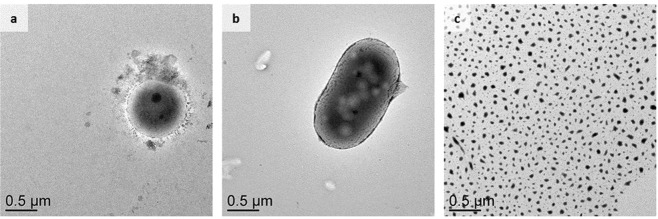
Biomolecules for OMIC analysis of microbial communities are commonly extracted by bead-beating or ultra-sonication, but both showed varying yields. In addition to that, different disruption pressures are necessary to lyse bacteria and fungi. However, the disruption efficiency and yields comparing bead-beating and ultra-sonication of different biological material have not yet been demonstrated. Here, we show that ultra-sonication in a bath transfers three times more energy than bead-beating over 10 min. TEM imaging revealed intact gram-positive bacterial and fungal cells whereas the gram-negative bacterial cells were destroyed beyond recognition after 10 min of ultra-sonication. DNA extraction using 10 min of bead-beating revealed higher yields for fungi but the extraction efficiency was at least three-fold lower considering its larger genome. By our critical viewpoint, we encourage the review of the commonly used extraction techniques as we provide evidence for a potential underrepresentation of resistant microbes, particularly fungi, in ecological studies.
生物分子常用于微生物群落的 OMIC 分析,通常通过珠磨或超声提取,但两者的产量都有所不同。此外,裂解细菌和真菌需要不同的破坏压力。然而,尚未证明不同生物材料的珠磨和超声破碎的破坏效率和产量。在这里,我们表明,在 10 分钟内,浴式超声传递的能量比珠磨多三倍。TEM 成像显示,革兰氏阳性细菌和真菌细胞完整,而革兰氏阴性细菌细胞在超声处理 10 分钟后被破坏得无法辨认。使用 10 分钟珠磨提取 DNA 显示真菌的产量更高,但考虑到其较大的基因组,提取效率至少低了三倍。从我们的关键观点来看,我们鼓励对常用的提取技术进行审查,因为我们提供了证据,证明在生态研究中,特别是真菌等抗性微生物可能存在代表性不足的情况。