Chi Xintong, Zhang Shanshan, Sun Huili, Duan Yangkai, Qiao Cuncun, Luan Guodong, Lu Xuefeng
Key Laboratory of Biofuels, Qingdao Institute of Bioenergy and Bioprocess Technology, Chinese Academy of Sciences, Qingdao, China.
Shandong Provincial Key Laboratory of Synthetic Biology, Qingdao Institute of Bioenergy and Bioprocess Technology, Chinese Academy of Sciences, Qingdao, China.
Front Microbiol. 2019 Mar 21;10:551. doi: 10.3389/fmicb.2019.00551. eCollection 2019.
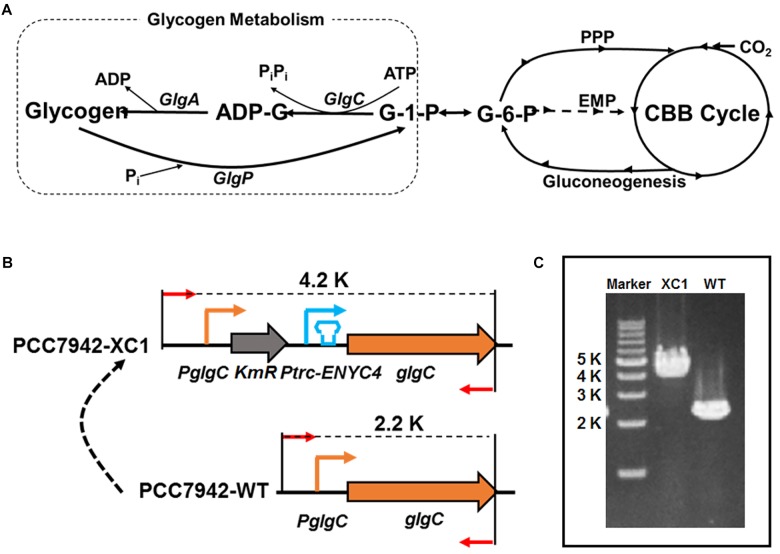
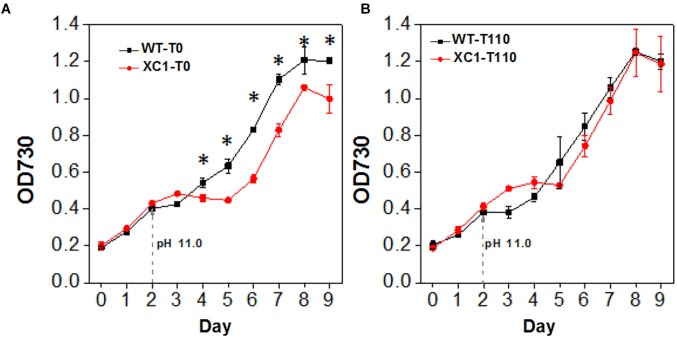
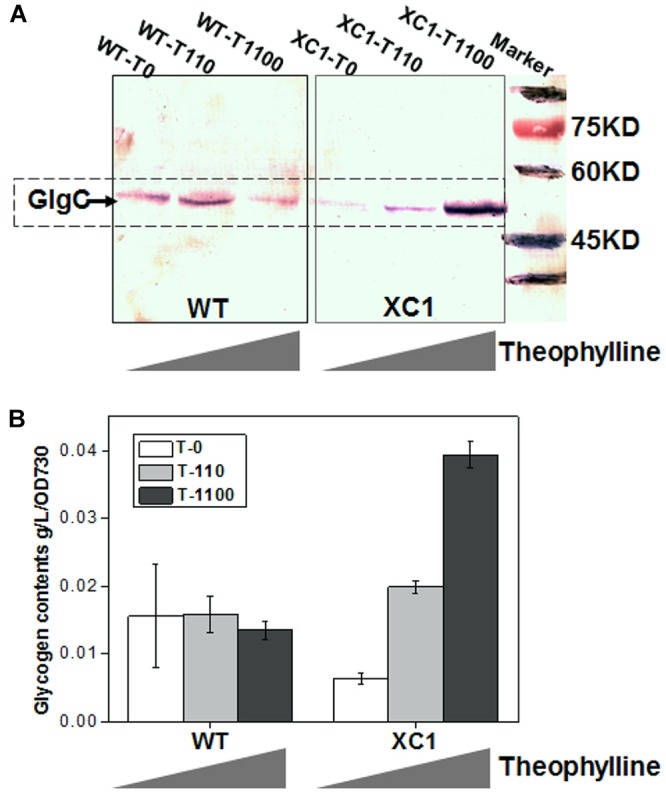
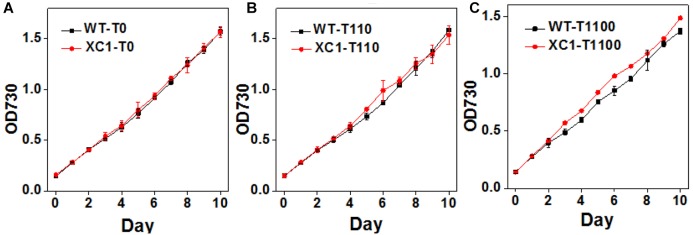
Cyanobacteria are supposed to be promising photosynthetic microbial platforms that recycle carbon dioxide driven into biomass and bioproducts by solar energy. Glycogen synthesis serves as an essential natural carbon sink mechanism, storing a large portion of energy and organic carbon source of photosynthesis. Engineering glycogen metabolism to harness and rewire carbon flow is an important strategy to optimize efficacy of cyanobacteria platforms. ADP-glucose pyrophosphorylase (GlgC) catalyzes the rate-limiting step for glycogen synthesis. However, knockout of fails to promote cell growth or photosynthetic production in cyanobacteria, on the contrary, deficiency impairs cellular fitness and robustness. In this work, we adopted a theophylline-responsive riboswitch to engineer and control expression in PCC7942 and achieved flexible regulation of intracellular GlgC abundance and glycogen storage. With this approach, glycogen synthesis and glycogen contents in PCC7942 cells could be regulated in a range from about 40 to 300% of wild type levels. In addition, the results supported a positive role of glycogen metabolism in cyanobacteria cellular robustness. When glycogen storage was reduced, cellular physiology and growth under standard conditions was not impaired, while cellular tolerance toward environmental stresses was weakened. While when glycogen synthesis was enhanced, cells of PCC7942 displayed optimized cellular robustness. Our findings emphasize the significance of glycogen metabolism for cyanobacterial physiology and the importance of flexible approaches for engineering and understanding cellular physiology and metabolism.
蓝藻被认为是很有前景的光合微生物平台,可将太阳能驱动的二氧化碳回收利用,转化为生物质和生物产品。糖原合成是一种重要的天然碳汇机制,储存了光合作用产生的大部分能量和有机碳源。改造糖原代谢以利用和重新引导碳流是优化蓝藻平台功效的重要策略。ADP - 葡萄糖焦磷酸化酶(GlgC)催化糖原合成的限速步骤。然而,在蓝藻中敲除GlgC并不能促进细胞生长或光合产物合成,相反,GlgC缺陷会损害细胞的适应性和稳健性。在这项工作中,我们采用茶碱响应型核糖开关来改造和控制集胞藻PCC7942中GlgC的表达,并实现了细胞内GlgC丰度和糖原储存的灵活调控。通过这种方法,集胞藻PCC7942细胞中的糖原合成和糖原含量可以在野生型水平的约40%至300%范围内进行调节。此外,结果支持了糖原代谢在蓝藻细胞稳健性中的积极作用。当糖原储存减少时,标准条件下的细胞生理和生长未受损害,但细胞对环境胁迫的耐受性减弱。而当糖原合成增强时,集胞藻PCC7942细胞表现出优化的细胞稳健性。我们的研究结果强调了糖原代谢对蓝藻生理的重要性,以及灵活方法在改造和理解细胞生理与代谢方面的重要性。