Alborghetti Marcos Rodrigo, Correa Maria Elvira Pizzigatti, Whangbo Jennifer, Shi Xu, Aricetti Juliana Aparecida, da Silva Andreia Aparecida, Miranda Eliana Cristina Martins, Sforca Mauricio Luis, Caldana Camila, Gerszten Robert E, Ritz Jerome, Zeri Ana Carolina de Mattos
Department of Cell Biology, University of Brasilia, Brasilia, Brazil.
Hematology and Hemotherapy Center, Instituto Nacional de Ciência e Tecnologia do Sangue, University of Campinas, Hemocentro-Unicamp, Campinas, Brazil.
Front Oncol. 2019 Mar 18;9:141. doi: 10.3389/fonc.2019.00141. eCollection 2019.
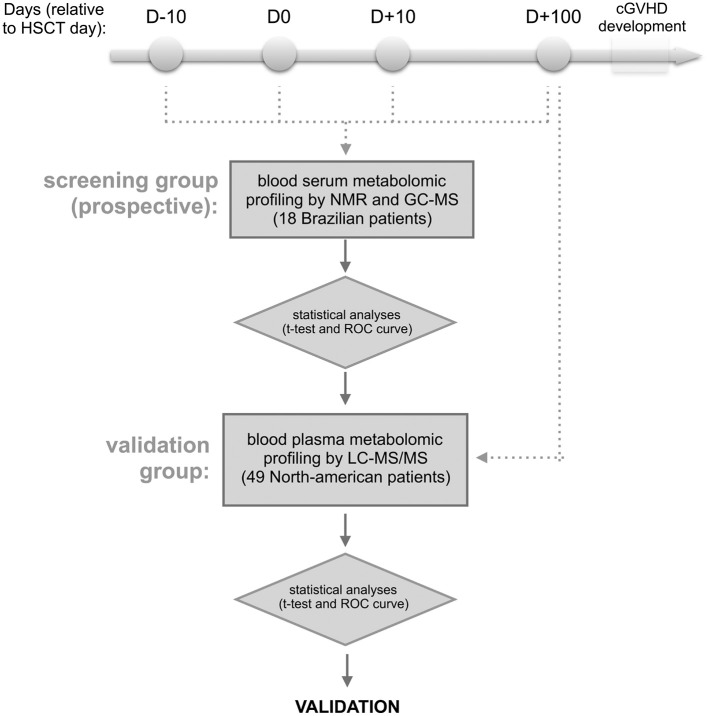
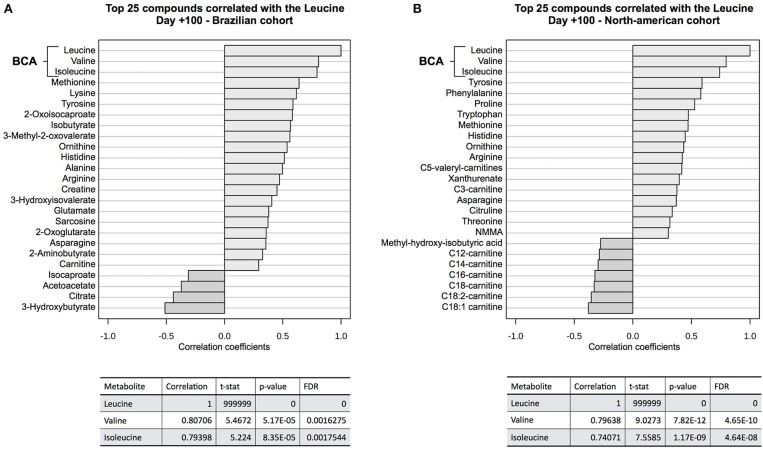
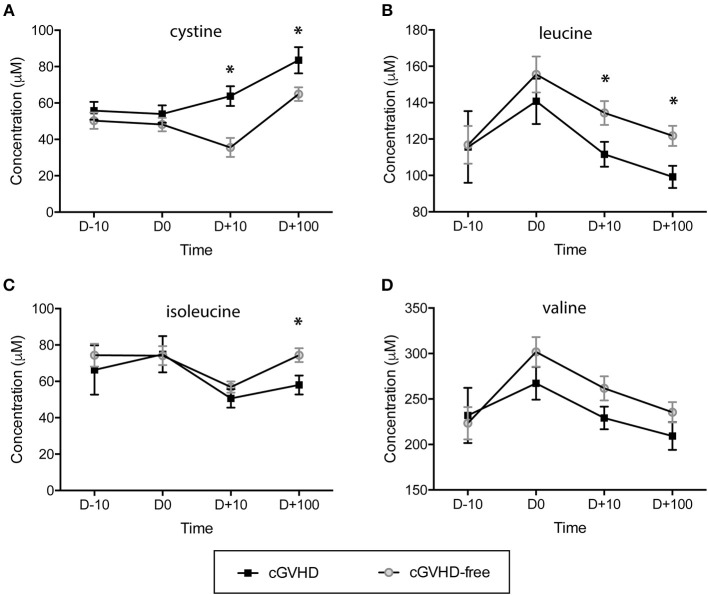
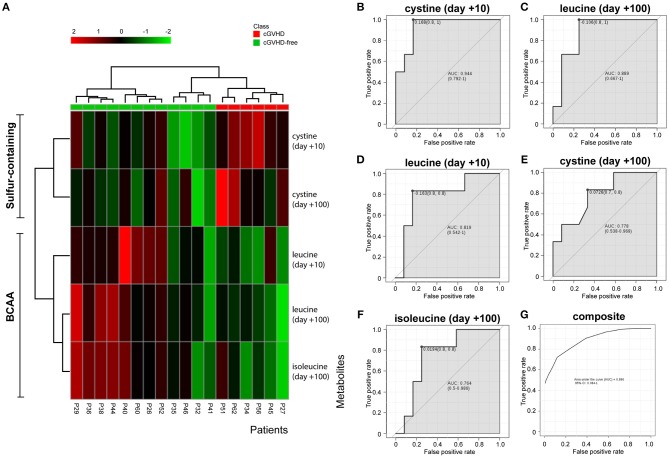
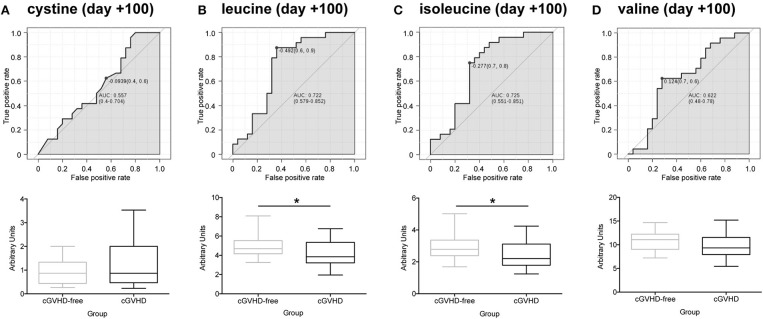
The allogeneic hematopoietic stem cell transplantation procedure-the only curative therapy for many types of hematological cancers-is increasing, and graft vs. host disease (GVHD) is the main cause of morbidity and mortality after transplantation. Currently, GVHD diagnosis is clinically performed. Whereas, biomarker panels have been developed for acute GVHD (aGVHD), there is a lack of information about the chronic form (cGVHD). Using nuclear magnetic resonance (NMR) and gas chromatography coupled to time-of-flight (GC-TOF) mass spectrometry, this study prospectively evaluated the serum metabolome of 18 Brazilian patients who had undergone allogeneic hematopoietic stem cell transplantation (HSCT). We identified and quantified 63 metabolites and performed the metabolomic profile on day -10, day 0, day +10 and day +100, in reference to day of transplantation. Patients did not present aGVHD or cGVHD clinical symptoms at sampling times. From 18 patients analyzed, 6 developed cGVHD. The branched-chain amino acids (BCAAs) leucine and isoleucine were reduced and the sulfur-containing metabolite (cystine) was increased at day +10 and day +100. The area under receiver operating characteristics (ROC) curves was higher than 0.79. BCAA findings were validated by liquid chromatography coupled to tandem mass spectrometry (LC-MS/MS) in 49 North American patients at day +100; however, cystine findings were not statistically significant in this patient set. Our results highlight the importance of multi-temporal and multivariate biomarker panels for predicting and understanding cGVHD.
异基因造血干细胞移植程序——多种血液系统癌症的唯一治愈性疗法——正在增加,而移植物抗宿主病(GVHD)是移植后发病和死亡的主要原因。目前,GVHD诊断是在临床上进行的。虽然已经开发了用于急性GVHD(aGVHD)的生物标志物面板,但关于慢性形式(cGVHD)的信息却很缺乏。本研究使用核磁共振(NMR)和气相色谱-飞行时间(GC-TOF)质谱法,前瞻性评估了18名接受异基因造血干细胞移植(HSCT)的巴西患者的血清代谢组。我们鉴定并定量了63种代谢物,并在移植日的第-10天、第0天、第+10天和第+100天进行了代谢组学分析。患者在采样时未出现aGVHD或cGVHD临床症状。在分析的18名患者中,有6名发生了cGVHD。在第+10天和第+100天,支链氨基酸(BCAAs)亮氨酸和异亮氨酸减少,含硫代谢物(胱氨酸)增加。受试者工作特征(ROC)曲线下面积高于0.79。在第+100天,通过液相色谱-串联质谱法(LC-MS/MS)在49名北美患者中验证了BCAA的研究结果;然而,在该患者组中,胱氨酸的研究结果无统计学意义。我们的结果强调了多时间和多变量生物标志物面板在预测和理解cGVHD方面的重要性。