Willeit M, Ganopolski A, Calov R, Brovkin V
Potsdam Institute for Climate Impact Research, Potsdam, Germany.
Max Planck Institute for Meteorology, Hamburg, Germany.
Sci Adv. 2019 Apr 3;5(4):eaav7337. doi: 10.1126/sciadv.aav7337. eCollection 2019 Apr.
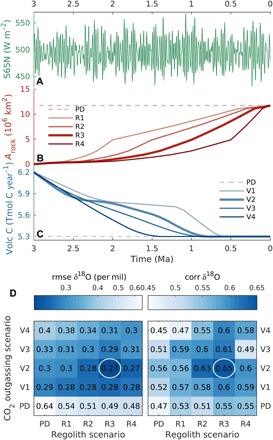
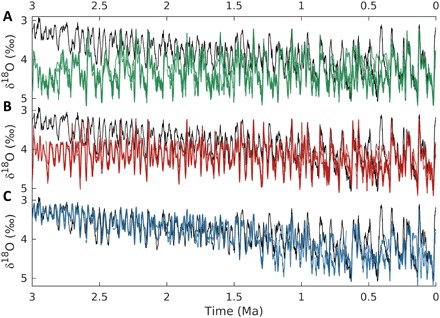
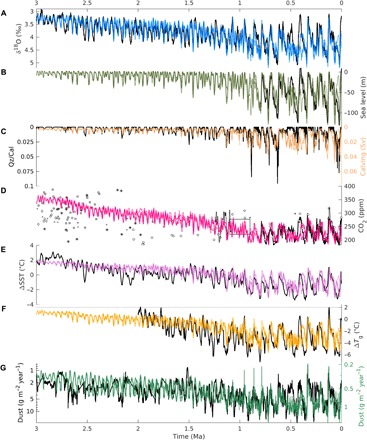
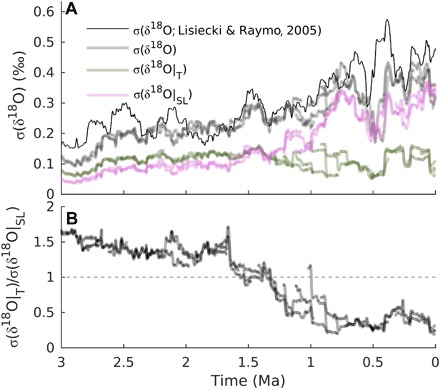
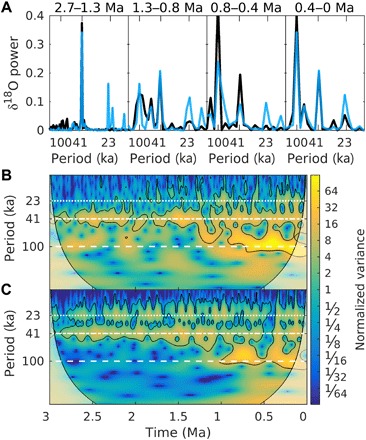
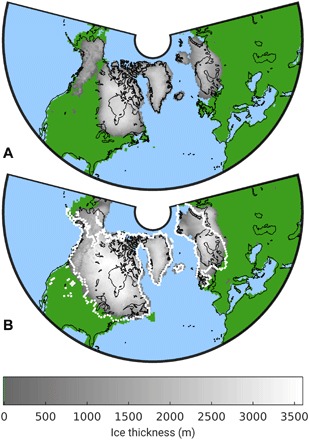
Variations in Earth's orbit pace the glacial-interglacial cycles of the Quaternary, but the mechanisms that transform regional and seasonal variations in solar insolation into glacial-interglacial cycles are still elusive. Here, we present transient simulations of coevolution of climate, ice sheets, and carbon cycle over the past 3 million years. We show that a gradual lowering of atmospheric CO and regolith removal are essential to reproduce the evolution of climate variability over the Quaternary. The long-term CO decrease leads to the initiation of Northern Hemisphere glaciation and an increase in the amplitude of glacial-interglacial variations, while the combined effect of CO decline and regolith removal controls the timing of the transition from a 41,000- to 100,000-year world. Our results suggest that the current CO concentration is unprecedented over the past 3 million years and that global temperature never exceeded the preindustrial value by more than 2°C during the Quaternary.
地球轨道的变化主导着第四纪的冰期-间冰期循环,然而,将太阳辐射的区域和季节变化转化为冰期-间冰期循环的机制仍不明确。在此,我们展示了过去300万年气候、冰盖和碳循环共同演化的瞬态模拟。我们表明,大气CO₂的逐渐降低和风化层的移除对于重现第四纪气候变化的演化至关重要。长期的CO₂减少导致北半球冰川作用的开始以及冰期-间冰期变化幅度的增加,而CO₂下降和风化层移除的综合作用控制了从41000年到100000年周期转变的时间。我们的结果表明,当前的CO₂浓度在过去300万年中是前所未有的,并且在第四纪期间全球温度从未超过工业化前值2°C以上。