School of Biological Sciences and Maurice Wilkins Centre for Molecular Biodiscovery, The University of Auckland, Auckland, 1010, New Zealand.
Synthetic Biology Future Science Platform, CSIRO Land and Water, Canberra, 2601, ACT, Australia.
Nat Commun. 2019 Apr 5;10(1):1558. doi: 10.1038/s41467-019-09534-x.
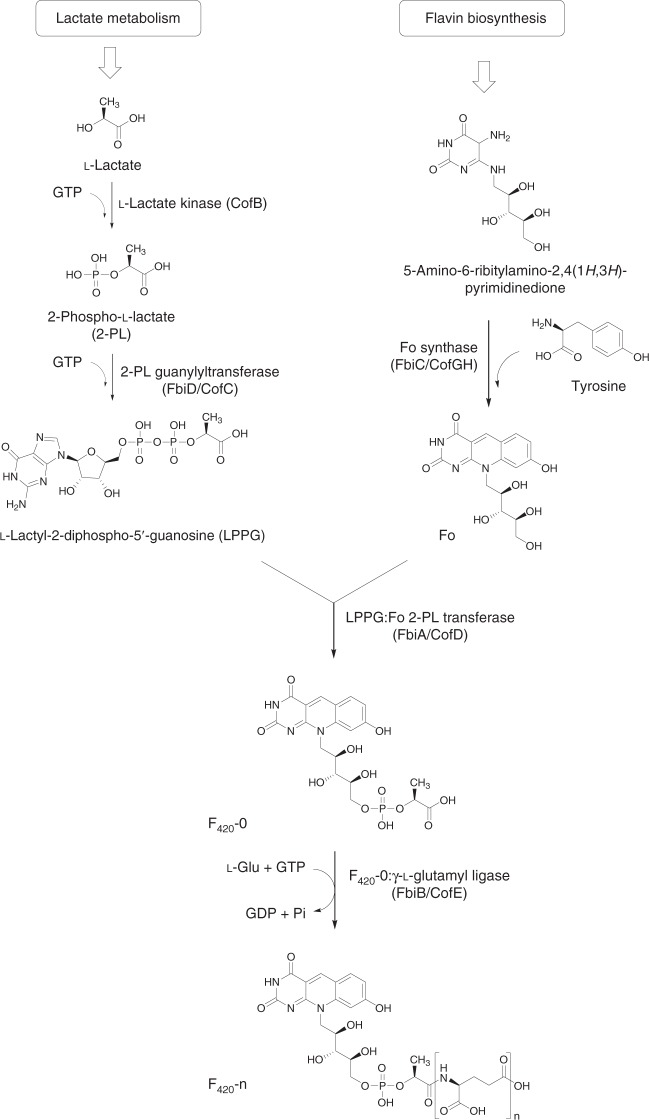
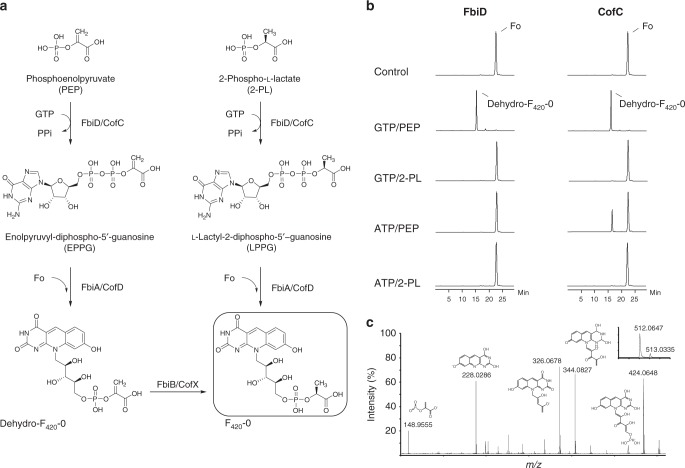
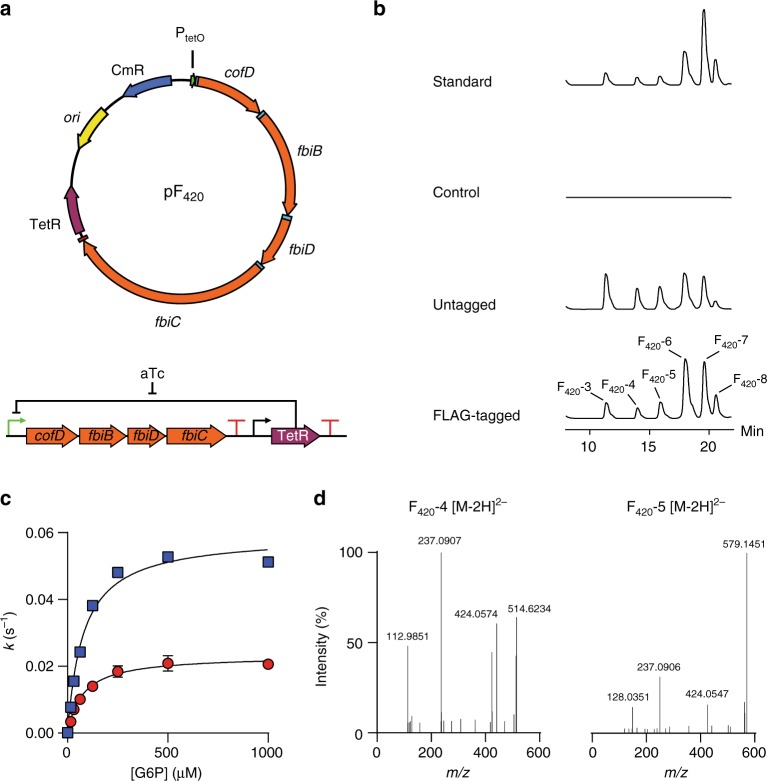
Cofactor F plays critical roles in primary and secondary metabolism in a range of bacteria and archaea as a low-potential hydride transfer agent. It mediates a variety of important redox transformations involved in bacterial persistence, antibiotic biosynthesis, pro-drug activation and methanogenesis. However, the biosynthetic pathway for F has not been fully elucidated: neither the enzyme that generates the putative intermediate 2-phospho-L-lactate, nor the function of the FMN-binding C-terminal domain of the γ-glutamyl ligase (FbiB) in bacteria are known. Here we present the structure of the guanylyltransferase FbiD and show that, along with its archaeal homolog CofC, it accepts phosphoenolpyruvate, rather than 2-phospho-L-lactate, as the substrate, leading to the formation of the previously uncharacterized intermediate dehydro-F-0. The C-terminal domain of FbiB then utilizes FMNH to reduce dehydro-F-0, which produces mature F species when combined with the γ-glutamyl ligase activity of the N-terminal domain. These new insights have allowed the heterologous production of F from a recombinant F biosynthetic pathway in Escherichia coli.
辅因子 F 作为一种低势能氢化物转移试剂,在多种细菌和古菌的初级和次级代谢中发挥着关键作用。它介导了多种与细菌存活、抗生素生物合成、前药激活和甲烷生成相关的重要氧化还原转化。然而,F 的生物合成途径尚未完全阐明:既不知道生成假定中间产物 2-磷酸-L-乳酸的酶,也不知道 γ-谷氨酰连接酶(FbiB)的 FMN 结合 C 末端结构域在细菌中的功能。在这里,我们展示了鸟苷转移酶 FbiD 的结构,并表明它与其古菌同源物 CofC 一样,接受磷酸烯醇丙酮酸,而不是 2-磷酸-L-乳酸,作为底物,形成以前未表征的中间产物脱氢-F-0。然后,FbiB 的 C 末端结构域利用 FMNH 还原脱氢-F-0,当与 N 末端结构域的 γ-谷氨酰连接酶活性结合时,产生成熟的 F 物质。这些新的见解使得可以通过大肠杆菌中的重组 F 生物合成途径异源生产 F。