University of Michigan, Department of Obstetrics and Gynecology, Ann Arbor, MI, USA.
University of Pennsylvania Perelman School of Medicine, Department of Obstetrics and Gynecology, Philadelphia, PA, USA.
J Perinatol. 2019 Jul;39(7):904-910. doi: 10.1038/s41372-019-0373-2. Epub 2019 Apr 5.
To determine the influence of delivery hospital on the rate of vaginal birth after cesarean (VBAC).
This retrospective cohort study used claims data from Blue Cross and Blue Shield of Michigan. Women with a prior cesarean and a singleton livebirth between 2012 and 2016 were included. We calculated the hospital-specific risk-standardized VBAC rates and median odds ratio as a measure of variation.
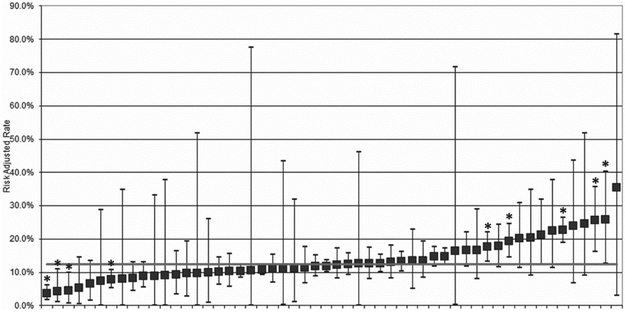
Hospital-level adjusted rates varied nearly tenfold (3.7%-35.5%). Compared to the lowest volume hospitals (1st quartile), the likelihood of VBAC increased for those in the 2nd (adjusted OR 2.75 [95% CI 1.23-6.17]), 3rd (adjusted OR 3.73 [95% CI 1.59-8.75]), and 4th quartiles (adjusted OR 2.9 [95% CI 1.11-7.72]). The median OR suggested significant variation by hospital after adjustment.
The delivery hospital itself explains a large amount of the variation in rates of VBAC after adjustment for patient and hospital characteristics.
确定分娩医院对剖宫产术后阴道分娩(VBAC)率的影响。
本回顾性队列研究使用了密歇根蓝十字蓝盾的数据。纳入了 2012 年至 2016 年间有剖宫产史和单胎活产的女性。我们计算了特定医院的风险标准化 VBAC 率和中位数优势比,作为变异的衡量标准。
医院级别的调整后 VBAC 率差异近十倍(3.7%-35.5%)。与最低容量的医院(第 1 四分位数)相比,第 2 (调整后的 OR 2.75 [95% CI 1.23-6.17])、第 3 (调整后的 OR 3.73 [95% CI 1.59-8.75])和第 4 四分位数(调整后的 OR 2.9 [95% CI 1.11-7.72])的 VBAC 可能性增加。调整后,中位数 OR 表明医院之间存在显著的变异。
在调整了患者和医院特征后,分娩医院本身就可以解释 VBAC 率差异的很大一部分。