Williams Samual T, Collinson Wendy, Patterson-Abrolat Claire, Marneweck David G, Swanepoel Lourens H
Department of Zoology, University of Venda, Thohoyandou, South Africa.
Department of Anthropology, Durham University, Durham, United Kingdom.
PeerJ. 2019 Mar 29;7:e6650. doi: 10.7717/peerj.6650. eCollection 2019.
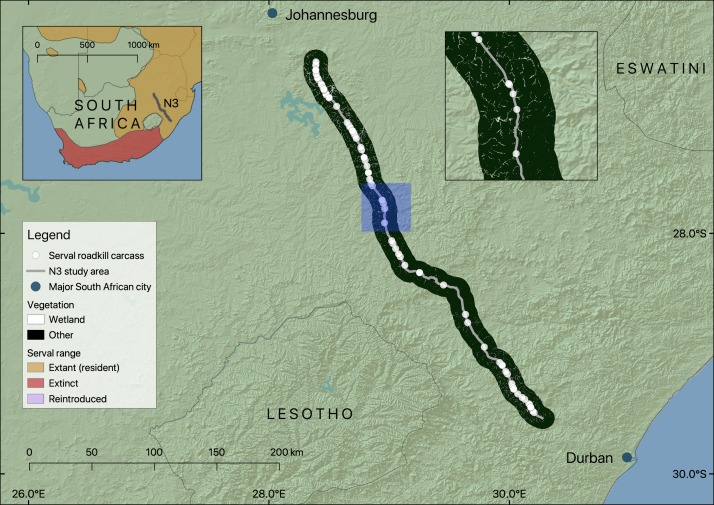
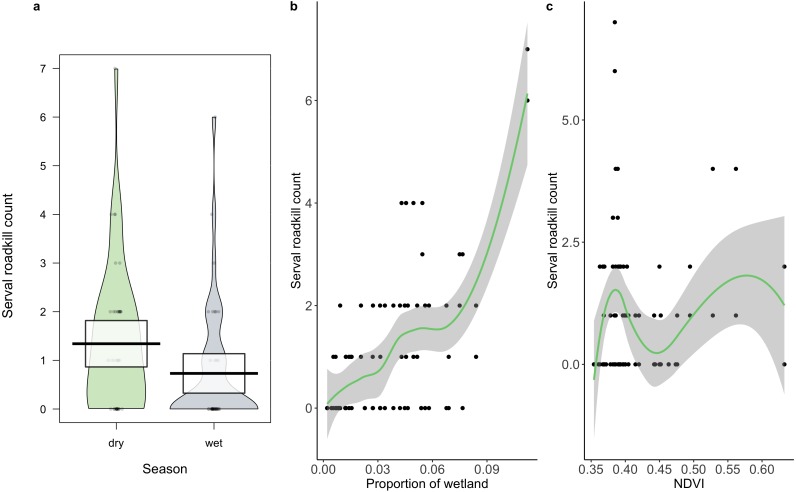
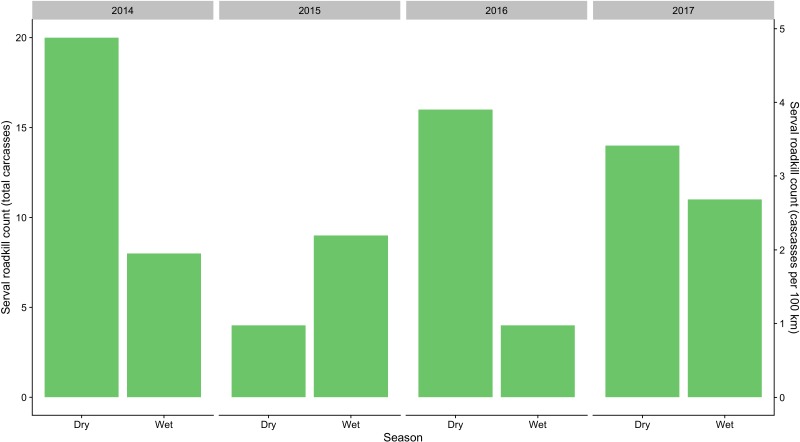
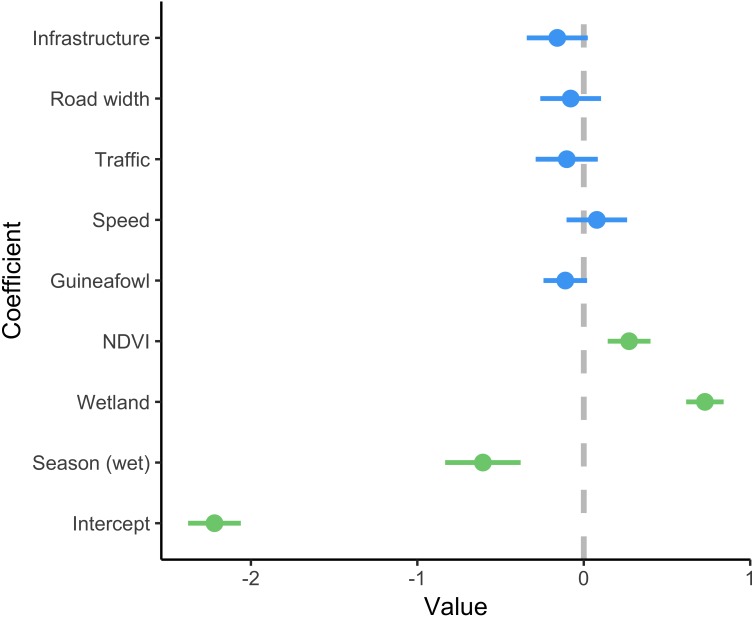
As the global road network expands, roads pose an emerging threat to wildlife populations. One way in which roads can affect wildlife is wildlife-vehicle collisions, which can be a significant cause of mortality through roadkill. In order to successfully mitigate these problems, it is vital to understand the factors that can explain the distribution of roadkill. Collecting the data required to enable this can be expensive and time consuming, but there is significant potential in partnering with organisations that conduct existing road patrols to obtain the necessary data. We assessed the feasibility of using roadkill data collected daily between 2014 and 2017 by road patrol staff from a private road agency on a 410 km length of the N3 road in South Africa. We modelled the relationship between a set of environmental and anthropogenic variables on the number of roadkill carcasses, using serval () as a model species. We recorded 5.24 serval roadkill carcasses/100 km/year. The number of carcasses was related to season, the amount of wetland, and NDVI, but was not related to any of the anthropogenic variables we included. This suggests that roadkill patterns may differ greatly depending on the ecology of species of interest, but targeting mitigation measures where roads pass through wetlands may help to reduce serval roadkill. Partnering with road agencies for data collection offers powerful opportunities to identify factors related to roadkill distribution and reduce the threats posed by roads to wildlife.
随着全球道路网络的扩张,道路对野生动物种群构成了新出现的威胁。道路影响野生动物的一种方式是野生动物与车辆的碰撞,这可能是导致动物因被车辆撞死而死亡的一个重要原因。为了成功缓解这些问题,了解能够解释动物被车辆撞死分布情况的因素至关重要。收集实现这一目标所需的数据可能既昂贵又耗时,但与进行现有道路巡逻的组织合作以获取必要数据具有巨大潜力。我们评估了利用一家私人道路机构的道路巡逻人员在2014年至2017年期间每天在南非N3公路410公里路段上收集的动物被车辆撞死数据的可行性。我们以薮猫()作为模式物种,对一组环境和人为变量与动物被车辆撞死尸体数量之间的关系进行了建模。我们记录到每年每100公里有5.24具薮猫被车辆撞死的尸体。尸体数量与季节、湿地面积和归一化植被指数有关,但与我们纳入的任何人为变量均无关。这表明,动物被车辆撞死的模式可能因目标物种的生态习性而有很大差异,但在道路穿过湿地的地方针对性地采取缓解措施可能有助于减少薮猫被车辆撞死的情况。与道路机构合作进行数据收集为识别与动物被车辆撞死分布相关的因素以及减少道路对野生动物构成的威胁提供了有力契机。