Monterey Bay Aquarium, 886 Cannery Row, Monterey, CA 93940, USA.
Environmental Studies Program, Colby College, 5356 Mayflower Hill, Waterville, ME 04901, USA.
Sci Adv. 2019 Mar 27;5(3):eaav5948. doi: 10.1126/sciadv.aav5948. eCollection 2019 Mar.
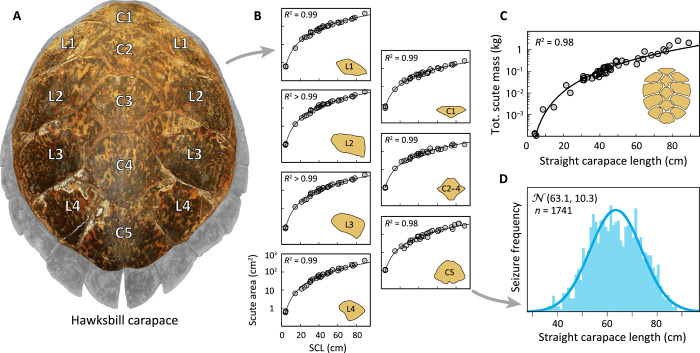
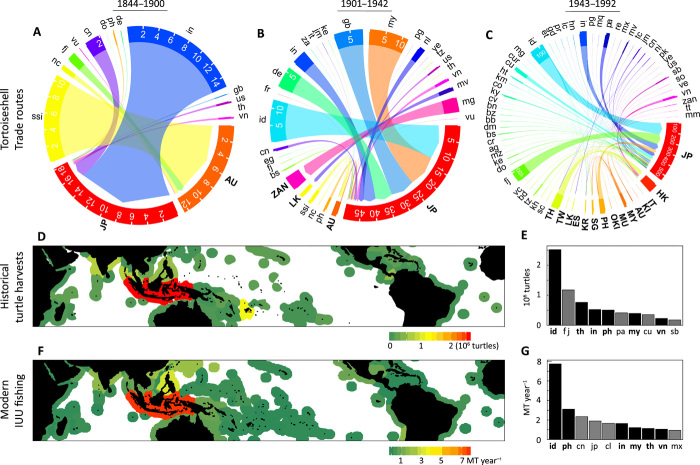
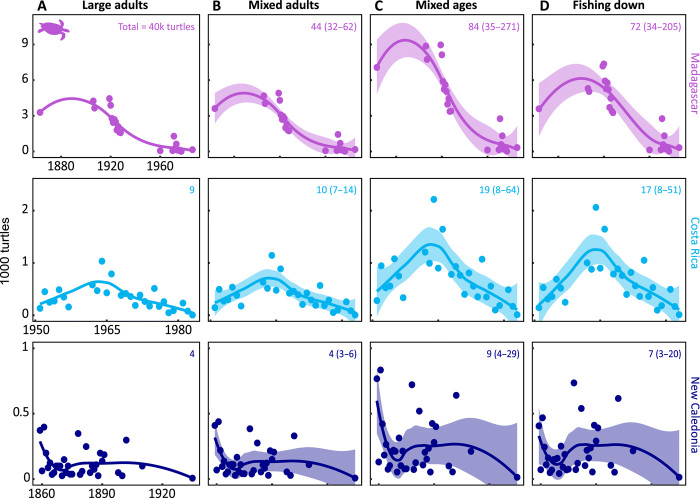
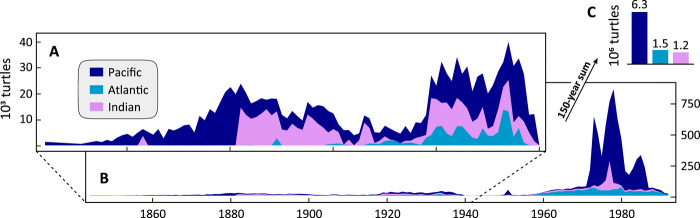
The complexity of trade networks is a major challenge to controlling wildlife trafficking and illegal, unreported, and unregulated (IUU) fishing. These networks may not be modern inventions, but have developed over centuries, from integrated global markets that preceded modern regulatory policies. To understand these linkages, we curated 150 years of tortoiseshell transactions and derived biologically informed harvest models to estimate the trade in critically endangered hawksbill sea turtles (). We find that trade networks concentrated in Southeast Asia harvested 9 million turtles, over six times previous estimates. These networks spread from within the Pacific, to the Indian and Atlantic basins, and became markedly more complex after 1950. Our results further indicate that the magnitude and extent of the coastally restricted hawksbill exploitation parallel current patterns of IUU fishing. Policies to combat these interlinked illegal practices should assimilate the important role of small-scale, coastal fisheries in these increasingly complex global networks.
贸易网络的复杂性是控制野生动植物贩运和非法、未报告和无管制(IUU)捕捞的主要挑战。这些网络可能不是现代发明,而是从现代监管政策之前的综合全球市场发展而来的。为了了解这些联系,我们整理了 150 年来玳瑁交易,并得出了生物信息收获模型,以估计极度濒危的玳瑁海龟()的贸易情况。我们发现,集中在东南亚的贸易网络收获了 900 万只海龟,是之前估计的六倍多。这些网络从太平洋内部扩展到印度洋和大西洋盆地,并在 1950 年后变得明显更加复杂。我们的研究结果进一步表明,沿海限制的玳瑁捕捞的规模和范围与当前 IUU 捕鱼的模式相吻合。打击这些相互关联的非法行为的政策应吸收小规模沿海渔业在这些日益复杂的全球网络中的重要作用。