Université Lyon, ENS de Lyon, Université Claude Bernard, CNRS UMR 5239, INSERM U1210, Laboratory of Biology and Modelling of the Cell, F-69007, Lyon, France.
Proteome and Genome Research Unit, Department of Oncology, Luxembourg Institute of Health (LIH), L-1445 Strassen, Luxembourg.
Genome Res. 2019 May;29(5):711-722. doi: 10.1101/gr.241315.118. Epub 2019 Apr 8.
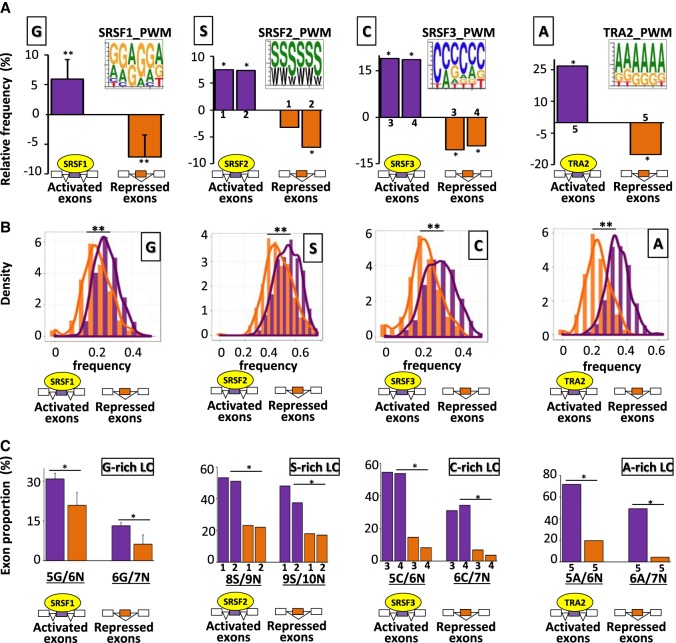
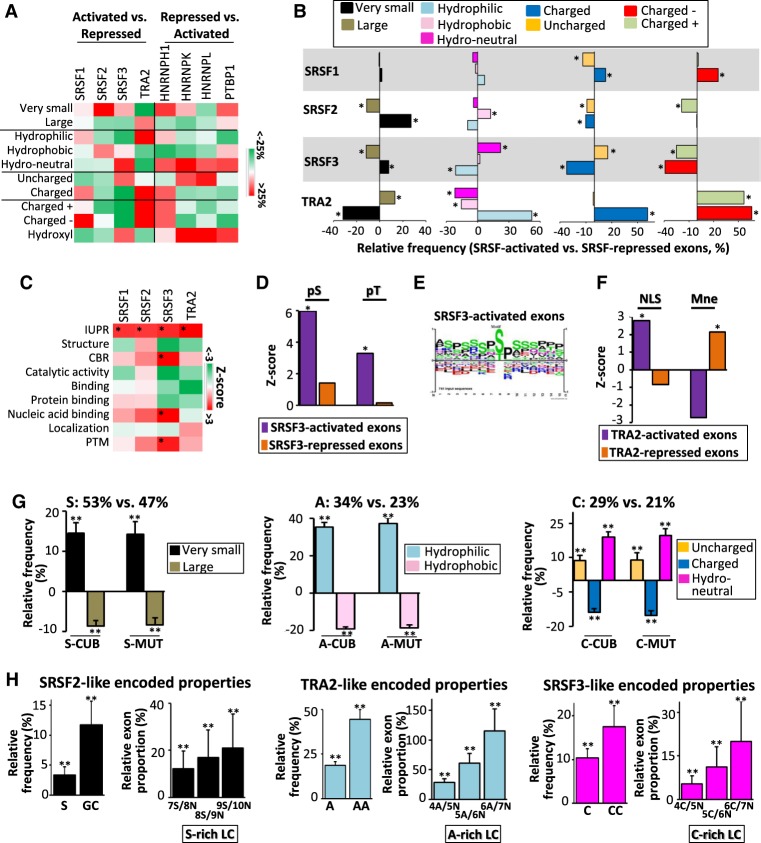
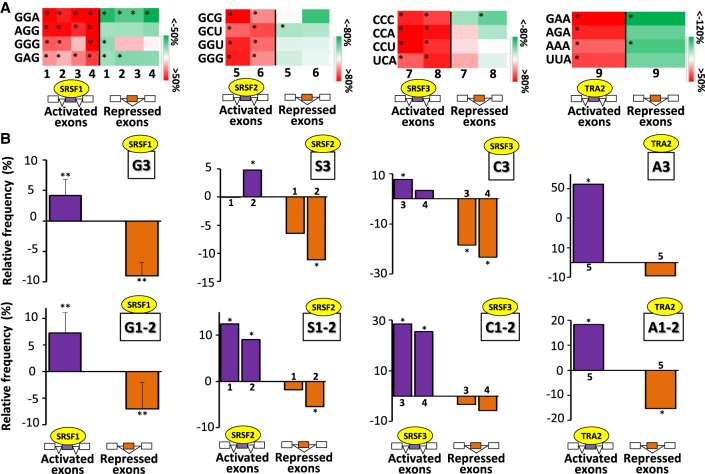
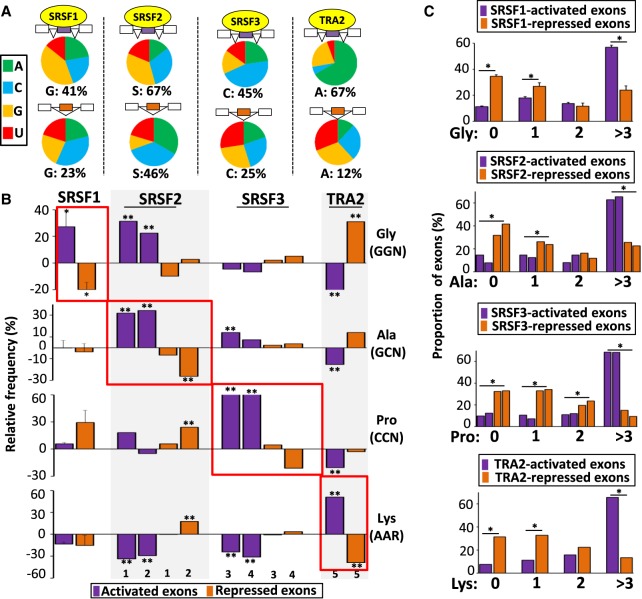
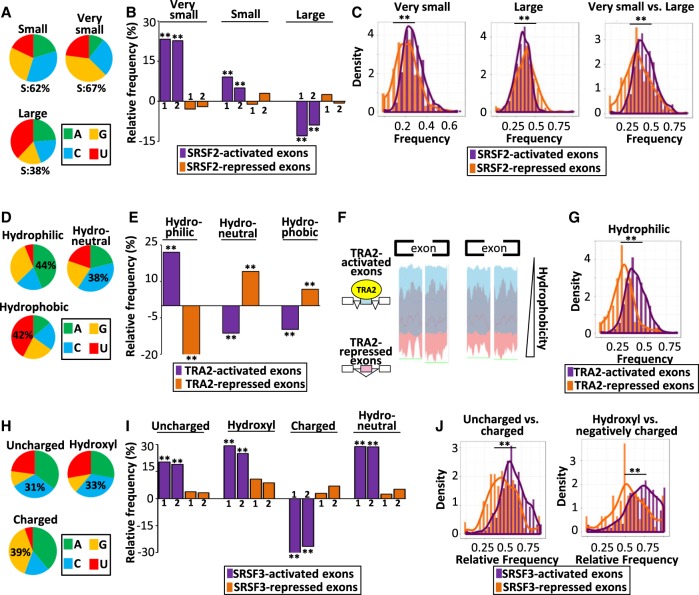
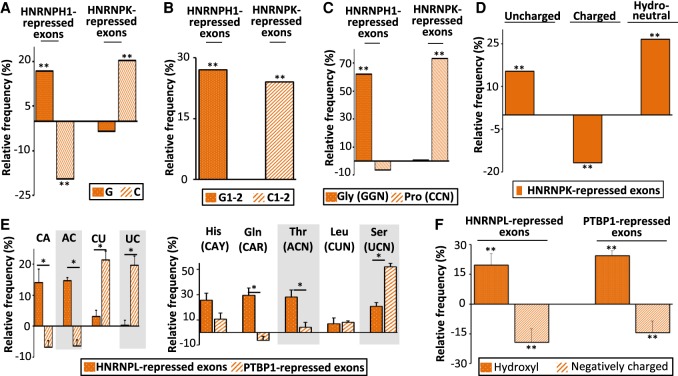
The inclusion of exons during the splicing process depends on the binding of splicing factors to short low-complexity regulatory sequences. The relationship between exonic splicing regulatory sequences and coding sequences is still poorly understood. We demonstrate that exons that are coregulated by any given splicing factor share a similar nucleotide composition bias and preferentially code for amino acids with similar physicochemical properties because of the nonrandomness of the genetic code. Indeed, amino acids sharing similar physicochemical properties correspond to codons that have the same nucleotide composition bias. In particular, we uncover that the TRA2A and TRA2B splicing factors that bind to adenine-rich motifs promote the inclusion of adenine-rich exons coding preferentially for hydrophilic amino acids that correspond to adenine-rich codons. SRSF2 that binds guanine/cytosine-rich motifs promotes the inclusion of GC-rich exons coding preferentially for small amino acids, whereas SRSF3 that binds cytosine-rich motifs promotes the inclusion of exons coding preferentially for uncharged amino acids, like serine and threonine that can be phosphorylated. Finally, coregulated exons encoding amino acids with similar physicochemical properties correspond to specific protein features. In conclusion, the regulation of an exon by a splicing factor that relies on the affinity of this factor for specific nucleotide(s) is tightly interconnected with the exon-encoded physicochemical properties. We therefore uncover an unanticipated bidirectional interplay between the splicing regulatory process and its biological functional outcome.
在剪接过程中包含外显子取决于剪接因子与短低复杂度调节序列的结合。外显子剪接调节序列与编码序列之间的关系仍然知之甚少。我们证明,任何给定剪接因子共同调节的外显子具有相似的核苷酸组成偏好,并优先编码具有相似理化性质的氨基酸,这是由于遗传密码的非随机性。事实上,具有相似理化性质的氨基酸对应于具有相同核苷酸组成偏好的密码子。特别是,我们发现与富含腺嘌呤的基序结合的 TRA2A 和 TRA2B 剪接因子促进富含腺嘌呤的外显子的包含,这些外显子优先编码对应于富含腺嘌呤的密码子的亲水氨基酸。与富含鸟嘌呤/胞嘧啶的基序结合的 SRSF2 促进 GC 丰富的外显子的包含,优先编码小的氨基酸,而与富含胞嘧啶的基序结合的 SRSF3 促进优先编码不带电荷的氨基酸(如丝氨酸和苏氨酸)的外显子的包含,这些氨基酸可以被磷酸化。最后,共同编码具有相似理化性质的氨基酸的外显子对应于特定的蛋白质特征。总之,依赖于该因子对特定核苷酸的亲和力的剪接因子对一个外显子的调节与外显子编码的理化性质紧密相关。因此,我们揭示了剪接调控过程与其生物学功能结果之间出乎意料的双向相互作用。