Zeng Ming, Zhou Dezhong, Ng Singwei, Ahern Jonathan O Keeffe, Alshehri Fatma, Gao Yongsheng, Pierucci Luca, Greiser Udo, Wang Wenxin
Charles Institute of Dermatology, University College Dublin, Dublin 4, Ireland.
Department of Dermatology, the First Affiliated Hospital of Anhui Medical University, Hefei 230022, China.
Polymers (Basel). 2017 May 1;9(5):161. doi: 10.3390/polym9050161.
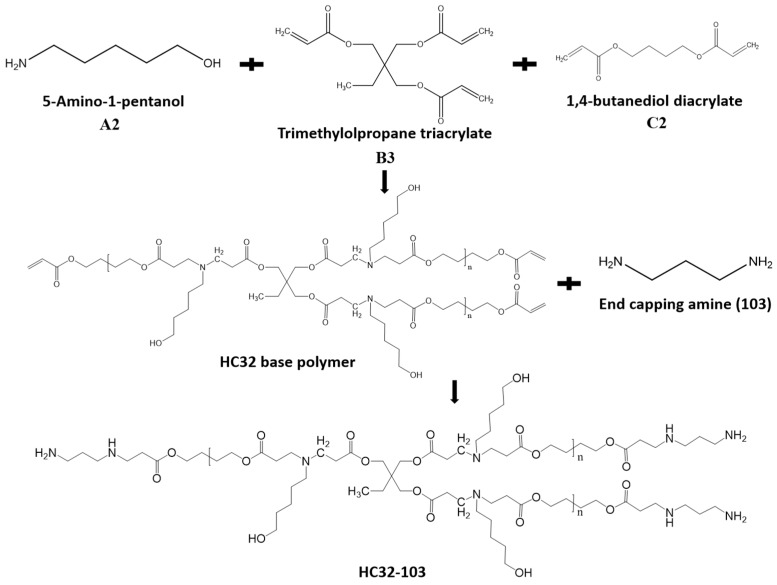
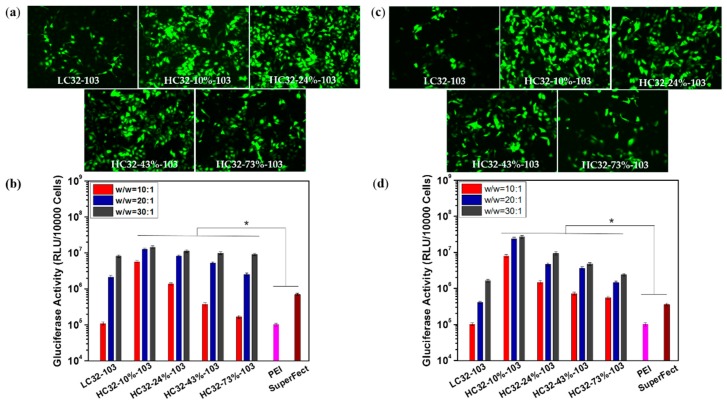
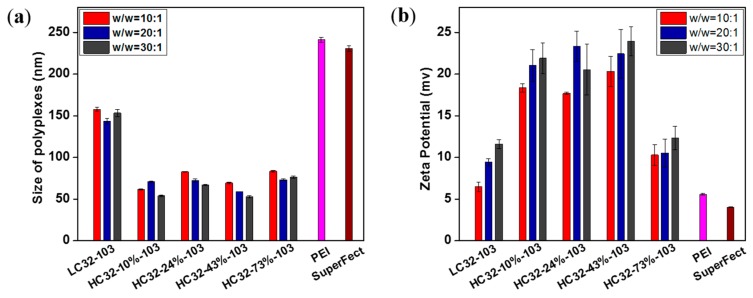
The top-performing linear poly(β-amino ester) (LPAE), poly(5-amino-1-pentanol-co-1,4-butanediol diacrylate) (C32), has demonstrated gene transfection efficiency comparable to viral-mediated gene delivery. Herein, we report the synthesis of a series of highly branched poly(5-amino-1-pentanol-co-1,4-butanediol diacrylate) (HC32) and explore how the branching structure influences the performance of C32 in gene transfection. HC32 were synthesized by an "A2 + B3 + C2" Michal addition strategy. Gaussia luciferase (Gluciferase) and green fluorescent protein (GFP) coding plasmid DNA were used as reporter genes and the gene transfection efficiency was evaluated in human cervical cancer cell line (HeLa) and human recessive dystrophic epidermolysis bullosa keratinocyte (RDEBK) cells. We found that the optimal branching structure led to a much higher gene transfection efficiency in comparison to its linear counterpart and commercial reagents, while preserving high cell viability in both cell types. The branching strategy affected DNA binding, proton buffering capacity and degradation of polymers as well as size, zeta potential, stability, and DNA release rate of polyplexes significantly. Polymer degradation and DNA release rate played pivotal parts in achieving the high gene transfection efficiency of HC32-103 polymers, providing new insights for the development of poly(β-amino ester)s-based gene delivery vectors.
表现最佳的线性聚(β-氨基酯)(LPAE),即聚(5-氨基-1-戊醇-co-1,4-丁二醇二丙烯酸酯)(C32),已证明其基因转染效率与病毒介导的基因递送相当。在此,我们报告了一系列高度支化的聚(5-氨基-1-戊醇-co-1,4-丁二醇二丙烯酸酯)(HC32)的合成,并探讨了支化结构如何影响C32在基因转染中的性能。HC32通过“A2 + B3 + C2”迈克尔加成策略合成。使用高斯荧光素酶(Gluciferase)和绿色荧光蛋白(GFP)编码质粒DNA作为报告基因,并在人宫颈癌细胞系(HeLa)和人隐性营养不良性大疱性表皮松解角质形成细胞(RDEBK)中评估基因转染效率。我们发现,与线性对应物和商业试剂相比,最佳支化结构导致更高的基因转染效率,同时在两种细胞类型中均保持高细胞活力。支化策略显著影响了聚合物的DNA结合、质子缓冲能力和降解,以及多聚体的大小、zeta电位、稳定性和DNA释放速率。聚合物降解和DNA释放速率在实现HC32-103聚合物的高基因转染效率中起关键作用,为基于聚(β-氨基酯)的基因递送载体的开发提供了新的见解。