Hôpitaux Universitaires Paris-Sud, Hôpital de Bicêtre, APHP, Service de Médecine Intensive-Réanimation et de Surveillance Continue Médicale, 78, rue du Général Leclerc, F-94270, Le Kremlin-Bicêtre, France.
Inserm UMR S_999, Univ Paris-Sud, 78, rue du Général Leclerc, F-94270, Le Kremlin-Bicêtre, France.
Crit Care. 2019 Apr 11;23(1):116. doi: 10.1186/s13054-019-2413-x.
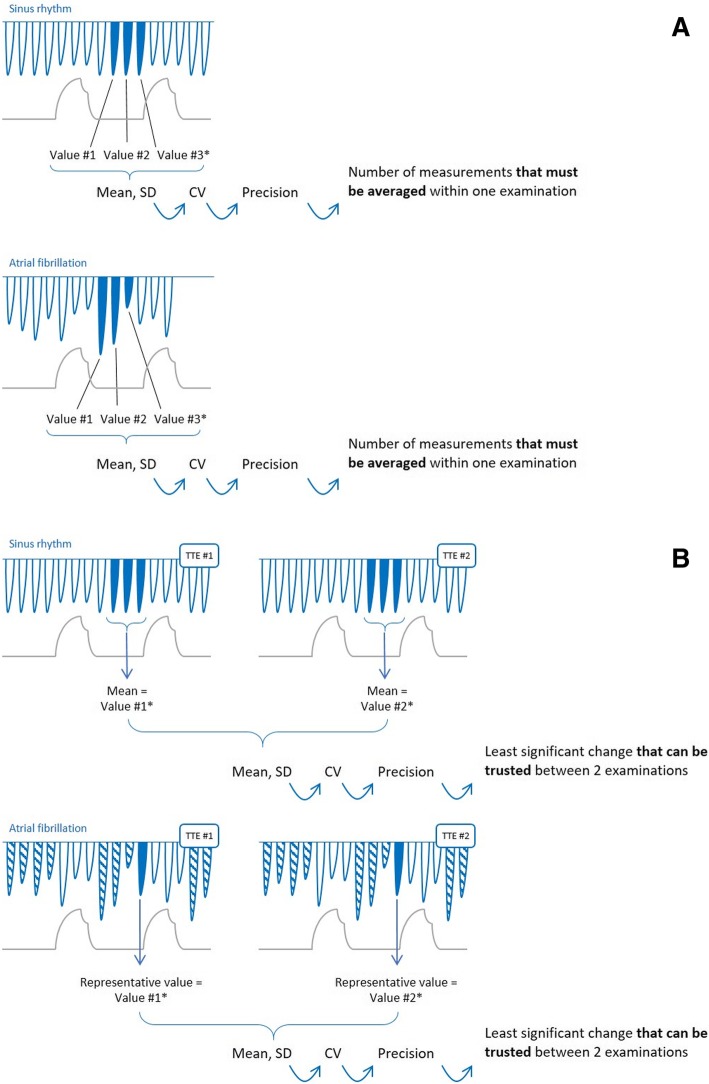
In critically ill patients, changes in the velocity-time integral (VTI) of the left ventricular outflow tract, measured by transthoracic echocardiography (TTE), are often used to non-invasively assess the response to fluid administration or for performing tests assessing fluid responsiveness. However, the precision of TTE measurements has not yet been investigated in such patients. First, we aimed at assessing how many measurements should be averaged within one TTE examination to reach a sufficient precision for various variables. Second, we aimed at identifying the least significant change (LSC) of these variables between successive TTE examinations.
We prospectively included 100 haemodynamically stable patients in whom TTE examination was planned. Three TTE examinations were performed, the first and the third by one operator and the second by another one. We calculated the precision and LSC (1) within one examination depending on the number of averaged measurements and (2) between measurements performed in two successive examinations.
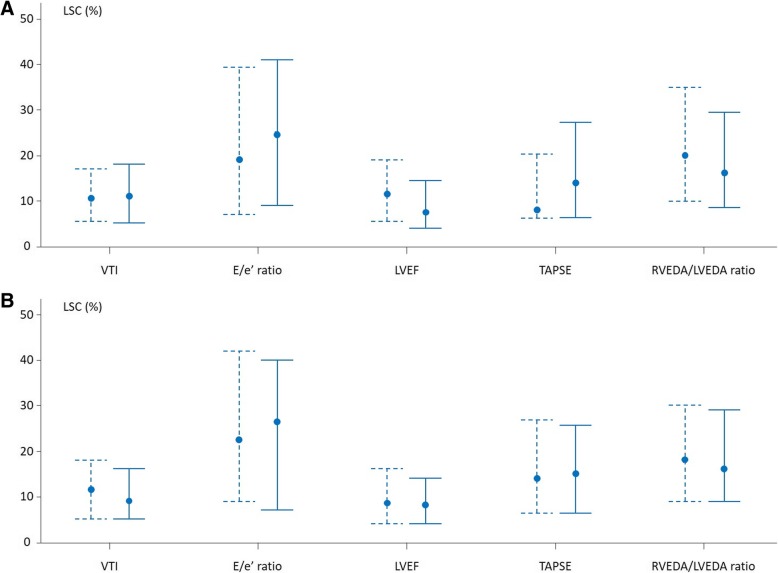
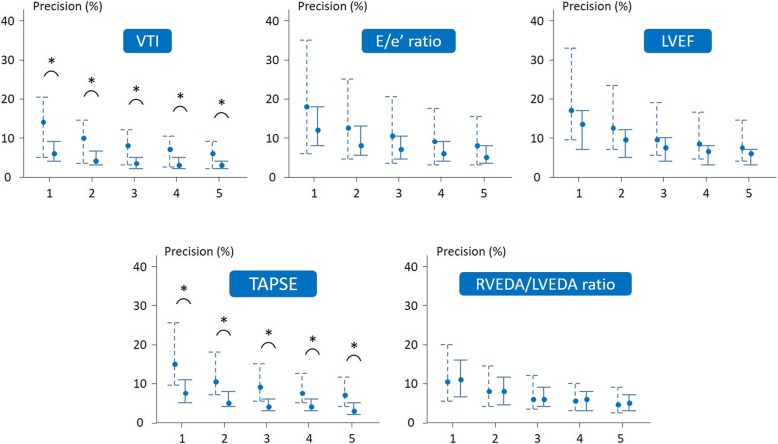
In patients in sinus rhythm, averaging three measurements within an examination was enough for obtaining an acceptable precision (interquartile range highest value < 10%) for VTI. In patients with atrial fibrillation, averaging five measurements was necessary. The precision of some other common TTE variables depending on the number of measurements is provided. Between two successive examinations performed by the same operator, the LSC was 11 [5-18]% for VTI. If two operators performed the examinations, the LSC for VTI significantly increased to 14 [8-26]%. The LSC between two examinations for other TTE variables is also provided.
Averaging three measurements within one TTE examination is enough for obtaining precise measurements for VTI in patients in sinus rhythm but not in patients with atrial fibrillation. Between two TTE examinations performed by the same operator, the LSC of VTI is compatible with the assessment of the effects of a 500-mL fluid infusion but is not precise enough for assessing the effects of some tests predicting preload responsiveness.
在危重症患者中,经胸超声心动图(TTE)测量的左心室流出道速度时间积分(VTI)的变化常被用于非侵入性评估液体给药的反应或进行评估液体反应性的测试。然而,TTE 测量的精度尚未在这些患者中进行研究。首先,我们旨在评估在一次 TTE 检查中应平均多少次测量才能达到各种变量的足够精度。其次,我们旨在确定两次连续 TTE 检查之间这些变量的最小有意义变化(LSC)。
我们前瞻性地纳入了 100 例血流动力学稳定的患者,计划进行 TTE 检查。进行了三次 TTE 检查,第一次和第三次由一名操作者进行,第二次由另一名操作者进行。我们根据平均测量次数计算了一次检查内的精度和 LSC(1)以及两次连续检查之间的测量值的精度和 LSC(2)。
在窦性心律患者中,平均三次测量即可获得可接受的 VTI 精度(四分位间距最高值<10%)。在心房颤动患者中,需要平均五次测量。还提供了一些其他常见 TTE 变量的精度,具体取决于测量次数。同一操作者进行的两次连续检查之间的 LSC 为 VTI 11[5-18]%。如果两名操作者进行检查,则 VTI 的 LSC 显著增加至 14[8-26]%。还提供了两次连续 TTE 检查之间其他 TTE 变量的 LSC。
在窦性心律患者中,一次 TTE 检查中平均三次测量即可获得 VTI 的精确测量值,但在心房颤动患者中则不行。同一操作者进行的两次 TTE 检查之间,VTI 的 LSC 与评估 500ml 液体输注效果兼容,但对于评估某些预测前负荷反应性的测试效果不够精确。