Dale Natasha C, Johnstone Elizabeth K M, White Carl W, Pfleger Kevin D G
Molecular Endocrinology and Pharmacology, Harry Perkins Institute of Medical Research, QEII Medical Centre, Nedlands, WA, Australia.
Centre for Medical Research, The University of Western Australia, Crawley, WA, Australia.
Front Bioeng Biotechnol. 2019 Mar 26;7:56. doi: 10.3389/fbioe.2019.00056. eCollection 2019.
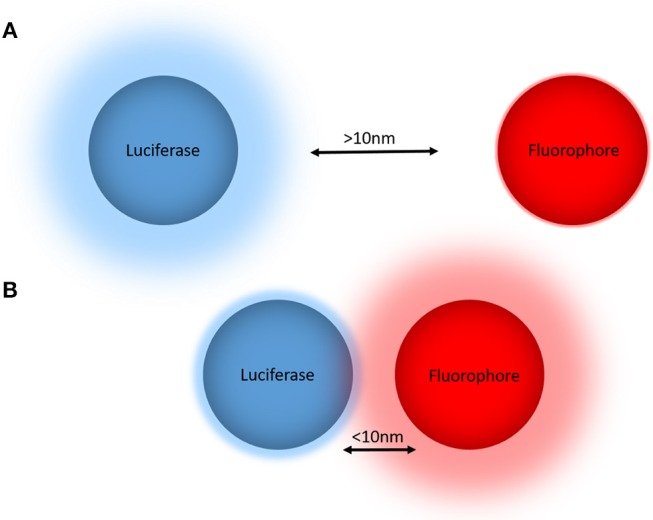
Bioluminescence resonance energy transfer (BRET) is a biophysical technique used to monitor proximity within live cells. BRET exploits the naturally occurring phenomenon of dipole-dipole energy transfer from a donor enzyme (luciferase) to an acceptor fluorophore following enzyme-mediated oxidation of a substrate. This results in production of a quantifiable signal that denotes proximity between proteins and/or molecules tagged with complementary luciferase and fluorophore partners. BRET assays have been used to observe an array of biological functions including ligand binding, intracellular signaling, receptor-receptor proximity, and receptor trafficking, however, BRET assays can theoretically be used to monitor the proximity of any protein or molecule for which appropriate fusion constructs and/or fluorophore conjugates can be produced. Over the years, new luciferases and approaches have been developed that have increased the potential applications for BRET assays. In particular, the development of the small, bright and stable Nanoluciferase (NanoLuc; Nluc) and its use in NanoBRET has vastly broadened the potential applications of BRET assays. These advances have exciting potential to produce new experimental methods to monitor protein-protein interactions (PPIs), protein-ligand interactions, and/or molecular proximity. In addition to NanoBRET, Nluc has also been exploited to produce NanoBiT technology, which further broadens the scope of BRET to monitor biological function when NanoBiT is combined with an acceptor. BRET has proved to be a powerful tool for monitoring proximity and interaction, and these recent advances further strengthen its utility for a range of applications.
生物发光共振能量转移(BRET)是一种用于监测活细胞内分子接近程度的生物物理技术。BRET利用了一种自然发生的现象,即供体酶(荧光素酶)在底物经酶介导氧化后,将偶极-偶极能量转移给受体荧光团。这会产生一个可量化的信号,该信号表示用互补荧光素酶和荧光团伴侣标记的蛋白质和/或分子之间的接近程度。BRET分析已被用于观察一系列生物学功能,包括配体结合、细胞内信号传导、受体-受体接近程度以及受体运输。然而,从理论上讲,BRET分析可用于监测任何能产生合适融合构建体和/或荧光团缀合物的蛋白质或分子的接近程度。多年来,已开发出新型荧光素酶和方法,增加了BRET分析的潜在应用。特别是,小型、明亮且稳定的纳米荧光素酶(NanoLuc;Nluc)的开发及其在NanoBRET中的应用极大地拓宽了BRET分析的潜在应用范围。这些进展为产生监测蛋白质-蛋白质相互作用(PPI)、蛋白质-配体相互作用和/或分子接近程度的新实验方法带来了令人兴奋的潜力。除了NanoBRET,Nluc还被用于开发NanoBiT技术,当NanoBiT与受体结合时,该技术进一步拓宽了BRET监测生物学功能的范围。事实证明,BRET是监测接近程度和相互作用的有力工具,这些最新进展进一步增强了其在一系列应用中的实用性。