Zeitoun David, Caliaperoumal Guavri, Bensidhoum Morad, Constans Jean Marc, Anagnostou Fani, Bousson Valérie
Centre hospitalier Lariboisière, Hopital Lariboisière, Service de radiologie ostéo-articulaire, 2 rue Ambroise Paré, 75010, Paris, France.
CNRS Laboratoire B2OA, Laboratoire B2OA.10, Avenue de Verdun, 75010, Paris, France.
Eur Radiol Exp. 2019 Apr 11;3(1):17. doi: 10.1186/s41747-019-0094-5.
To better understand bone fragility in type 2 diabetes mellitus and define the contribution of microcomputed tomography (micro-CT) to the evaluation of bone microarchitecture and vascularisation, we conducted an in vitro preliminary study on the femur of Zucker diabetic fatty (ZDF) rats and Zucker lean (ZL) rats. We first analysed bone microarchitecture, then determined whether micro-CT allowed to explore bone vascularisation, and finally looked for a link between these parameters.
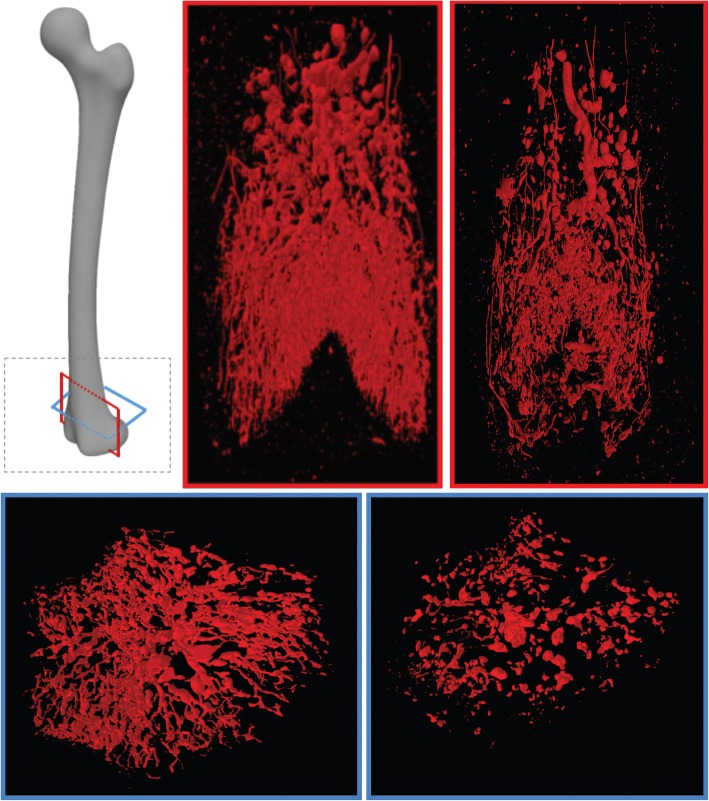
Eight ZDF and six ZL rats were examined for bone microarchitecture (group 1), and six ZDF and six ZL rats were studied for bone vascularisation after Microfil® perfusion which is a radiopaque casting agent (group 2). In group 1, we used micro-CT to examine the trabecular and cortical bone microarchitecture of the femoral head, neck, shaft, and distal metaphysis. In group 2, micro-CT was used to study the blood vessels in the head, neck, and distal metaphysis.
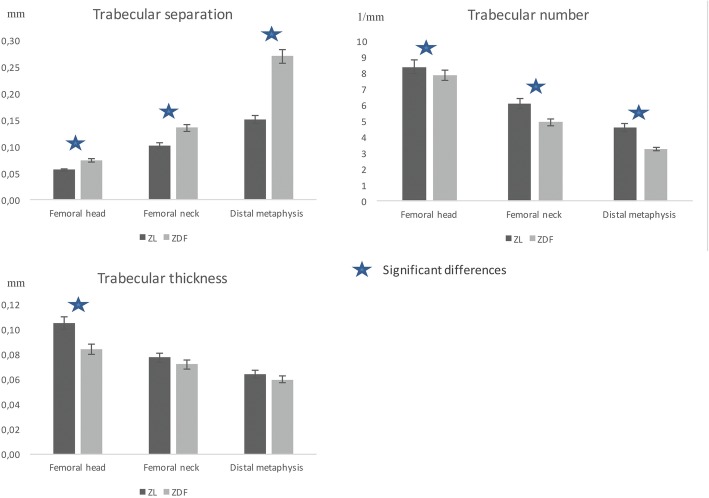
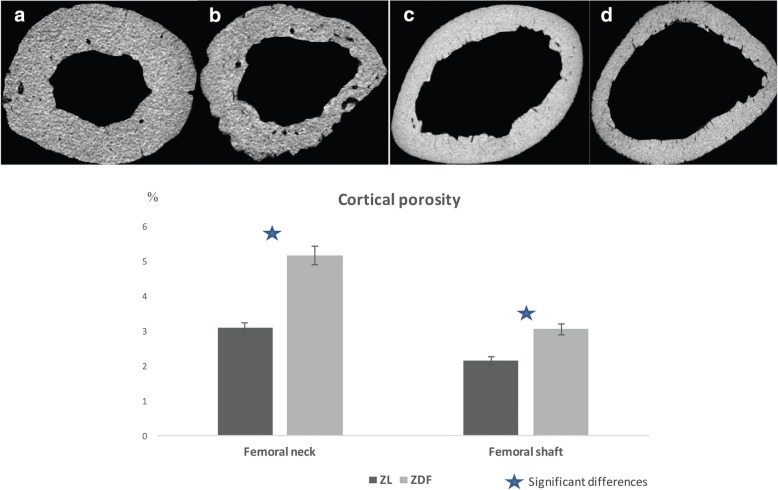
Compared to ZL rats, the ZDF rats exhibited significantly lower trabecular bone volume and number and higher trabecular separation in the three locations (p = 0.02, p = 0.02, p = 0.003). Cortical porosity was significantly higher in the ZDF rats at the neck and shaft (p = 0.001 and p = 0.005). We observed a dramatically poorer bone vascularisation in the femur of ZDF rats, especially in distal metaphysis (p < 0.047).
Micro-CT demonstrated not only significant alterations in the bone microarchitecture of the femurs of ZDF rats, but also significant alterations in bone vascularisation. Further studies are required to demonstrate the causal link between poor vascularisation and impaired bone architecture.
为了更好地理解2型糖尿病中的骨脆性,并确定微计算机断层扫描(micro-CT)对骨微结构和血管化评估的贡献,我们对Zucker糖尿病肥胖(ZDF)大鼠和Zucker瘦素(ZL)大鼠的股骨进行了一项体外初步研究。我们首先分析骨微结构,然后确定micro-CT是否能够探究骨血管化,最后寻找这些参数之间的联系。
对8只ZDF大鼠和6只ZL大鼠进行骨微结构检查(第1组),对6只ZDF大鼠和6只ZL大鼠在使用不透射线的铸型剂Microfil®灌注后进行骨血管化研究(第2组)。在第1组中,我们使用micro-CT检查股骨头、颈、骨干和干骺端的小梁骨和皮质骨微结构。在第2组中,使用micro-CT研究头、颈和干骺端的血管。
与ZL大鼠相比,ZDF大鼠在三个部位的小梁骨体积和数量显著降低,小梁间距更高(p = 0.02,p = 0.02,p = 0.003)。ZDF大鼠在颈部和骨干的皮质孔隙率显著更高(p = 0.001和p = 0.005)。我们观察到ZDF大鼠股骨的骨血管化明显较差,尤其是在干骺端(p < 0.047)。
Micro-CT不仅显示ZDF大鼠股骨的骨微结构有显著改变,而且骨血管化也有显著改变。需要进一步研究来证明血管化不良与骨结构受损之间的因果关系。