• 文献检索
  • 文档翻译
  • 深度研究
  • 学术资讯
  • Suppr Zotero 插件Zotero 插件
  • 邀请有礼
  • 套餐&价格
  • 历史记录
应用&插件
Suppr Zotero 插件Zotero 插件浏览器插件Mac 客户端Windows 客户端微信小程序
定价
高级版会员购买积分包购买API积分包
服务
文献检索文档翻译深度研究API 文档MCP 服务
关于我们
关于 Suppr公司介绍联系我们用户协议隐私条款
关注我们

Suppr 超能文献

核心技术专利:CN118964589B侵权必究
粤ICP备2023148730 号-1Suppr @ 2026

文献检索

告别复杂PubMed语法,用中文像聊天一样搜索,搜遍4000万医学文献。AI智能推荐,让科研检索更轻松。

立即免费搜索

文件翻译

保留排版,准确专业,支持PDF/Word/PPT等文件格式,支持 12+语言互译。

免费翻译文档

深度研究

AI帮你快速写综述,25分钟生成高质量综述,智能提取关键信息,辅助科研写作。

立即免费体验

基于智能手机应用程序(电子 12 小时膳食回忆)的方法估计成年人习惯性膳食摄入量的相对有效性。

Relative Validity of a Method Based on a Smartphone App (Electronic 12-Hour Dietary Recall) to Estimate Habitual Dietary Intake in Adults.

机构信息

Department of Preventive Medicine and Public Health, School of Medicine, University of Seville, Seville, Spain.

Virgen Macarena University Hospital, Seville, Spain.

出版信息

JMIR Mhealth Uhealth. 2019 Apr 11;7(4):e11531. doi: 10.2196/11531.

DOI:10.2196/11531
PMID:30973343
原文链接:https://pmc.ncbi.nlm.nih.gov/articles/PMC6489347/
Abstract

BACKGROUND

Accurate dietary assessment is key to understanding nutrition-related outcomes and for estimating the dietary change in nutrition-based interventions. When researching the habitual consumption of selected food groups, it is essential to be aware of factors that could possibly affect reporting accuracy.

OBJECTIVE

This study aimed to evaluate the relative validity of the current-day dietary recall, a method based on a smartphone app called electronic 12-hour dietary recall (e-12HR), to categorize individuals according to habitual intake, in the whole sample of adults and in different strata thereof.

METHODS

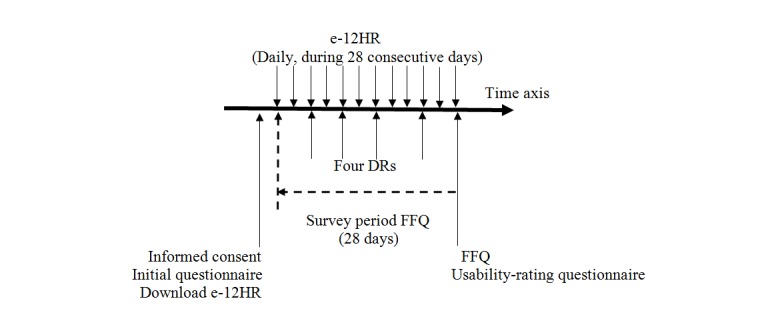
University students and employees over 18 years recorded the consumption of 10 selected groups of food using e-12HR during 28 consecutive days. During this period, they also completed 4 dietary records. Once the period was finished, the subjects then completed a food frequency questionnaire (FFQ) and a usability-rating questionnaire for e-12HR. The food group intakes estimated by the e-12HR app, the dietary records, and the FFQ were categorized into sextiles: less than once a week, once or twice a week, 3-4 times a week, 5-6 times a week, once or twice a day, and 3 or more times a day. The 10 selected groups with e-12HR were compared with 4 dietary records and an FFQ reference method, in the whole sample and in different strata thereof: age (years): <25 and ≥25; gender: females and males; occupation: students and employees; smoking: no and yes; physical activity (minutes/week): ≥150 and <150; and body mass index (kg/m): <25 and ≥25. The association between the different methods was assessed using Spearman correlation coefficient (SCC). Cross-classification and kappa statistic were used as a measure of agreement between the different methods.

RESULTS

In total, 203 participants completed the study (56.7% [115/203] women, and 43.3% [88/203] men). For all food groups and all participants, the mean SCC for e-12HR versus FFQ was 0.67 (≥0.62 for all strata). On average, 50.7% of participants were classified into the same category (≥47.0% for all strata) and 90.2% within the nearest category (≥88.6% for all strata). Mean weighted kappa was 0.49 (≥0.44 for all strata). For e-12HR versus RDs, mean SCC was 0.65 (≥0.57 for all strata). On average, 50.0% of participants were classified into the same category (≥47.0% for all strata) and 88.2% within the nearest category (≥86.1% for all strata). Mean weighted kappa was 0.50 (≥0.44 for all strata).

CONCLUSIONS

The results indicate that e-12HR generated categories of dietary intake highly comparable with the 2 reference methods in the whole sample and in different strata thereof. The inclusion of photographs to facilitate estimation of the servings consumed generated correlation/agreement data between e-12HR and the FFQ that were similar to a previous study using an older version of the app, which did not include photographs.
https://cdn.ncbi.nlm.nih.gov/pmc/blobs/9fad/6489347/a36e98b2f549/mhealth_v7i4e11531_fig1.jpg
摘要

背景

准确的饮食评估是理解营养相关结果和估计营养干预措施中饮食变化的关键。当研究特定食物组的习惯性消费时,必须意识到可能影响报告准确性的因素。

目的

本研究旨在评估当前的日常饮食回忆方法的相对有效性,该方法基于一个名为电子 12 小时饮食回忆(e-12HR)的智能手机应用程序,用于根据习惯性摄入对成年人和不同人群进行分类。

方法

大学生和 18 岁以上的员工在 28 天内使用 e-12HR 记录 10 组选定的食物摄入量。在此期间,他们还完成了 4 份饮食记录。一旦完成这段时间,参与者就完成了食物频率问卷(FFQ)和 e-12HR 可用性评分问卷。e-12HR 应用程序、饮食记录和 FFQ 估计的食物组摄入量被分为六类:每周少于一次、每周一次或两次、每周 3-4 次、每周 5-6 次、每天一次或两次、每天 3 次或更多次。用 e-12HR 比较了 10 个选定的组与 4 种饮食记录和一种 FFQ 参考方法,在整个样本和不同人群中:年龄(岁):<25 和≥25;性别:女性和男性;职业:学生和员工;吸烟:否和是;体力活动(分钟/周):≥150 和<150;和身体质量指数(kg/m):<25 和≥25。使用 Spearman 相关系数(SCC)评估不同方法之间的关联。交叉分类和kappa 统计用于衡量不同方法之间的一致性。

结果

共有 203 名参与者完成了研究(56.7%[115/203]为女性,43.3%[88/203]为男性)。对于所有食物组和所有参与者,e-12HR 与 FFQ 的平均 SCC 为 0.67(所有人群均≥0.62)。平均而言,50.7%的参与者被归入同一类别(所有人群均≥47.0%),90.2%的参与者归入最近的类别(所有人群均≥88.6%)。平均加权 kappa 为 0.49(所有人群均≥0.44)。对于 e-12HR 与 RDs,平均 SCC 为 0.65(所有人群均≥0.57)。平均而言,50.0%的参与者被归入同一类别(所有人群均≥47.0%),88.2%的参与者归入最近的类别(所有人群均≥86.1%)。平均加权 kappa 为 0.50(所有人群均≥0.44)。

结论

结果表明,e-12HR 生成的饮食摄入量类别与整个样本和不同人群中的两种参考方法高度可比。为了便于估计所消耗的份量,包含照片生成了 e-12HR 与 FFQ 之间的相关/一致性数据,这与之前使用不包含照片的应用程序的旧版本进行的研究相似。

相似文献

1
Relative Validity of a Method Based on a Smartphone App (Electronic 12-Hour Dietary Recall) to Estimate Habitual Dietary Intake in Adults.基于智能手机应用程序(电子 12 小时膳食回忆)的方法估计成年人习惯性膳食摄入量的相对有效性。
JMIR Mhealth Uhealth. 2019 Apr 11;7(4):e11531. doi: 10.2196/11531.
2
Electronic 12-Hour Dietary Recall (e-12HR): Comparison of a Mobile Phone App for Dietary Intake Assessment With a Food Frequency Questionnaire and Four Dietary Records.电子12小时膳食回顾(e-12HR):用于膳食摄入量评估的手机应用程序与食物频率问卷及四份膳食记录的比较
JMIR Mhealth Uhealth. 2018 Jun 15;6(6):e10409. doi: 10.2196/10409.
3
First evaluation steps of a new method for dietary intake estimation regarding a list of key food groups in adults and in different sociodemographic and health-related behaviour strata.新方法在成年人和不同社会人口学及健康相关行为阶层中针对关键食物组列表进行膳食摄入量估计的初步评估步骤。
Public Health Nutr. 2017 Oct;20(15):2660-2669. doi: 10.1017/S1368980017001641. Epub 2017 Aug 9.
4
Validity and Usability of a Smartphone Image-Based Dietary Assessment App Compared to 3-Day Food Diaries in Assessing Dietary Intake Among Canadian Adults: Randomized Controlled Trial.智能手机图像膳食评估应用与 3 天食物日记评估加拿大成年人膳食摄入量的有效性和可用性:随机对照试验。
JMIR Mhealth Uhealth. 2020 Sep 9;8(9):e16953. doi: 10.2196/16953.
5
Short-Term Effect of a Health Promotion Intervention Based on the Electronic 12-Hour Dietary Recall (e-12HR) Smartphone App on Adherence to the Mediterranean Diet Among Spanish Primary Care Professionals: Randomized Controlled Clinical Trial.基于电子 12 小时膳食回顾(e-12HR)智能手机应用程序的健康促进干预对西班牙初级保健专业人员遵守地中海饮食的短期效果:随机对照临床试验。
JMIR Mhealth Uhealth. 2024 Jan 8;12:e49302. doi: 10.2196/49302.
6
EVIDENT Smartphone App, a New Method for the Dietary Record: Comparison With a Food Frequency Questionnaire.明显智能手机应用程序,一种新的饮食记录方法:与食物频率问卷的比较。
JMIR Mhealth Uhealth. 2019 Feb 8;7(2):e11463. doi: 10.2196/11463.
7
Relative Validity and Reliability of a 1-Week, Semiquantitative Food Frequency Questionnaire for Women Participating in the Supplemental Nutrition Assistance Program.参加补充营养援助计划的女性使用一周半定量食物频率问卷的相对有效性和可靠性。
J Acad Nutr Diet. 2017 Dec;117(12):1972-1982.e2. doi: 10.1016/j.jand.2017.05.013. Epub 2017 Jun 29.
8
A Smartphone Food Record App Developed for the Dutch National Food Consumption Survey: Relative Validity Study.一款专为荷兰国家食物消费调查开发的智能手机食物记录应用:相对有效性研究。
JMIR Mhealth Uhealth. 2024 Feb 9;12:e50196. doi: 10.2196/50196.
9
Electronic Dietary Intake Assessment (e-DIA): relative validity of a mobile phone application to measure intake of food groups.电子膳食摄入量评估(e-DIA):一款用于测量食物组摄入量的手机应用程序的相对效度。
Br J Nutr. 2016 Jun;115(12):2219-26. doi: 10.1017/S0007114516001525. Epub 2016 Apr 28.
10
Feasibility of a commercial smartphone application for dietary assessment in epidemiological research and comparison with 24-h dietary recalls.商业智能手机应用程序用于流行病学研究中的膳食评估的可行性,并与 24 小时膳食回忆进行比较。
Nutr J. 2018 Jan 9;17(1):5. doi: 10.1186/s12937-018-0315-4.

引用本文的文献

1
Adherence to the Mediterranean Diet in Association with Self-Perception of Dietary Behavior (Discrepancy between Self-Perceived and Actual Diet Quality): A Cross-Sectional Study among Spanish University Students of Both Genders.坚持地中海饮食与自我感知的饮食行为之间的关系(自我感知与实际饮食质量之间的差异):一项针对西班牙男女大学生的横断面研究。
Nutrients. 2024 Oct 3;16(19):3364. doi: 10.3390/nu16193364.
2
Short-Term Effect of a Health Promotion Intervention Based on the Electronic 12-Hour Dietary Recall (e-12HR) Smartphone App on Adherence to the Mediterranean Diet Among Spanish Primary Care Professionals: Randomized Controlled Clinical Trial.基于电子 12 小时膳食回顾(e-12HR)智能手机应用程序的健康促进干预对西班牙初级保健专业人员遵守地中海饮食的短期效果:随机对照临床试验。
JMIR Mhealth Uhealth. 2024 Jan 8;12:e49302. doi: 10.2196/49302.
3

本文引用的文献

1
Electronic 12-Hour Dietary Recall (e-12HR): Comparison of a Mobile Phone App for Dietary Intake Assessment With a Food Frequency Questionnaire and Four Dietary Records.电子12小时膳食回顾(e-12HR):用于膳食摄入量评估的手机应用程序与食物频率问卷及四份膳食记录的比较
JMIR Mhealth Uhealth. 2018 Jun 15;6(6):e10409. doi: 10.2196/10409.
2
Accurately Inferring Compliance to Five Major Food Guidelines Through Simplified Surveys: Applying Data Mining to the UK National Diet and Nutrition Survey.通过简化调查准确推断对五大主要饮食指南的依从性:将数据挖掘应用于英国国家饮食与营养调查
JMIR Public Health Surveill. 2018 May 30;4(2):e56. doi: 10.2196/publichealth.9536.
3
Validation of Dietary Intake Estimated by Web-Based Dietary Assessment Methods and Usability Using Dietary Records or 24-h Dietary Recalls: A Scoping Review.基于网络的膳食评估方法估计的膳食摄入量的验证及使用膳食记录或 24 小时膳食回忆的可用性:范围综述。
Nutrients. 2023 Apr 8;15(8):1816. doi: 10.3390/nu15081816.
4
Effectiveness of a Smartphone App (e-12HR) in Improving Adherence to the Mediterranean Diet in Spanish University Students by Age, Gender, Field of Study, and Body Mass Index: A Randomized Controlled Trial.智能手机应用程序(e-12HR)对改善西班牙大学生地中海饮食依从性的效果:按年龄、性别、学科和体重指数分层的随机对照试验。
Nutrients. 2023 Mar 30;15(7):1688. doi: 10.3390/nu15071688.
5
Stance4Health Nutritional APP: A Path to Personalized Smart Nutrition.立场健康营养 APP:个性化智能营养之路。
Nutrients. 2023 Jan 5;15(2):276. doi: 10.3390/nu15020276.
6
Evaluation of an Application for Mobile Telephones (e-12HR) to Increase Adherence to the Mediterranean Diet in University Students: A Controlled, Randomized and Multicentric Study.应用于移动电话(e-12HR)提高大学生地中海饮食依从性的评估:一项对照、随机、多中心研究。
Nutrients. 2022 Oct 8;14(19):4196. doi: 10.3390/nu14194196.
7
Weekend-Weekday Differences in Adherence to the Mediterranean Diet among Spanish University Students.周末-工作日西班牙大学生对地中海饮食的坚持差异。
Nutrients. 2022 Jul 8;14(14):2811. doi: 10.3390/nu14142811.
8
Measurement Properties of Smartphone Approaches to Assess Diet, Alcohol Use, and Tobacco Use: Systematic Review.智能手机评估饮食、酒精和烟草使用的测量特性:系统评价。
JMIR Mhealth Uhealth. 2022 Feb 17;10(2):e27337. doi: 10.2196/27337.
9
[Analysis of eating habits among the main health care agents in health promotion (physicians and nurses) of emergency services in times of COVID-19].[新冠疫情期间急诊服务机构中主要健康促进医疗人员(医生和护士)的饮食习惯分析]
Semergen. 2022 Apr;48(3):154-162. doi: 10.1016/j.semerg.2021.07.001. Epub 2021 Jul 28.
First evaluation steps of a new method for dietary intake estimation regarding a list of key food groups in adults and in different sociodemographic and health-related behaviour strata.
新方法在成年人和不同社会人口学及健康相关行为阶层中针对关键食物组列表进行膳食摄入量估计的初步评估步骤。
Public Health Nutr. 2017 Oct;20(15):2660-2669. doi: 10.1017/S1368980017001641. Epub 2017 Aug 9.
4
The e-EPIDEMIOLOGY Mobile Phone App for Dietary Intake Assessment: Comparison with a Food Frequency Questionnaire.用于膳食摄入量评估的电子流行病学手机应用程序:与食物频率问卷的比较。
JMIR Res Protoc. 2016 Nov 2;5(4):e208. doi: 10.2196/resprot.5782.
5
Development of a brief, reliable and valid diet assessment tool for impaired glucose tolerance and diabetes: the UK Diabetes and Diet Questionnaire.开发一种针对糖耐量受损和糖尿病的简短、可靠且有效的饮食评估工具:英国糖尿病与饮食问卷。
Public Health Nutr. 2017 Feb;20(2):191-199. doi: 10.1017/S1368980016002275. Epub 2016 Sep 9.
6
Associations between reported intakes of carotenoid-rich foods and concentrations of carotenoids in plasma: a validation study of a web-based food recall for children and adolescents.富含类胡萝卜素食物的报告摄入量与血浆类胡萝卜素浓度之间的关联:一项针对儿童和青少年的基于网络的食物召回的验证研究。
Public Health Nutr. 2016 Dec;19(18):3265-3275. doi: 10.1017/S1368980016001622. Epub 2016 Jun 27.
7
Can a dietary quality score derived from a short-form FFQ assess dietary quality in UK adult population surveys?源自简化版食物频率问卷的饮食质量评分能否评估英国成年人群调查中的饮食质量?
Public Health Nutr. 2016 Nov;19(16):2915-2923. doi: 10.1017/S1368980016001099. Epub 2016 May 16.
8
Reproducibility and Relative Validity of a Short Food Frequency Questionnaire in 9-10 Year-Old Children.9-10 岁儿童短式食物频率问卷的可重复性和相对有效性。
Nutrients. 2016 May 7;8(5):271. doi: 10.3390/nu8050271.
9
The reliability and validity of a short food frequency questionnaire among 9-11-year olds: a multinational study on three middle-income and high-income countries.9至11岁儿童简短食物频率问卷的信度和效度:一项关于三个中高收入国家的跨国研究
Int J Obes Suppl. 2015 Dec;5(Suppl 2):S22-8. doi: 10.1038/ijosup.2015.15. Epub 2015 Dec 8.
10
Validity and calibration of the FFQ used in the Melbourne Collaborative Cohort Study.墨尔本协作队列研究中使用的食物频率问卷的效度与校准
Public Health Nutr. 2016 Sep;19(13):2357-68. doi: 10.1017/S1368980016000690. Epub 2016 Apr 14.