Department of Kinesiology, Iowa State University, Ames, IA.
Department of Kinesiology, University of Wisconsin-Madison, Madison WI.
Med Sci Sports Exerc. 2019 Sep;51(9):1909-1917. doi: 10.1249/MSS.0000000000002006.
The endocannabinoid (eCB) system is implicated in the pathophysiology of depression and is responsive to acute exercise in healthy adults.
We aimed to describe acute changes in serum eCB across a prescribed moderate (MOD) and a self-selected/preferred (PREF) intensity exercise session in women with major depressive disorder (MDD) and determine relationships between changes in eCB and mood states.
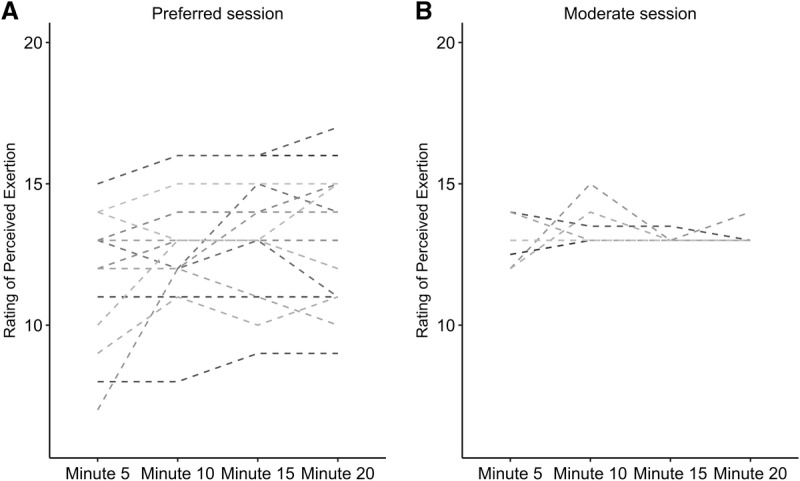
Women with MDD (n = 17) exercised in separate sessions for 20 min on a cycle ergometer at both MOD or PREF in a within-subjects design. Blood was drawn before and within 10 min after exercise. Serum concentrations of eCB (anandamide [AEA], 2-arachidonoylglycerol) and related lipids (palmitoylethanolamine, oleoylethanolamine, 2-oleoylglycerol) were quantified using stable isotope-dilution, liquid chromatography/mass spectrometry/mass spectrometry. The profile of mood states and state-trait anxiety inventory (state only) were completed before, 10 min and 30 min postexercise.
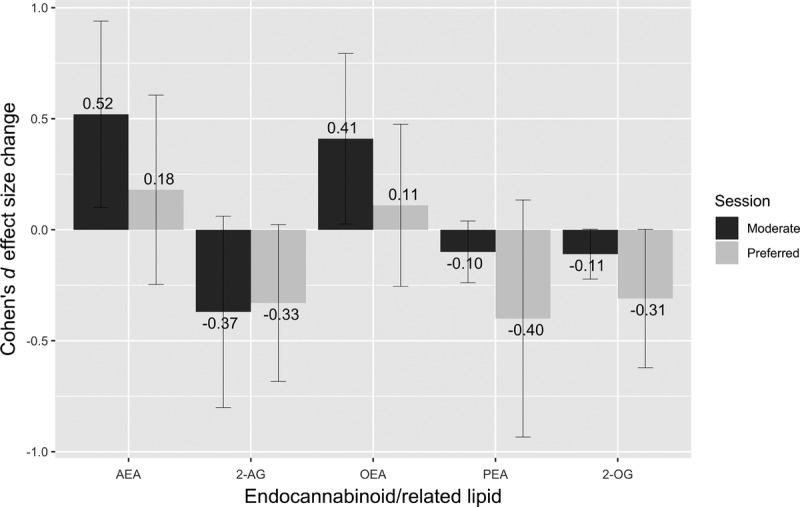
Significant elevations in AEA (P = 0.013) and oleoylethanolamine (P = 0.024) occurred for MOD (moderate effect sizes: Cohen's d = 0.58 and 0.41, respectively). Significant (P < 0.05) moderate negative associations existed between changes in AEA and mood states for MOD at 10 min (depression, confusion, fatigue, total mood disturbance [TMD] and state anxiety) and 30 min postexercise (confusion, TMD and state anxiety). Significant (P < 0.05) moderate negative associations existed between 2-arachidonoylglycerol and mood states at 10 min (depression and confusion) and 30 min postexercise (confusion and TMD). Changes in eCB or related lipids or eCB-mood relationships were not found for PREF.
Given the broad, moderate-strength relationships between improvements in mood states and eCB increases after MOD, it is plausible that the eCB system contributes to the mood-enhancing effects of prescribed acute exercise in MDD. Alternative mechanisms are likely involved in the positive mood state effects of preferred exercise.
内源性大麻素 (eCB) 系统与抑郁症的病理生理学有关,并对健康成年人的急性运动有反应。
我们旨在描述患有重度抑郁症 (MDD) 的女性在规定的中度 (MOD) 和自我选择/首选 (PREF) 强度运动期间血清 eCB 的急性变化,并确定 eCB 变化与情绪状态之间的关系。
MDD 女性 (n = 17) 在一项 20 分钟的自行车测力计运动中,在自身设计的 MOD 或 PREF 下分别进行运动。在运动前和运动后 10 分钟内采血。使用稳定同位素稀释、液相色谱/质谱/质谱法定量测定血清中 eCB(花生四烯酸乙醇酰胺 [AEA]、2-花生四烯酰甘油)和相关脂质(棕榈酰乙醇胺、油酰乙醇胺、2-油酰甘油)的浓度。在运动前、运动后 10 分钟和 30 分钟完成心境状态量表和状态特质焦虑量表(仅状态)。
MOD 时 AEA (P = 0.013) 和油酰乙醇胺显著升高 (P = 0.024)(中度效应大小:Cohen's d 分别为 0.58 和 0.41)。MOD 时,AEA 变化与心境状态之间存在显著的中度负相关 (P < 0.05),包括运动后 10 分钟 (抑郁、困惑、疲劳、总心境障碍 [TMD] 和状态焦虑) 和 30 分钟 (困惑、TMD 和状态焦虑)。运动后 10 分钟 (抑郁和困惑) 和 30 分钟 (困惑和 TMD),2-花生四烯酰甘油与心境状态之间存在显著的中度负相关 (P < 0.05)。未发现 PREF 时 eCB 或相关脂质或 eCB-心境关系的变化。
鉴于 MOD 后情绪状态改善与 eCB 增加之间存在广泛的中度强度关系,内源性大麻素系统可能有助于规定的急性运动对 MDD 情绪的增强作用。在首选运动的积极情绪状态影响中,可能涉及替代机制。