Departamento de Ciencias de la Vida, Facultad de Ciencias, Universidad de Alcalá, E-28805, Alcalá de Henares, Spain.
Research Network in Biodiversity and Evolutionary Biology, Research Centre in Biodiversity and Genetic Resources (InBIO-CIBIO), Universidade do Porto, PT4485-661, Vairão, Portugal.
Biol Rev Camb Philos Soc. 2019 Aug;94(4):1477-1501. doi: 10.1111/brv.12511. Epub 2019 Apr 11.
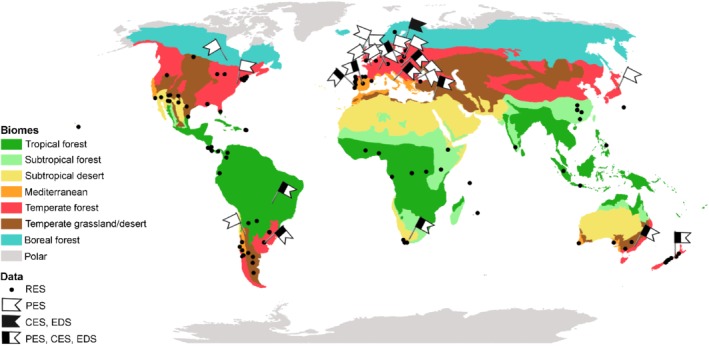
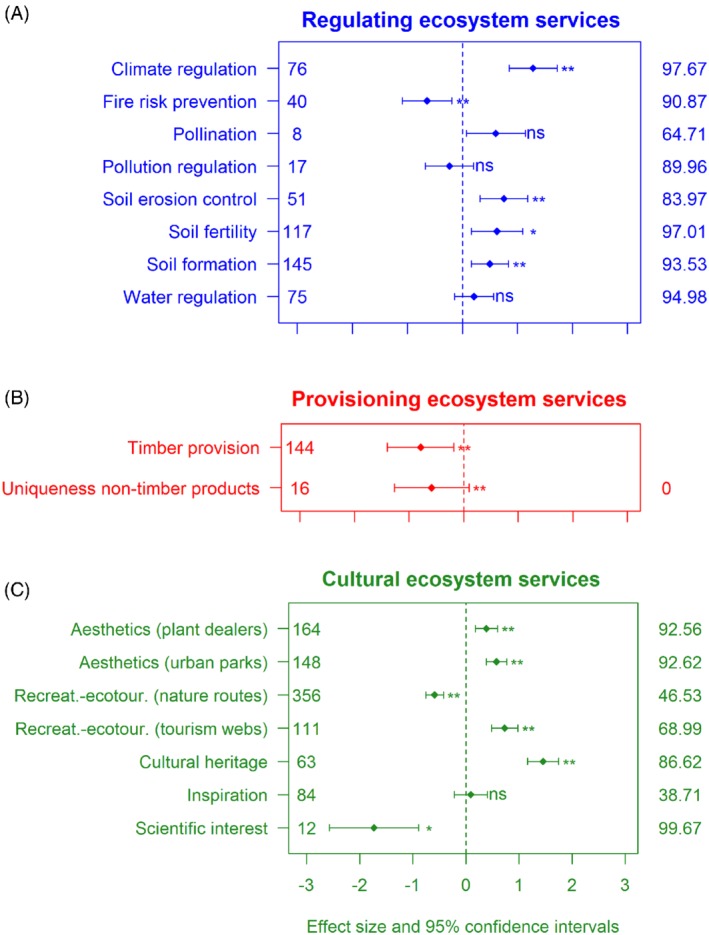
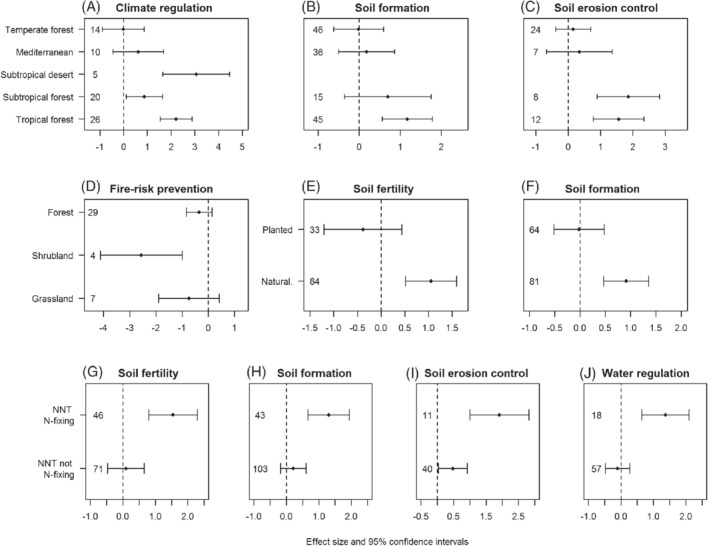
Non-native tree (NNT) species have been transported worldwide to create or enhance services that are fundamental for human well-being, such as timber provision, erosion control or ornamental value; yet NNTs can also produce undesired effects, such as fire proneness or pollen allergenicity. Despite the variety of effects that NNTs have on multiple ecosystem services, a global quantitative assessment of their costs and benefits is still lacking. Such information is critical for decision-making, management and sustainable exploitation of NNTs. We present here a global assessment of NNT effects on the three main categories of ecosystem services, including regulating (RES), provisioning (PES) and cultural services (CES), and on an ecosystem disservice (EDS), i.e. pollen allergenicity. By searching the scientific literature, country forestry reports, and social media, we compiled a global data set of 1683 case studies from over 125 NNT species, covering 44 countries, all continents but Antarctica, and seven biomes. Using different meta-analysis techniques, we found that, while NNTs increase most RES (e.g. climate regulation, soil erosion control, fertility and formation), they decrease PES (e.g. NNTs contribute less than native trees to global timber provision). Also, they have different effects on CES (e.g. increase aesthetic values but decrease scientific interest), and no effect on the EDS considered. NNT effects on each ecosystem (dis)service showed a strong context dependency, varying across NNT types, biomes and socio-economic conditions. For instance, some RES are increased more by NNTs able to fix atmospheric nitrogen, and when the ecosystem is located in low-latitude biomes; some CES are increased more by NNTs in less-wealthy countries or in countries with higher gross domestic products. The effects of NNTs on several ecosystem (dis)services exhibited some synergies (e.g. among soil fertility, soil formation and climate regulation or between aesthetic values and pollen allergenicity), but also trade-offs (e.g. between fire regulation and soil erosion control). Our analyses provide a quantitative understanding of the complex synergies, trade-offs and context dependencies involved for the effects of NNTs that is essential for attaining a sustained provision of ecosystem services.
非本地树种(NNT)已被广泛引入世界各地,以创造或增强对人类福祉至关重要的服务,例如木材供应、控制侵蚀或观赏价值;然而,NNT 也可能产生不良影响,例如易燃性或花粉致敏性。尽管 NNT 对多种生态系统服务产生了各种影响,但仍缺乏对其成本和效益的全球量化评估。此类信息对于 NNT 的决策、管理和可持续利用至关重要。我们在此呈现了对 NNT 对三大生态系统服务(调节服务、供应服务和文化服务)以及生态系统不利服务(花粉致敏性)的影响的全球评估。通过搜索科学文献、国家林业报告和社交媒体,我们从超过 125 种 NNT 物种的 1683 个案例研究中编制了一个全球数据集,涵盖了 44 个国家、除南极洲外的所有大陆和七个生物群落。使用不同的荟萃分析技术,我们发现,虽然 NNT 增加了大多数调节服务(例如气候调节、土壤侵蚀控制、肥力和形成),但它们减少了供应服务(例如,NNT 对全球木材供应的贡献小于本地树木)。此外,它们对文化服务有不同的影响(例如增加美学价值但减少科学兴趣),并且对所考虑的生态系统不利服务没有影响。NNT 对每种生态系统(不利)服务的影响表现出强烈的背景依赖性,因 NNT 类型、生物群落和社会经济条件而异。例如,一些调节服务在能够固定大气氮的 NNT 中增加更多,并且在低纬度生物群落中;一些文化服务在较贫穷国家或国内生产总值较高的国家中增加更多。NNT 对几种生态系统(不利)服务的影响表现出一些协同作用(例如,在土壤肥力、土壤形成和气候调节之间,或者在美学价值和花粉致敏性之间),但也存在权衡(例如,在火灾调节和土壤侵蚀控制之间)。我们的分析提供了对 NNT 影响所涉及的复杂协同作用、权衡和背景依赖性的定量理解,这对于实现生态系统服务的可持续供应至关重要。