Division of Paediatric Neurology, University Children's Hospital Basel (UKBB), University of Basel, 4056 Basel, Switzerland.
Department of Radiation Oncology, Leopoldina Hospital Schweinfurt, 97422 Schweinfurt, Germany.
Nutrients. 2019 Apr 10;11(4):811. doi: 10.3390/nu11040811.
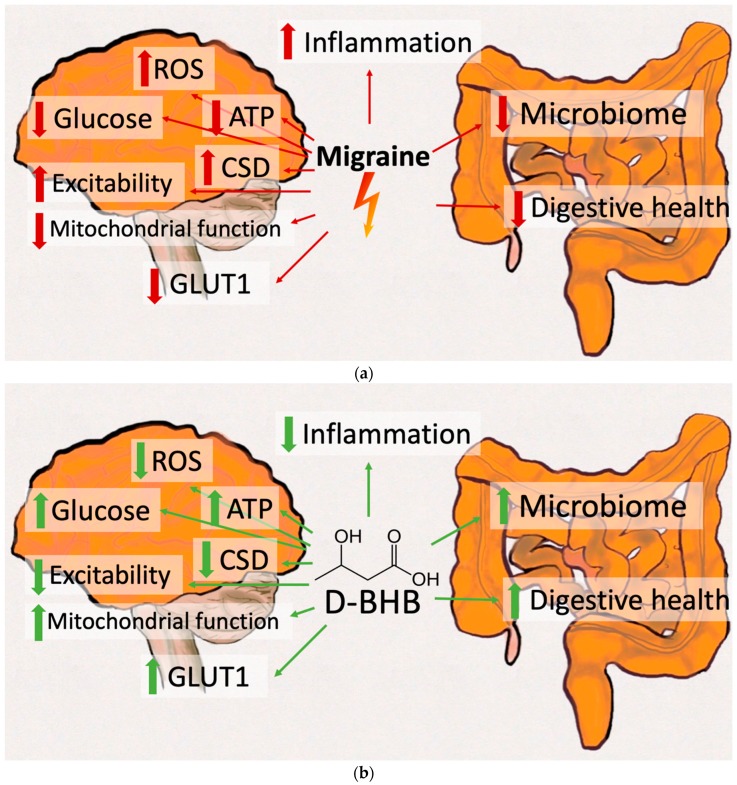
An increasing amount of evidence suggests that migraines are a response to a cerebral energy deficiency or oxidative stress levels that exceed antioxidant capacity. The ketogenic diet (KD), a diet mimicking fasting that leads to the elevation of ketone bodies (KBs), is a therapeutic intervention targeting cerebral metabolism that has recently shown great promise in the prevention of migraines. KBs are an alternative fuel source for the brain, and are thus likely able to circumvent some of the abnormalities in glucose metabolism and transport found in migraines. Recent research has shown that KBs-D-β-hydroxybutyrate in particular-are more than metabolites. As signalling molecules, they have the potential to positively influence other pathways commonly believed to be part of migraine pathophysiology, namely: mitochondrial functioning, oxidative stress, cerebral excitability, inflammation and the gut microbiome. This review will describe the mechanisms by which the presence of KBs, D-BHB in particular, could influence those migraine pathophysiological mechanisms. To this end, common abnormalities in migraines are summarised with a particular focus on clinical data, including phenotypic, biochemical, genetic and therapeutic studies. Experimental animal data will be discussed to elaborate on the potential therapeutic mechanisms of elevated KBs in migraine pathophysiology, with a particular focus on the actions of D-BHB. In complex diseases such as migraines, a therapy that can target multiple possible pathogenic pathways seems advantageous. Further research is needed to establish whether the absence/restriction of dietary carbohydrates, the presence of KBs, or both, are of primary importance for the migraine protective effects of the KD.
越来越多的证据表明,偏头痛是大脑能量缺乏或氧化应激水平超过抗氧化能力的反应。生酮饮食(KD)是一种模拟禁食的饮食,导致酮体(KBs)升高,是一种针对大脑代谢的治疗干预措施,最近在预防偏头痛方面显示出巨大的前景。KBs 是大脑的替代燃料来源,因此可能能够规避偏头痛中发现的一些葡萄糖代谢和转运异常。最近的研究表明,KBs-D-β-羟基丁酸(D-BHB)不仅仅是代谢物。作为信号分子,它们有可能积极影响其他通常被认为是偏头痛病理生理学一部分的途径,即:线粒体功能、氧化应激、大脑兴奋性、炎症和肠道微生物组。这篇综述将描述 KBs(特别是 D-BHB)的存在如何影响那些偏头痛病理生理学机制。为此,总结了偏头痛中常见的异常,特别关注临床数据,包括表型、生化、遗传和治疗研究。将讨论实验动物数据,以详细阐述升高的 KBs 在偏头痛病理生理学中的潜在治疗机制,特别关注 D-BHB 的作用。在偏头痛等复杂疾病中,能够针对多种可能的致病途径的治疗方法似乎具有优势。需要进一步的研究来确定饮食碳水化合物的缺乏/限制、KBs 的存在或两者是否对 KD 预防偏头痛的作用至关重要。