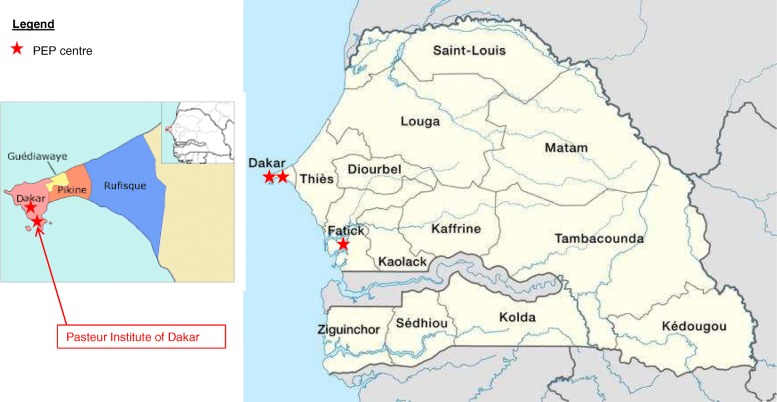
Pasteur Institute of Dakar, Centre for human rabies post exposition prophylaxis, Dakar, Senegal.
Pasteur Institute of Dakar, Epidemiology unit, Dakar, Senegal.
BMC Infect Dis. 2019 Apr 11;19(1):321. doi: 10.1186/s12879-019-3928-0.
Rabies remains a major public health problem in developing countries. Most fatal rabies cases, especially in children, result from dog bites and occur in low-income countries, such as those in Sub-Saharan Africa. Rabies can be controlled through mass dog vaccination and human deaths prevented through timely and appropriate post-exposure prophylaxis (PEP). As access to appropriate PEP remains a serious challenge for bite-victims, the aim of this study was to understand the use of PEP, to evaluate the knowledge, attitudes and practices with respect to rabies and to identify risk factors related to non-compliance with PEP to define recommendations for improving PEP in Senegal.
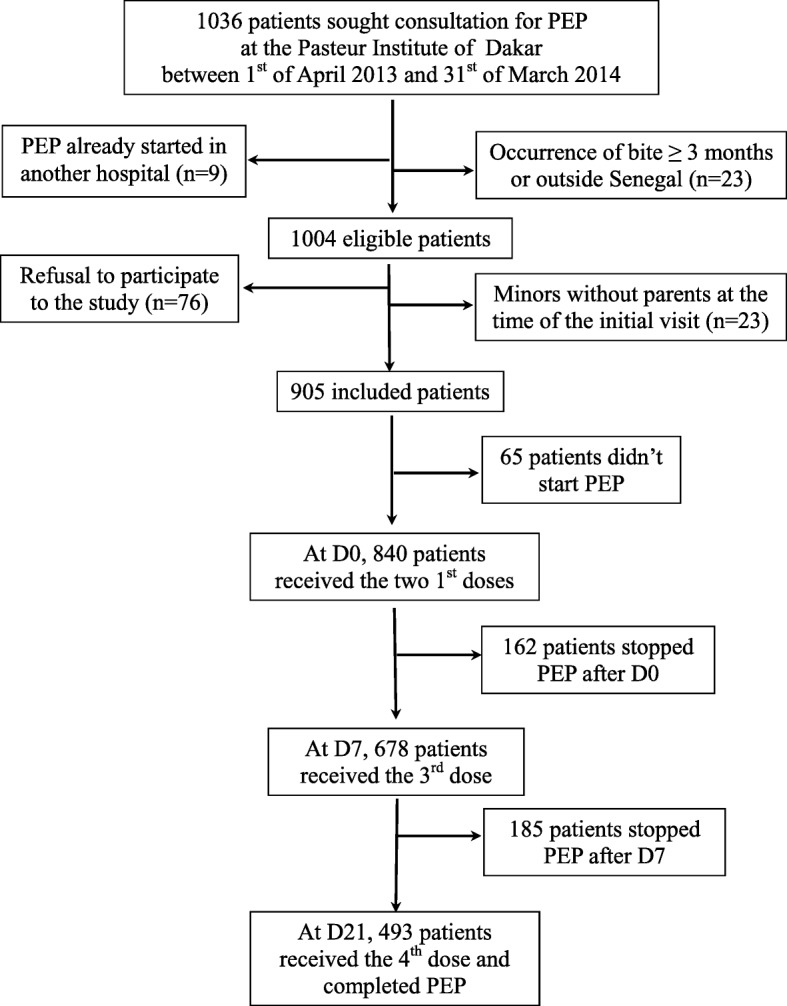
This study included patients with suspicion of rabies exposure who sought PEP at the Pasteur Institute of Dakar from April 2013 to March 2014. Patients with rabies clinical symptoms, those who had already started PEP and those with exposure outside Senegal or for more than 3 months were excluded. Data on risk factors and propensity to seek and complete PEP were collected using questionnaires and phone interviews. The association between acceptability and compliance with PEP and other independent variables were evaluated using multivariate regression analysis.
Among the 905 patients enrolled into the study, 67% were male (sex ratio M/F, 2) and 46%, children under 15 years of age. Exposures by animal bites represented 87%, whereas the remainder were due to scratches or contact; 76% were classified as WHO category III and 88% were due to dogs. Among these patients, 7% refused to start PEP and 54.5% completed the full schedule. Main factors reported by non-compliant patients were vaccine costs and affordability, and knowledge on status of biting animal.
This study shows that despite the awareness about rabies dangers and prevention, only half of the patients completed the full PEP schedule. The following recommendations, such as free of charge prophylaxis or intradermal regimens as an alternative to intramuscular regimens, should be considered to increase the adherence to PEP at the Pasteur Institute of Dakar and in Senegal.
狂犬病仍是发展中国家的一个主要公共卫生问题。大多数致命的狂犬病病例,特别是儿童病例,是由狗咬伤引起的,发生在低收入国家,如撒哈拉以南非洲国家。通过大规模给狗接种疫苗和及时、适当的暴露后预防(PEP)可以控制狂犬病。由于接触到适当的 PEP 仍然是咬伤人的一个严重挑战,因此本研究的目的是了解 PEP 的使用情况,评估与狂犬病相关的知识、态度和实践,并确定与不遵守 PEP 相关的风险因素,以确定在塞内加尔改善 PEP 的建议。
本研究纳入了 2013 年 4 月至 2014 年 3 月期间在达喀尔巴斯德研究所寻求 PEP 的疑似狂犬病暴露患者。有狂犬病临床症状的患者、已开始 PEP 的患者以及在塞内加尔以外地区或暴露超过 3 个月的患者被排除在外。使用问卷和电话访谈收集了有关风险因素以及寻求和完成 PEP 的倾向的数据。使用多变量回归分析评估了 PEP 的可接受性和依从性与其他独立变量之间的关系。
在纳入的 905 名患者中,67%为男性(性别比 M/F,2),46%为 15 岁以下儿童。动物咬伤暴露占 87%,其余为抓伤或接触;76%为世界卫生组织(WHO)类别 III,88%为狗咬伤。这些患者中,7%拒绝开始 PEP,54.5%完成了全程 PEP。不依从患者报告的主要因素是疫苗费用和负担能力,以及对咬伤动物状况的了解。
本研究表明,尽管对狂犬病的危害和预防有一定认识,但只有一半的患者完成了全程 PEP 方案。应考虑免费预防或皮内方案作为肌内方案的替代方案,以提高达喀尔巴斯德研究所和塞内加尔的 PEP 依从性。