Luo Chaobing, Li Yuanqiu, Chen Ying, Fu Chun, Long Wencong, Xiao Ximeng, Liao Hong, Yang Yaojun
1Bamboo Diseases and Pests Control and Resources Development Key Laboratory of Sichuan Province, Leshan Normal University, No. 778, Riverside Road, Central District, Leshan, 614000 Sichuan China.
2College of Food and Biological Engineering, Xihua University, Chengdu, 610039 Sichuan China.
Biotechnol Biofuels. 2019 Apr 1;12:70. doi: 10.1186/s13068-019-1411-1. eCollection 2019.
Gut symbiotic microbiota plays a critical role in nutrient supply, digestion, and absorption. The bamboo snout beetle, , a common pest of several bamboo species, exhibits high lignocellulolytic enzyme activity and contains various CAZyme genes. However, to date, no studies have evaluated the role of gut symbiotic microbiota of the snout beetle on bamboo lignocellulose degradation. Therefore, the present study investigated the role of gut symbiotic microbiota of . on bamboo lignocellulose degradation.
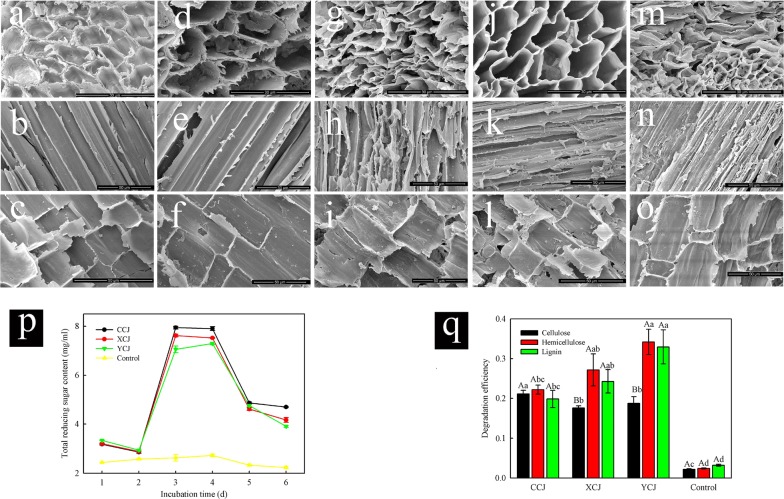
Gut symbiotic microbiota of female (CCJ), male (XCJ), and larvae (YCJ) beetles was used to treat bamboo shoot particles (BSPs) in vitro for 6 days. Scanning electron microscopy (SEM) revealed significant destruction of the lignocellulose structure after treatment, which was consistent with the degradation efficiencies of CCJ, XCJ, and YCJ for cellulose (21.11%, 17.58% and 18.74%, respectively); hemicellulose (22.22%, 27.18% and 34.20%, respectively); and lignin (19.83%, 24.30% and 32.97%, respectively). Gut symbiotic microbiota of adult and larvae beetles was then identified using 16sRNA sequencing, which revealed that four microbes: , , and , comprise approximately 84% to 94% of the microbiota. Moreover, the genomes of 45 , 72 , 86 and 4 microbes were used to analyse resident CAZyme genes. These results indicated that gut symbiotic microbiota of adult and larvae . is involved in the lignocellulose degradation traits shown by the host.
This study shows that the gut symbiotic microbiota of . participates in bamboo lignocellulose degradation, providing innovative findings for bamboo lignocellulose bioconversion. Furthermore, the results of this study will allow us to further isolate lignocellulose-degrading microbiota for use in bamboo lignocellulose bioconversion.
肠道共生微生物群在营养供应、消化和吸收中起着关键作用。竹象甲是几种竹子的常见害虫,具有较高的木质纤维素分解酶活性,并含有多种碳水化合物活性酶(CAZyme)基因。然而,迄今为止,尚无研究评估竹象甲肠道共生微生物群对竹子木质纤维素降解的作用。因此,本研究调查了竹象甲肠道共生微生物群对竹子木质纤维素降解的作用。
使用雌性(CCJ)、雄性(XCJ)和幼虫(YCJ)竹象甲的肠道共生微生物群在体外处理竹笋颗粒(BSPs)6天。扫描电子显微镜(SEM)显示处理后木质纤维素结构受到显著破坏,这与CCJ、XCJ和YCJ对纤维素的降解效率(分别为21.11%、17.58%和18.7%)、半纤维素的降解效率(分别为22.22%、27.18%和34.20%)以及木质素的降解效率(分别为19.83%、24.30%和32.97%)一致。然后使用16sRNA测序鉴定成虫和幼虫竹象甲的肠道共生微生物群,结果显示四种微生物:[具体微生物名称1]、[具体微生物名称2]、[具体微生物名称3]和[具体微生物名称4],约占微生物群的84%至94%。此外,利用45种[具体微生物名称1]、72种[具体微生物名称2]、86种[具体微生物名称3]和4种[具体微生物名称4]微生物的基因组分析其所含的CAZyme基因。这些结果表明成虫和幼虫竹象甲的肠道共生微生物群参与了宿主所表现出的木质纤维素降解特性。
本研究表明竹象甲的肠道共生微生物群参与竹子木质纤维素的降解,为竹子木质纤维素生物转化提供了创新性发现。此外,本研究结果将使我们能够进一步分离用于竹子木质纤维素生物转化的木质纤维素降解微生物群。