Li Ning, Zheng Hongliang, Cui Jingnan, Wang Jingguo, Liu Hualong, Sun Jian, Liu Tongtong, Zhao Hongwei, Lai Yongcai, Zou Detang
Key Laboratory of Germplasm Enhancement, Physiology and Ecology of Food Crops in Cold Region, Ministry of Education, Northeast Agricultural University, Harbin, 150030, China.
Heilongjiang Academy of Agricultural Sciences Postdoctoral Programme, Harbin, 150030, China.
Rice (N Y). 2019 Apr 11;12(1):24. doi: 10.1186/s12284-019-0285-y.
Salinity-alkalinity stress is one of the major factors limiting rice production. The damage caused by alkaline salt stress to rice growth is more severe than that caused by neutral salt stress. At present, the genetic resources (quantitative trait loci (QTLs) and genes) that can be used by rice breeders to improve alkalinity tolerance are limited. Here, we assessed the alkalinity tolerance of rice at the seedling stage and performed a genome-wide association study (GWAS) based on genotypic data including 788,396 single-nucleotide polymorphisms (SNPs) developed by re-sequencing 295 japonica rice varieties.
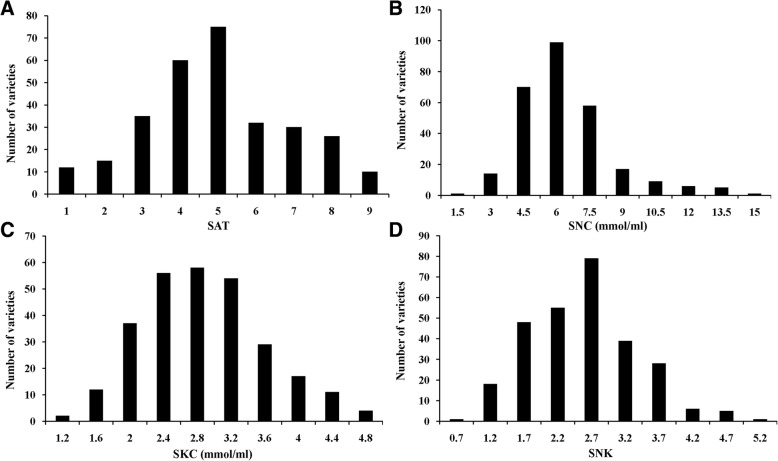
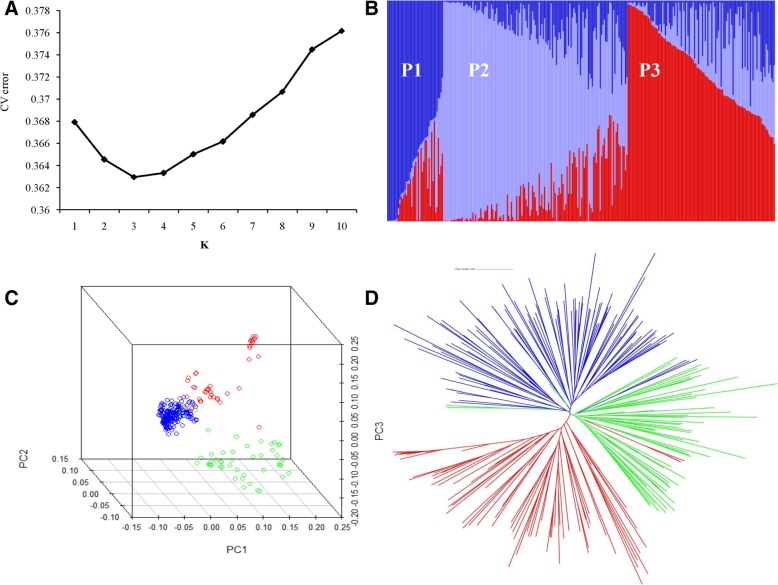
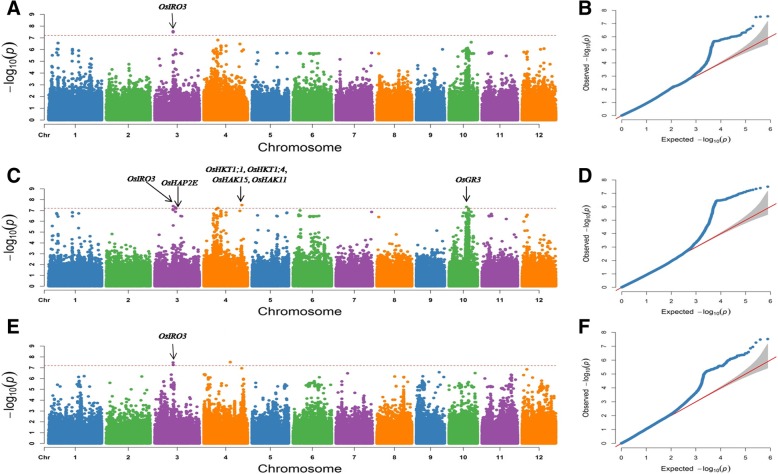
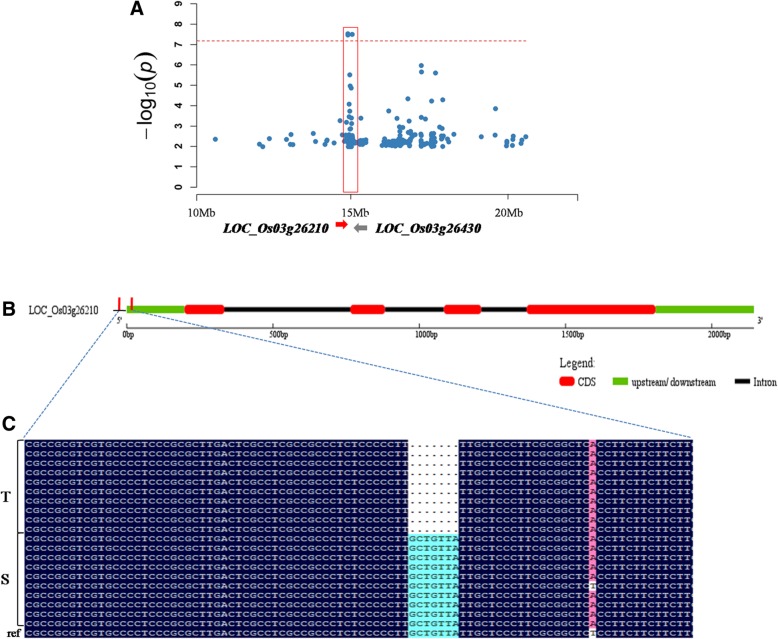
We used the score of alkalinity tolerance (SAT), the concentrations of Na and K in the shoots (SNC and SKC, respectively) and the Na/K ratio of shoots (SNK) as indices to assess alkalinity tolerance at the seedling stage in rice. Based on population structure analysis, the japonica rice panel was divided into three subgroups. Linkage disequilibrium (LD) analysis showed that LD decay occurred at 109.77 kb for the whole genome and varied between 13.79 kb and 415.77 kb across the 12 chromosomes, at which point the pairwise squared correlation coefficient (r) decreased to half of its maximum value. A total of eight QTLs significantly associated with the SAT, SNC and SNK were identified by genome-wide association mapping. A common QTL associated with the SAT, SNC and SNK on chromosome 3 at the position of 15.0 Mb, which explaining 13.36~13.64% of phenotypic variation, was selected for further analysis. The candidate genes were filtered based on LD decay, Gene Ontology (GO) enrichment, RNA sequencing data, and quantitative real-time PCR (qRT-PCR) analysis. Moreover, sequence analysis revealed one 7-bp insertion/deletion (indel) difference in LOC_Os03g26210 (OsIRO3) between the alkalinity-tolerant and alkalinity-sensitive rice varieties. OsIRO3 encodes a bHLH-type transcription factor and has been shown to be a negative regulator of the Fe-deficiency response in rice.
Based on these results, OsIRO3 maybe a novel functional gene associated with alkalinity tolerance in japonica rice. This study provides resources for improving alkalinity tolerance in rice, and the functional molecular marker could be verified to breed new rice varieties with alkalinity tolerance via marker-assisted selection (MAS).
盐碱胁迫是限制水稻生产的主要因素之一。碱性盐胁迫对水稻生长造成的损害比中性盐胁迫更为严重。目前,可供水稻育种者用于提高耐碱性的遗传资源(数量性状位点(QTL)和基因)有限。在此,我们评估了水稻幼苗期的耐碱性,并基于对295个粳稻品种重测序开发的包括788,396个单核苷酸多态性(SNP)的基因型数据进行了全基因组关联研究(GWAS)。
我们使用耐碱性评分(SAT)、地上部Na和K的浓度(分别为SNC和SKC)以及地上部Na/K比(SNK)作为指标来评估水稻幼苗期的耐碱性。基于群体结构分析,粳稻群体被分为三个亚组。连锁不平衡(LD)分析表明,全基因组的LD衰减发生在109.77 kb处,并且在12条染色体上的衰减范围在13.79 kb至415.77 kb之间,此时成对平方相关系数(r)降至其最大值的一半。通过全基因组关联图谱共鉴定出8个与SAT、SNC和SNK显著相关的QTL。选择位于第3染色体上15.0 Mb位置的一个与SAT、SNC和SNK相关的常见QTL进行进一步分析,该QTL解释了13.36%至13.64%的表型变异。基于LD衰减、基因本体论(GO)富集、RNA测序数据和定量实时PCR(qRT-PCR)分析对候选基因进行了筛选。此外,序列分析揭示了耐碱性和碱敏感水稻品种之间LOC_Os03g26210(OsIRO3)存在一个7 bp的插入/缺失(indel)差异。OsIRO3编码一个bHLH型转录因子,并且已被证明是水稻缺铁响应的负调控因子。
基于这些结果,OsIRO3可能是一个与粳稻耐碱性相关的新功能基因。本研究为提高水稻耐碱性提供了资源,并且可以验证功能分子标记以通过标记辅助选择(MAS)培育耐碱性水稻新品种。