Department of Biomolecular Chemistry, University of Wisconsin School of Medicine and Public Health , Madison, WI 53706 , USA.
Open Biol. 2018 Dec;8(12):180183. doi: 10.1098/rsob.180183.
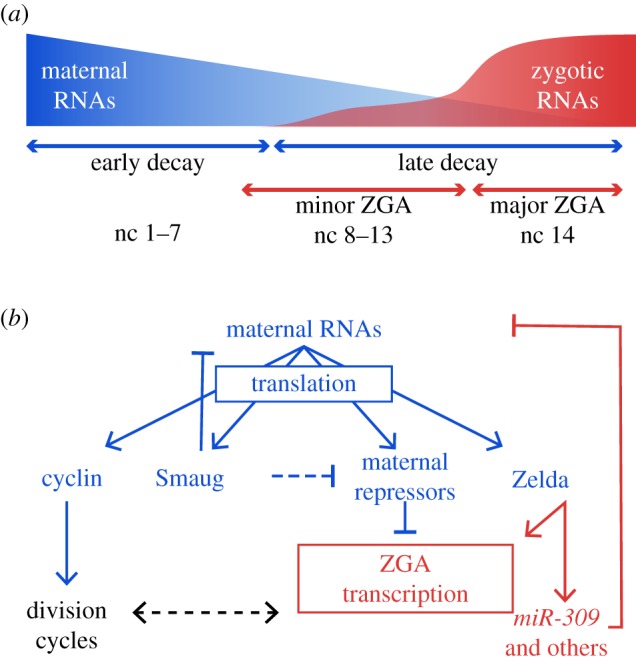
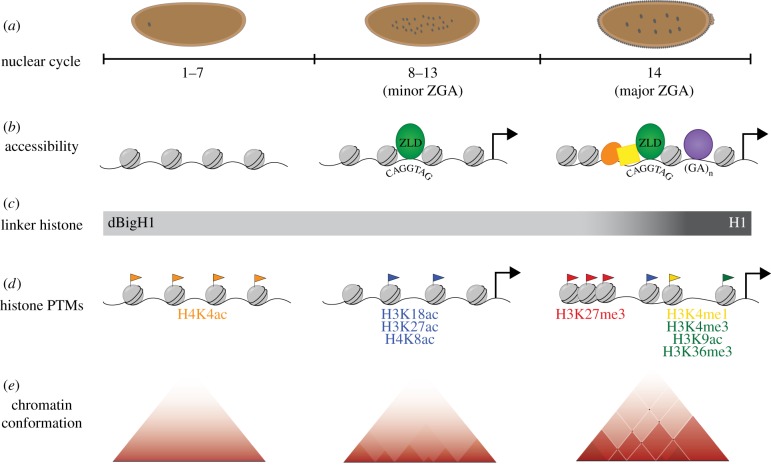
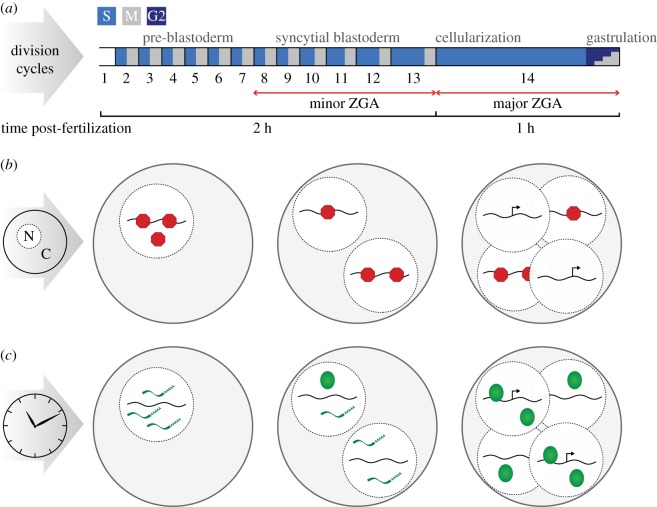
The onset of metazoan development requires that two terminally differentiated germ cells, a sperm and an oocyte, become reprogrammed to the totipotent embryo, which can subsequently give rise to all the cell types of the adult organism. In nearly all animals, maternal gene products regulate the initial events of embryogenesis while the zygotic genome remains transcriptionally silent. Developmental control is then passed from mother to zygote through a process known as the maternal-to-zygotic transition (MZT). The MZT comprises an intimately connected set of molecular events that mediate degradation of maternally deposited mRNAs and transcriptional activation of the zygotic genome. This essential developmental transition is conserved among metazoans but is perhaps best understood in the fruit fly, Drosophila melanogaster. In this article, we will review our understanding of the events that drive the MZT in Drosophila embryos and highlight parallel mechanisms driving this transition in other animals.
后生动物发育的起始要求两个终末分化的生殖细胞,即精子和卵子,重新编程为全能胚胎,随后全能胚胎可产生成体生物的所有细胞类型。在几乎所有动物中,母体基因产物调节胚胎发生的初始事件,而合子基因组保持转录沉默。通过称为母源到合子过渡(MZT)的过程,发育控制从母体传递到合子。MZT 由一组密切相关的分子事件组成,这些事件介导母体沉积的 mRNA 的降解和合子基因组的转录激活。这种重要的发育转变在后生动物中是保守的,但在果蝇,黑腹果蝇中可能理解得最好。在本文中,我们将回顾我们对驱动果蝇胚胎 MZT 的事件的理解,并强调驱动其他动物过渡的平行机制。