Wang Shao-Jie, Zhang Zheng-Zheng, Jiang Dong, Qi Yan-Song, Wang Hai-Jun, Zhang Ji-Ying, Ding Jian-Xun, Yu Jia-Kuo
Institute of Sports Medicine, Beijing Key Laboratory of Sports Injuries, Peking University Third Hospital, Beijing 100191, China.
Key Laboratory of Polymer Ecomaterials, Changchun Institute of Applied Chemistry, Chinese Academy of Sciences, Changchun 130022, China.
Polymers (Basel). 2016 May 19;8(5):200. doi: 10.3390/polym8050200.
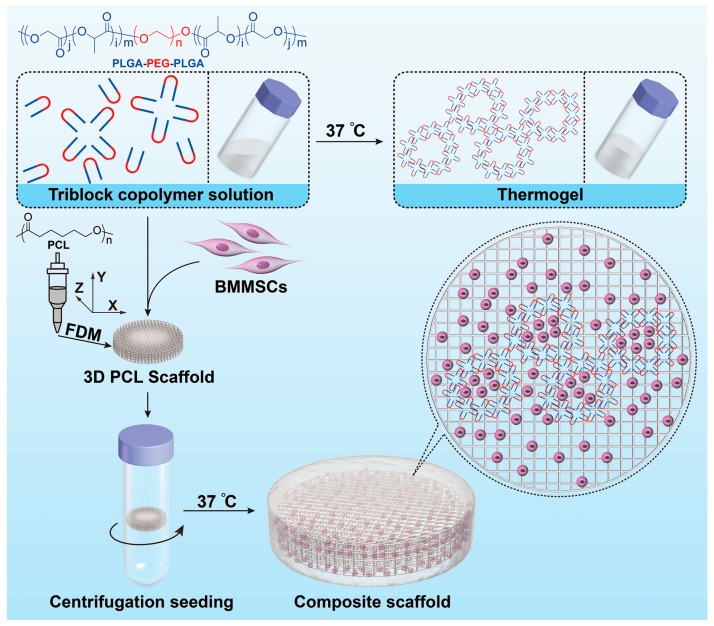
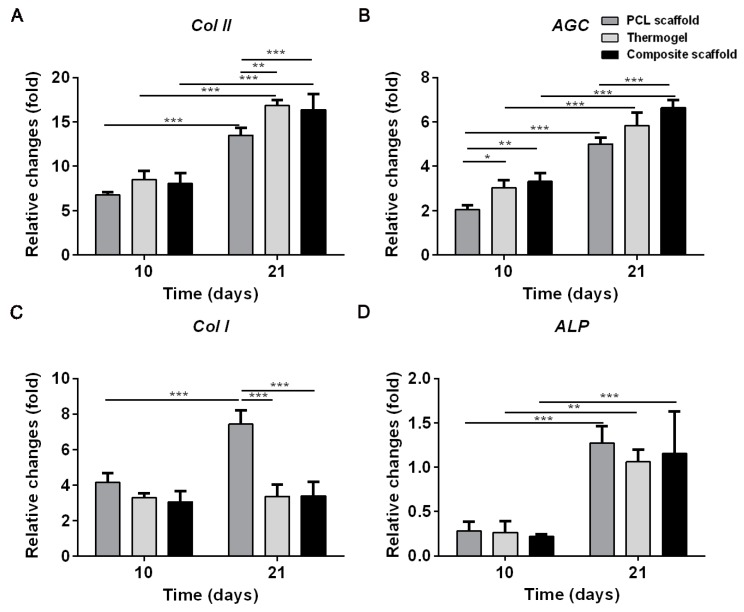
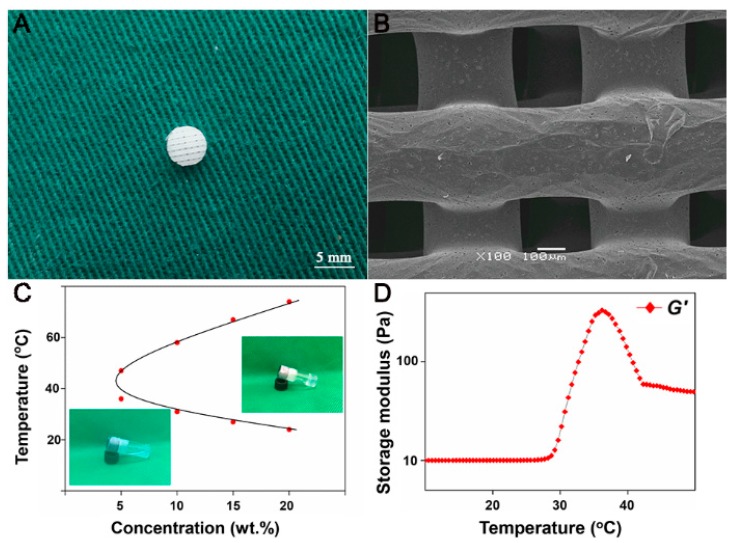
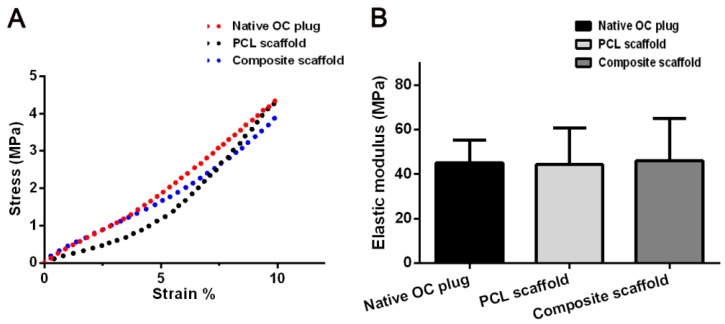
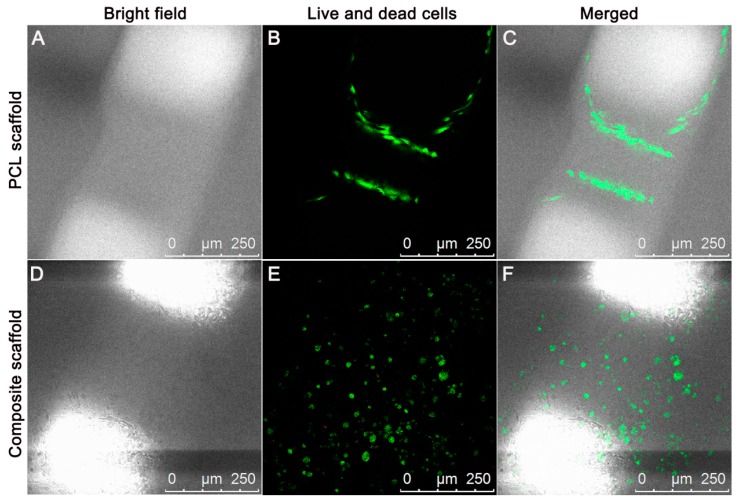
A three-dimensional (3D) composite scaffold was prepared for enhanced cartilage tissue engineering, which was composed of a poly(ε-caprolactone) (PCL) backbone network and a poly(lactide--glycolide)--poly(ethylene glycol)--poly(lactide--glycolide) (PLGA⁻PEG⁻PLGA) thermogel surface. The composite scaffold not only possessed adequate mechanical strength similar to native osteochondral tissue as a benefit of the PCL backbone, but also maintained cell-friendly microenvironment of the hydrogel. The PCL network with homogeneously-controlled pore size and total pore interconnectivity was fabricated by fused deposition modeling (FDM), and was impregnated into the PLGA⁻PEG⁻PLGA solution at low temperature (e.g., 4 °C). The PCL/Gel composite scaffold was obtained after gelation induced by incubation at body temperature (, 37 °C). The composite scaffold showed a greater number of cell retention and proliferation in comparison to the PCL platform. In addition, the composite scaffold promoted the encapsulated mesenchymal stromal cells (MSCs) to differentiate chondrogenically with a greater amount of cartilage-specific matrix production compared to the PCL scaffold or thermogel. Therefore, the 3D PCL/Gel composite scaffold may exhibit great potential for cartilage regeneration.
为增强软骨组织工程构建了一种三维(3D)复合支架,其由聚(ε-己内酯)(PCL)骨架网络和聚(丙交酯-乙交酯)-聚(乙二醇)-聚(丙交酯-乙交酯)(PLGA-PEG-PLGA)热凝胶表面组成。该复合支架不仅由于PCL骨架而具有与天然骨软骨组织相似的足够机械强度,而且还保持了水凝胶对细胞友好的微环境。通过熔融沉积建模(FDM)制备了孔径均匀可控且具有总孔隙互连性的PCL网络,并在低温(例如4℃)下将其浸渍到PLGA-PEG-PLGA溶液中。在体温(37℃)孵育诱导凝胶化后获得PCL/凝胶复合支架。与PCL平台相比,该复合支架显示出更多的细胞保留和增殖。此外,与PCL支架或热凝胶相比,该复合支架促进封装的间充质基质细胞(MSCs)向软骨细胞分化,并产生更多的软骨特异性基质。因此,3D PCL/凝胶复合支架在软骨再生方面可能具有巨大潜力。