
用于模拟初级体感皮层中神经脉冲发放的神经网络
Neural Networks for Modeling Neural Spiking in S1 Cortex.
作者信息
Lucas Alice, Tomlinson Tucker, Rohani Neda, Chowdhury Raeed, Solla Sara A, Katsaggelos Aggelos K, Miller Lee E
机构信息
Department of Electrical Engineering and Computer Science, Northwestern University, Evanston, IL, United States.
Department of Physiology, Northwestern University, Chicago, IL, United States.
出版信息
Front Syst Neurosci. 2019 Mar 29;13:13. doi: 10.3389/fnsys.2019.00013. eCollection 2019.
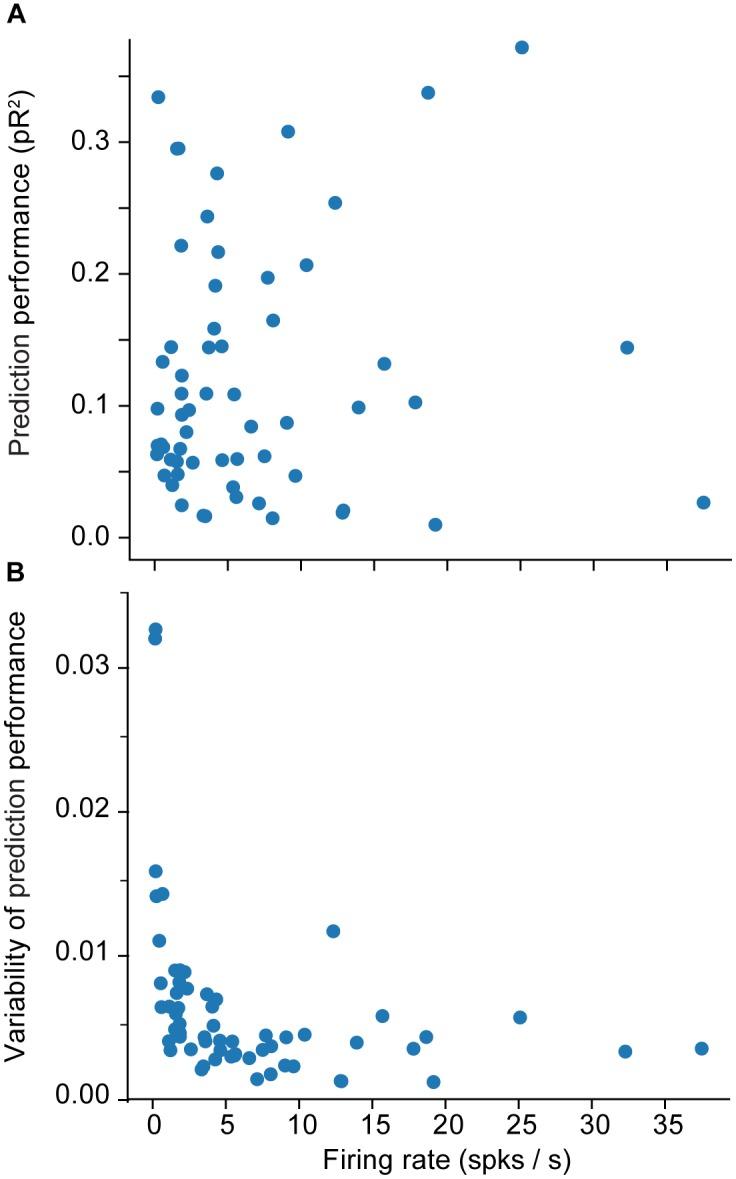
Somatosensation is composed of two distinct modalities: touch, arising from sensors in the skin, and proprioception, resulting primarily from sensors in the muscles, combined with these same cutaneous sensors. In contrast to the wealth of information about touch, we know quite less about the nature of the signals giving rise to proprioception at the cortical level. Likewise, while there is considerable interest in developing encoding models of touch-related neurons for application to brain machine interfaces, much less emphasis has been placed on an analogous proprioceptive interface. Here we investigate the use of Artificial Neural Networks (ANNs) to model the relationship between the firing rates of single neurons in area 2, a largely proprioceptive region of somatosensory cortex (S1) and several types of kinematic variables related to arm movement. To gain a better understanding of how these kinematic variables interact to create the proprioceptive responses recorded in our datasets, we train ANNs under different conditions, each involving a different set of input and output variables. We explore the kinematic variables that provide the best network performance, and find that the addition of information about joint angles and/or muscle lengths significantly improves the prediction of neural firing rates. Our results thus provide new insight regarding the complex representations of the limb motion in S1: that the firing rates of neurons in area 2 may be more closely related to the activity of peripheral sensors than it is to extrinsic hand position. In addition, we conduct numerical experiments to determine the sensitivity of ANN models to various choices of training design and hyper-parameters. Our results provide a baseline and new tools for future research that utilizes machine learning to better describe and understand the activity of neurons in S1.
躯体感觉由两种不同的模态组成
触觉,源于皮肤中的感受器;本体感觉,主要源于肌肉中的感受器,并与相同的皮肤感受器相结合。与关于触觉的丰富信息相比,我们对在皮层水平上产生本体感觉的信号的性质了解得要少得多。同样,虽然人们对开发与触觉相关的神经元编码模型以应用于脑机接口有相当大的兴趣,但对类似的本体感觉接口的关注却少得多。在这里,我们研究使用人工神经网络(ANN)来模拟体感皮层(S1)中一个主要为本体感觉区域的2区单个神经元的放电率与几种与手臂运动相关的运动学变量之间的关系。为了更好地理解这些运动学变量如何相互作用以产生我们数据集中记录的本体感觉反应,我们在不同条件下训练人工神经网络,每个条件都涉及不同的一组输入和输出变量。我们探索能提供最佳网络性能的运动学变量,发现添加有关关节角度和/或肌肉长度的信息能显著提高对神经放电率的预测。因此,我们的结果为S1中肢体运动的复杂表征提供了新的见解:2区神经元的放电率可能与外周感受器的活动比与外在手部位置的关系更密切。此外,我们进行数值实验以确定人工神经网络模型对训练设计和超参数的各种选择的敏感性。我们的结果为未来利用机器学习更好地描述和理解S1中神经元活动的研究提供了一个基线和新工具。




 Zotero 插件