Bey Marie Elena, Marzilger Robert, Hinkson Larry, Arampatzis Adamantios, Legerlotz Kirsten
Department of Training and Movement Sciences, Humboldt-Universität zu Berlin, Berlin, Germany.
Berlin School of Movement Science, Berlin, Germany.
Front Physiol. 2019 Mar 29;10:334. doi: 10.3389/fphys.2019.00334. eCollection 2019.
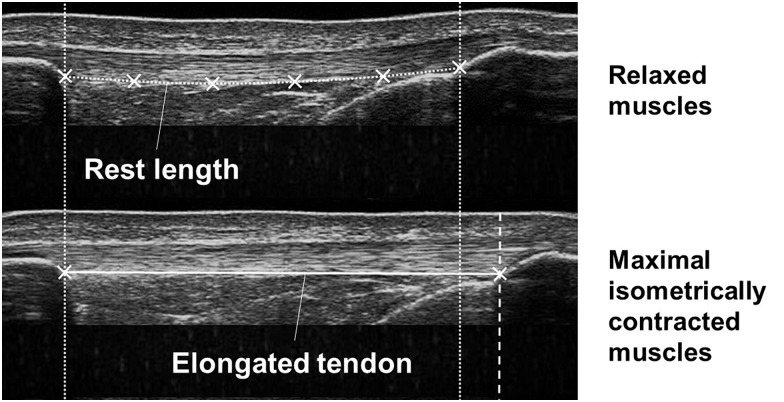
It is believed that hormonal changes during pregnancy lead to an increased compliance in ligaments and tendons, increasing the risk to suffer from connective tissue injuries particularly during exercise. While the laxity of the pelvic ligaments may increase to facilitate childbirth, to our knowledge no study has ever investigated the mechanical properties of human tendons in different stages of pregnancy. Thus, the purpose of our longitudinal study was to investigate the mechanical properties of the patellar tendon in different stages of pregnancy and postpartum. Nineteen pregnant women (30 ± 4 years) and 11 non-pregnant controls (28 ± 3 years) performed maximum isometric knee extension contractions on a dynamometer. Muscle strength and mechanical properties of the patellar tendon were determined integrating ultrasound, kinematic, and electromyographic measurements. In pregnant women, measurements were performed in the 16 ± 4th week of pregnancy (EP), the 29 ± 4th week of pregnancy (LP) and 32 ± 9th weeks postpartum (PP). On average, muscle strength as well as patellar tendon stiffness, force, and relative strain did not change during pregnancy and did not differ from non-pregnant controls. Tendon length measured at 90° knee flexion continuously increased during and after pregnancy (tendon length PP>EP; PP>controls). Our results indicate that patellar tendon stiffness is not universally affected by pregnancy. We found no evidence to support the often stated assumption that tendons would become more compliant during pregnancy. However, variability between individuals as well as the progressive increase in tendon rest length during and after pregnancy and its implications on injury risk need to be further examined.
人们认为,怀孕期间的激素变化会导致韧带和肌腱的顺应性增加,从而增加尤其是在运动期间发生结缔组织损伤的风险。虽然骨盆韧带的松弛可能会增加以利于分娩,但据我们所知,尚无研究调查过人类肌腱在怀孕不同阶段的力学性能。因此,我们纵向研究的目的是调查髌腱在怀孕不同阶段和产后的力学性能。19名孕妇(30±4岁)和11名非孕妇对照组(28±3岁)在测力计上进行最大等长膝关节伸展收缩。结合超声、运动学和肌电图测量来确定髌腱的肌肉力量和力学性能。对于孕妇,在怀孕第16±4周(EP)、怀孕第29±4周(LP)和产后第32±9周(PP)进行测量。平均而言,怀孕期间肌肉力量以及髌腱的刚度、力和相对应变没有变化,且与非孕妇对照组没有差异。在膝关节屈曲90°时测量的肌腱长度在怀孕期间和产后持续增加(肌腱长度PP>EP;PP>对照组)。我们的结果表明,髌腱刚度并非普遍受怀孕影响。我们没有发现证据支持经常提到的假设,即肌腱在怀孕期间会变得更具顺应性。然而,个体之间的变异性以及怀孕期间和产后肌腱静息长度的逐渐增加及其对损伤风险的影响需要进一步研究。