Yoo Kyoung-Ok, Kim Mi-Ja, Ly Sun Yung
Food and Nutrition Major, Woosong University, Daejeon 34606, Korea.
Department of Food and Nutrition, Daejeon Institute of Science and Technology, Daejeon 35408, Korea.
Nutr Res Pract. 2019 Apr;13(2):115-125. doi: 10.4162/nrp.2019.13.2.115. Epub 2019 Jan 9.
BACKGROUND/OBJECTIVES: Vitamin D plays an important role in skeletal growth and maintenance and in the prevention of various diseases. We investigated the relationship between vitamin D intake and bone mineral density (BMD) in Korean adults aged ≥ 50 years using the 2009 Korea National Health and Nutrition Examination Survey data.
SUBJECTS/METHODS: This study was conducted in 1,808 subjects aged ≥ 50 years with BMD data in Korea. Dietary vitamin D levels were assessed by the 24-hour recall method. BMD was measured using dual-energy X-ray absorptiometry. We investigated general characteristics and the association between these characteristics, vitamin D status, and BMD.
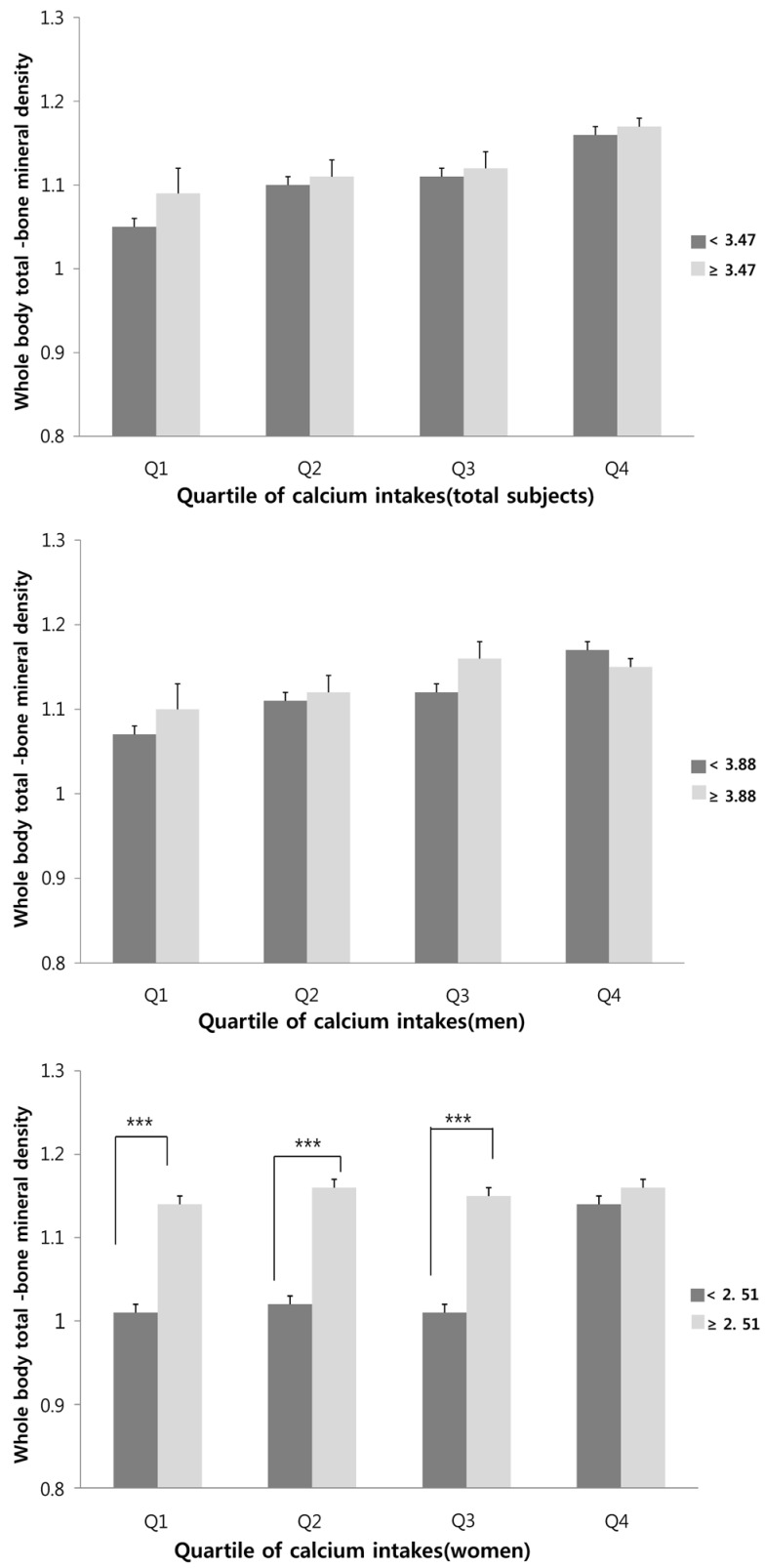
Vitamin D intake was significantly lower in the osteoporosis group among women ( < 0.05). Among all subjects, the higher the serum 25(OH)D concentration, the higher the whole-body total BMD (WBT-BMD), femoral total hip BMD, and femoral neck BMD ( < 0.01). In the serum vitamin D-deficient group of both the total population and women, serum 25(OH)D concentration was associated with WBT-BMD ( < 0.05). Among women with a calcium intake < 537.74 mg/day, BMD of those with a vitamin D intake > 2.51 µg/day (average intake of women) was higher than that of women with a vitamin D intake ≤ 2.51 µg/day ( < 0.001).
Korean adults should increase their BMD by increasing serum 25(OH)D concentration. Furthermore, increasing vitamin D intake could improve BMD, especially in Korean women who consume less calcium than the estimated average requirement.
背景/目的:维生素D在骨骼生长、维持以及预防多种疾病方面发挥着重要作用。我们利用2009年韩国国民健康与营养检查调查数据,对年龄≥50岁的韩国成年人中维生素D摄入量与骨密度(BMD)之间的关系进行了调查。
对象/方法:本研究在韩国1808名年龄≥50岁且有骨密度数据的对象中进行。通过24小时回顾法评估膳食维生素D水平。使用双能X线吸收法测量骨密度。我们调查了一般特征以及这些特征、维生素D状态和骨密度之间的关联。
骨质疏松组女性的维生素D摄入量显著较低(<0.05)。在所有对象中,血清25(OH)D浓度越高,全身总骨密度(WBT-BMD)、股骨总髋部骨密度和股骨颈骨密度越高(<0.01)。在总体人群和女性的血清维生素D缺乏组中,血清25(OH)D浓度与WBT-BMD相关(<0.05)。在钙摄入量<537.74毫克/天的女性中,维生素D摄入量>2.51微克/天(女性平均摄入量)者的骨密度高于维生素D摄入量≤2.51微克/天的女性(<0.001)。
韩国成年人应通过提高血清25(OH)D浓度来增加骨密度。此外,增加维生素D摄入量可改善骨密度,尤其是在钙摄入量低于估计平均需求量的韩国女性中。