Na Woori, Yu Tae Yang, Sohn Cheongmin
Department of Food and Nutrition, Wonkwang University, 460, Iksan-daero, Iksan-si, Jeonbuk, 54538, Republic of Korea.
Division of Endocrinology and Metabolism, Department of Medicine, Wonkwang University School of Medicine, Jeonbuk, Iksan, Republic of Korea.
Nutr Res Pract. 2019 Apr;13(2):150-158. doi: 10.4162/nrp.2019.13.2.150. Epub 2019 Mar 22.
BACKGROUND/OBJECTIVES: Inflammation is known to be a risk factor for metabolic diseases. This study aimed to develop a Food-based Index of Dietary Inflammatory Potential (FBDI) and examine its association with metabolic biomarkers.
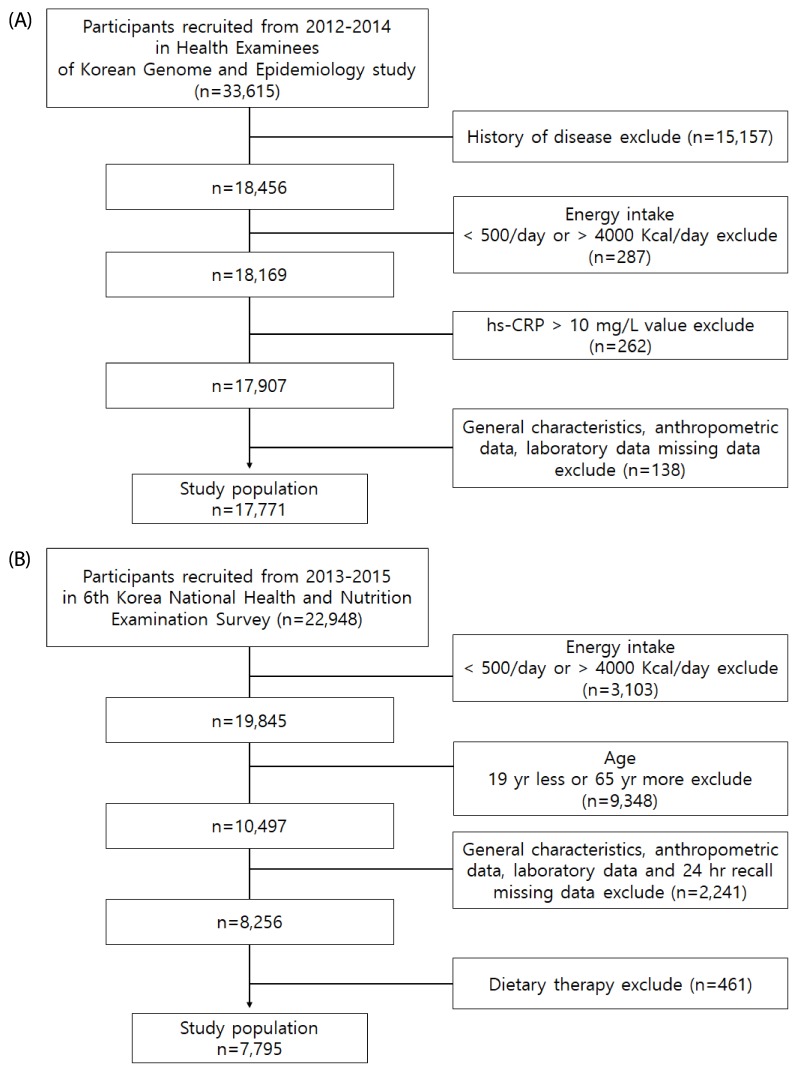
SUBJECTS/METHODS: This study analyzed the raw data from the 2012-2014 Korean Genome and Epidemiology Study data of 17,771 people. To analyze the relationship between foods consumed by Koreans and inflammation, we conducted a correlation analysis between 51 food groups and hs-CRP levels. The FBDI was developed from 17 food groups selected by multiple regression method. We examined whether FBDI was associated with metabolic markers (waist circumference, blood pressure, fasting glucose, triglyceride, and HDL-cholesterol) in the 6th Korea National Health and Nutrition Examination Survey (KNHANES). We used binary logistic regression analysis to examine the association.
The FBDI model included seven of the anti-inflammatory food groups and three of the pro-inflammatory food groups. The FBDI formula was calculated by multiplying the intake of food group by β-coefficients derived from the multiple regression model based on the correlation analysis. The FBDI was significantly associated with waist circumference ( < 0.001), blood pressure ( < 0.001), triglyceride level ( < 0.001), and HDL-cholesterol ( < 0.001) level among adults aged 20-64 years in the KNHANES. The prevalence of metabolic syndrome was 2.618 times higher in the group with the highest FBDI than in the group with the lowest one (95% confidence interval: 1.778-3.856, for trend < 0.001).
This study established an FBDI reflecting food intake patterns of Koreans, which showed a significant relationship with the prevalence of metabolic syndrome.
背景/目的:炎症是已知的代谢性疾病风险因素。本研究旨在开发基于食物的膳食炎症潜能指数(FBDI),并研究其与代谢生物标志物的关联。
受试者/方法:本研究分析了2012 - 2014年韩国基因组与流行病学研究中17771人的原始数据。为分析韩国人食用的食物与炎症之间的关系,我们对51个食物组与超敏C反应蛋白(hs-CRP)水平进行了相关性分析。FBDI由通过多元回归方法选择的17个食物组得出。我们在第六次韩国国家健康与营养检查调查(KNHANES)中研究了FBDI是否与代谢指标(腰围、血压、空腹血糖、甘油三酯和高密度脂蛋白胆固醇)相关。我们使用二元逻辑回归分析来研究这种关联。
FBDI模型包括7个抗炎食物组和3个促炎食物组。FBDI公式通过将食物组的摄入量乘以基于相关性分析的多元回归模型得出的β系数来计算。在KNHANES中,20 - 64岁成年人中,FBDI与腰围(<0.001)、血压(<0.001)、甘油三酯水平(<0.001)和高密度脂蛋白胆固醇(<0.001)水平显著相关。FBDI最高组的代谢综合征患病率比最低组高2.618倍(95%置信区间:1.778 - 3.856,趋势P<0.001)。
本研究建立了反映韩国人食物摄入模式的FBDI,其与代谢综合征患病率存在显著关系。