Bui Anthony L, Moscoso Miguel G, Bernabe-Ortiz Antonio, Checkley William, Gilman Robert H, Smeeth Liam, Miranda J Jaime
1David Geffen School of Medicine at UCLA, Los Angeles, CA USA.
2CRONICAS Centre of Excellence in Chronic Diseases, Universidad Peruana Cayetano Heredia, Av. Armendáriz 497, Miraflores, Lima 18 Peru.
BMC Obes. 2019 Apr 1;6:9. doi: 10.1186/s40608-019-0229-5. eCollection 2019.
Individuals' self-perceptions of weight often differ from objective measurements of body fat. This study aimed to 1) measure agreement between self-perceptions of weight and objective measurement of body fat by bioelectric impedance analysis (BIA) among Peruvian adults; and 2) quantify the association between body fat and a) baseline self-perceptions of weight and b) whether a participant underestimated their weight status.
Longitudinal data from the CRONICAS Cohort Study of 3181 Peruvian adults aged 35-years and older were used. BIA measurements of body fat were categorized across four nominal descriptions: low weight, normal, overweight, and obese. Kappa statistics were estimated to compare BIA measurements with baseline self-perceptions of weight. To quantify the association between body fat over time with both baseline self-perceptions of weight and underestimation of weight status, random effects models, controlling for socioeconomic and demographic covariates, were employed.
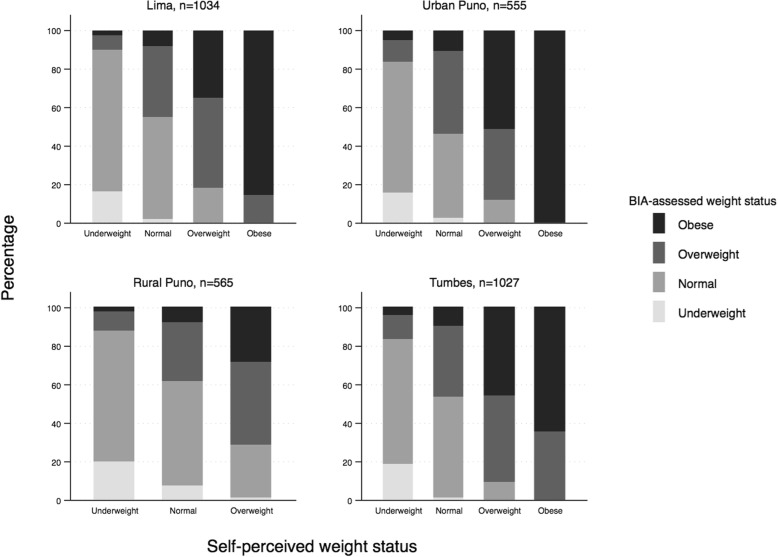
Of the 3181 participants, 1111 (34.9%) were overweight and 649 (20.4%) were obese at baseline. Agreement between self-perceived and BIA weight status was found among 43.1% of participants, while 49.9% underestimated and 6.9% overestimated their weight status. Weighted kappa statistics ranged from 0.20 to 0.31 across settings, suggesting poor agreement. Compared to perceiving oneself as normal, perceiving oneself as underweight, overweight, or obese was associated with - 4.1 ( < 0.001), + 5.2 ( < 0.001), and + 8.1 ( < 0.001) body fat percentage points, respectively. Underestimating one's weight status was associated with having 2.4 ( < 0.001) body fat percentage points more than those not underestimating only after adjusting for demographic and socioeconomic covariates.
Half of study participants were overweight or obese. There was poor agreement between self-perceptions of weight with BIA measurements of body fat, indicating that individuals often believe they weigh less than they actually do. Underestimating one's weight status was associated with having more body fat percentage points, but was only statistically significant after adjusting for demographic and socioeconomic characteristics. Further research should be conducted to investigate how self-perceptions of weight can support clinical and public health interventions to curb the obesity epidemic.
个体对体重的自我认知往往与身体脂肪的客观测量结果不同。本研究旨在:1)测量秘鲁成年人中体重自我认知与通过生物电阻抗分析(BIA)进行的身体脂肪客观测量之间的一致性;2)量化身体脂肪与a)体重的基线自我认知以及b)参与者是否低估其体重状况之间的关联。
使用了来自CRONICAS队列研究的3181名35岁及以上秘鲁成年人的纵向数据。根据四个标称描述对身体脂肪的BIA测量结果进行分类:体重过低、正常、超重和肥胖。估计kappa统计量以比较BIA测量结果与体重的基线自我认知。为了量化随时间变化的身体脂肪与体重的基线自我认知和体重状况低估之间的关联,采用了控制社会经济和人口统计学协变量的随机效应模型。
在3181名参与者中,1111人(34.9%)在基线时超重,649人(20.4%)肥胖。43.1%的参与者的自我认知与BIA体重状况之间存在一致性,而49.9%的人低估了自己的体重状况,6.9%的人高估了自己的体重状况。各情况下加权kappa统计量范围为0.20至0.31,表明一致性较差。与认为自己体重正常相比,认为自己体重过轻、超重或肥胖分别与身体脂肪百分比 -4.1(<0.001)、+5.2(<0.001)和 +8.1(<0.001)相关。仅在调整人口统计学和社会经济协变量后,低估自己的体重状况与比未低估者多2.4(<0.001)个身体脂肪百分点相关。
一半的研究参与者超重或肥胖。体重自我认知与身体脂肪的BIA测量结果之间一致性较差,表明个体通常认为自己的体重比实际体重轻。低估自己的体重状况与更多的身体脂肪百分点相关,但仅在调整人口统计学和社会经济特征后具有统计学意义。应进一步开展研究,以调查体重自我认知如何支持临床和公共卫生干预措施来遏制肥胖流行。