Department of Cardiology, 12th ward, Beijing Anzhen Hospital, Capital Medical University, Beijing Institute of Heart Lung and Blood Vessel Disease, Beijing Key Laboratory of Precision Medicine of Coronary Atherosclerotic Disease, Clinical center for coronary heart disease, Capital Medical University, Beijing, 100029, China.
Department of Cardiology, Wujin Hospital affiliated with Jiangsu University, Changzhou, 213017, Jiangsu, China.
Lipids Health Dis. 2019 Apr 13;18(1):99. doi: 10.1186/s12944-019-1043-2.
The value of atherogenic index of plasma (AIP) as a predictive biomarker for coronary artery disease (CAD) remains controversial. In addition, whether AIP is associated with the risk of acute coronary syndrome (ACS) in very young adults has not been well established.
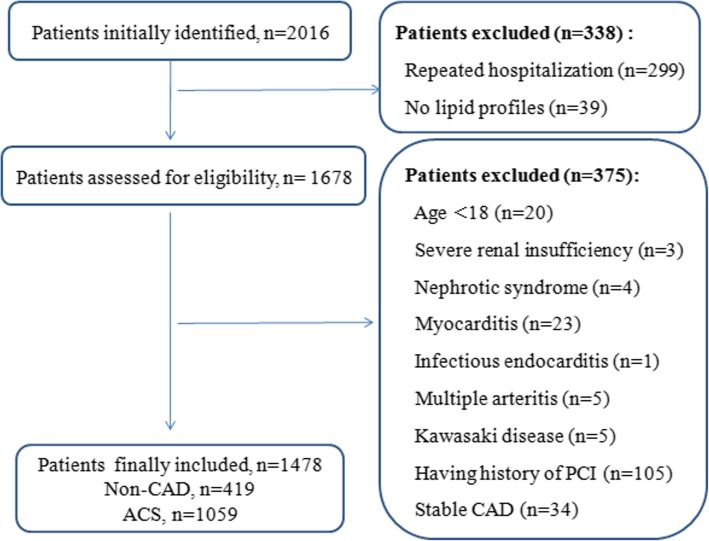
We consecutively collected very young adults (≤35 years of age) undergoing coronary angiography (CAG) at Anzhen Hospital, between January 2008 and December 2017. Total of 1, 478 very young participants, including 1, 059 ACS patients and 419 non-CAD subjects, were enrolled in the present study.
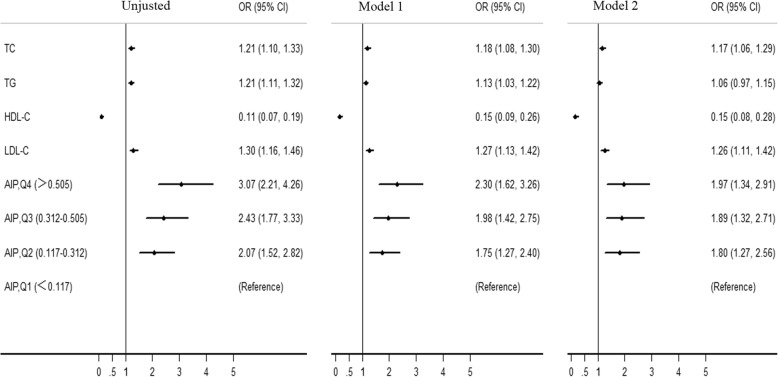
Very young patients with ACS had higher AIP level compared with non-CAD participants (0.35 ± 0.30 vs 0.21 ± 0.33, P < 0.001). According to Gensini Score (GS) and number of lesion vessel, patients were divided into four groups, respectively. With the elevated GS score and number of lesion vessels, the AIP level increased gradually (P all< 0.05). Multivariate logistic regression analyses suggested that AIP remained to be independently associated with the presence of ACS and was superior to traditional lipid profiles (for AIP, OR = 2.930, 95% CI = 1.855-4.627, P < 0.001; for total cholesterol, OR = 1.152, 95% CI = 1.048-1.266, P = 0.003; for triglyceride, OR = 1.078, 95% CI = 0.991-1.172, P = 0.079; for low-density lipoprotein cholesterol, OR = 1.046, 95% CI = 1.015-1.078, P < 0.001), after adjustment for other traditional confounders. Moreover, the prevalence of ACS, acute myocardial infarction, unstable angina pectoris and the value of GS were also elevated as AIP quartiles increased (P < 0.001). Subgroup analysis based on gender revealed that AIP was only independently associated with the ACS risk in male.
AIP was independently associated with the presence and severity of ACS in very young patients in a gender-dependent manner, which might be superior to traditional lipid profiles.
血浆致动脉粥样硬化指数(AIP)作为冠心病(CAD)的预测生物标志物的价值仍存在争议。此外,AIP 是否与非常年轻的成年人中急性冠状动脉综合征(ACS)的风险相关尚未得到充分证实。
我们连续收集了 2008 年 1 月至 2017 年 12 月期间在北京安贞医院接受冠状动脉造影(CAG)的非常年轻的成年人(≤35 岁)。本研究共纳入 1478 名非常年轻的参与者,包括 1059 例 ACS 患者和 419 例非 CAD 患者。
与非 CAD 参与者相比,ACS 的年轻患者的 AIP 水平更高(0.35±0.30 比 0.21±0.33,P<0.001)。根据 Gensini 评分(GS)和病变血管数量,患者被分为四组。随着 GS 评分和病变血管数量的升高,AIP 水平逐渐升高(P 均<0.05)。多变量 logistic 回归分析表明,AIP 与 ACS 的存在仍然密切相关,并且优于传统的血脂谱(对于 AIP,OR=2.930,95%CI=1.855-4.627,P<0.001;对于总胆固醇,OR=1.152,95%CI=1.048-1.266,P=0.003;对于甘油三酯,OR=1.078,95%CI=0.991-1.172,P=0.079;对于低密度脂蛋白胆固醇,OR=1.046,95%CI=1.015-1.078,P<0.001),调整其他传统混杂因素后。此外,随着 AIP 四分位值的增加,ACS、急性心肌梗死、不稳定型心绞痛的患病率和 GS 值也升高(P<0.001)。基于性别进行的亚组分析表明,AIP 仅与男性 ACS 风险独立相关。
AIP 与非常年轻患者 ACS 的发生和严重程度独立相关,且在性别依赖性方面优于传统的血脂谱。