Gao Zan, Zeng Nan, Pope Zachary C, Wang Ru, Yu Fang
School of Kinesiology, University of Minnesota-Twin Cities, Minneapolis, MN 55455, USA.
Department of Food Science and Human Nutrition, Colorado State University, Fort Collins, CO 80523, USA.
J Sport Health Sci. 2019 Mar;8(2):106-113. doi: 10.1016/j.jshs.2018.12.001. Epub 2018 Dec 6.
Few school settings offer opportunities for preschool children to engage in structured physical activity, and only a few studies have been conducted examining exergaming's effectiveness on health outcomes in this age group. This study's purpose, therefore, was to examine a school-based exergaming intervention's effect on preschool children's perceived competence (PC), motor skill competence (MSC), and physical activity versus usual care (recess), as well as to examine gender differences for these outcomes.
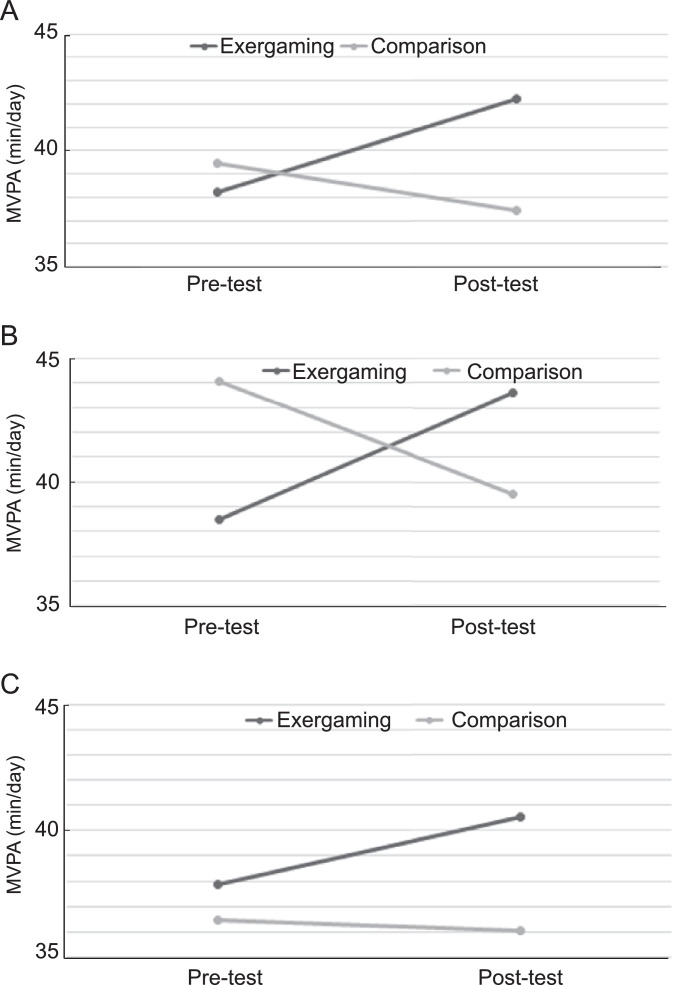
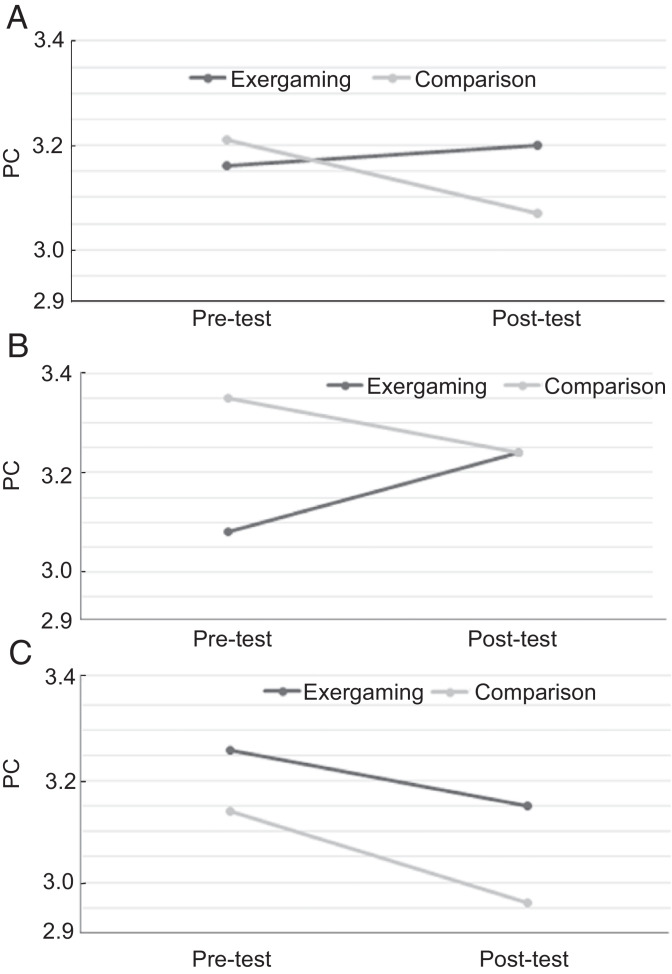
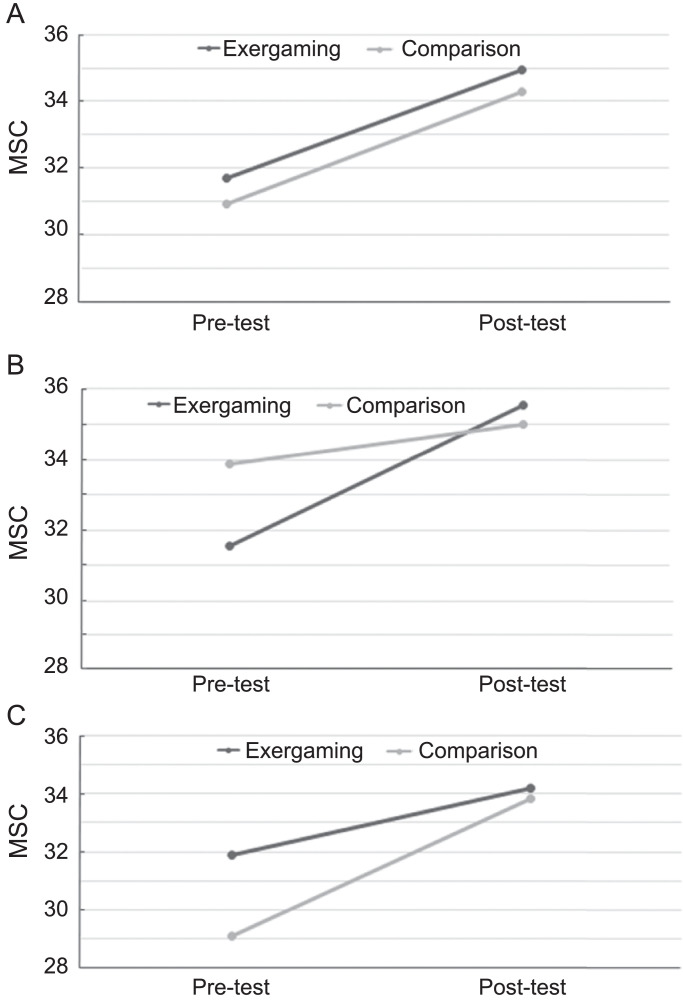
A total of 65 preschool children from 2 underserved urban schools were assigned to 1 of 2 conditions, with the school as the experimental unit: (1) usual care recess group (8 weeks of 100min of recess/week (5 days × 20 min)) and (2) exergaming intervention group (8 weeks of 100min of exergaming/week (5 days × 20 min) at school). All children underwent identical assessments of PC, MSC, and moderate-to-vigorous physical activity (MVPA) at baseline and at the end of the 8th week.
A significant Group × Time effect was observed for MVPA, (1, 52) = 4.37, = 0.04, = 0.04, but not for PC, (1, 52) = 0.83, = 0.37, = 0.02, or MSC, (1, 52) = 0.02, = 0.88, = 0.00. Specifically, the intervention children displayed significantly greater increased MVPA after 8weeks than the comparison children. Additionally, there was a significant time effect for MSC, (1, 52) = 15.61, < 0.01, = 0.23, and gender effect for MVPA, (1, 52) = 5.06, = 0.02, = 0.09. Although all preschoolers' MSC improved across time, boys demonstrated greater MVPA than girls at both time points.
Exergaming showed a positive effect in promoting preschool children's MVPA at school and has the potential to enhance PC and MSC. More research with larger sample sizes and longer study durations are warranted.
很少有学校环境为学龄前儿童提供参与结构化体育活动的机会,并且仅有少数研究探讨了电子游戏对该年龄组健康结果的有效性。因此,本研究的目的是检验一项基于学校的电子游戏干预对学龄前儿童的自我感知能力(PC)、运动技能能力(MSC)以及体育活动与常规护理(课间休息)的影响,同时检验这些结果的性别差异。
来自2所服务不足的城市学校的65名学龄前儿童被分配到2种情况中的1种,以学校作为实验单位:(1)常规护理课间休息组(8周,每周100分钟课间休息(5天×20分钟))和(2)电子游戏干预组(8周,每周在学校进行100分钟电子游戏(5天×20分钟))。所有儿童在基线和第8周结束时接受相同的PC、MSC和中度至剧烈身体活动(MVPA)评估。
观察到MVPA有显著的组×时间效应,(1, 52)= 4.37,p = 0.04,η² = 0.04,但PC没有,(1, 52)= 0.83,p = 0.37,η² = 0.02,MSC也没有,(1, 52)= 0.02,p = 0.88,η² = 0.00。具体而言,干预组儿童在8周后显示出比对照组儿童显著更大的MVPA增加。此外,MSC有显著的时间效应,(1, 52)= 15.61,p < 0.01,η² = 0.23,MVPA有性别效应,(1, 52)= 5.06,p = 0.02,η² = 0.09。尽管所有学龄前儿童的MSC随时间都有所改善,但在两个时间点男孩的MVPA都高于女孩。
电子游戏在促进学龄前儿童在学校的MVPA方面显示出积极效果,并且有增强PC和MSC的潜力。需要进行更多样本量更大、研究持续时间更长的研究。