Davis Kenneth J, Deng Aijun, Lauvaux Thomas, Miles Natasha L, Richardson Scott J, Sarmiento Daniel P, Gurney Kevin R, Hardesty R Michael, Bonin Timothy A, Brewer W Alan, Lamb Brian K, Shepson Paul B, Harvey Rebecca M, Cambaliza Maria O, Sweeney Colm, Turnbull Jocelyn C, Whetstone James, Karion Anna
Department of Meteorology and Atmospheric Science and the Earth and Environmental Sciences Institute, The Pennsylvania State University, University Park, Pennsylvania, US.
Department of Meteorology and Atmospheric Science, The Pennsylvania State University, University Park, Pennsylvania, US.
Elementa (Wash D C). 2017;5. doi: 10.1525/elementa.188.
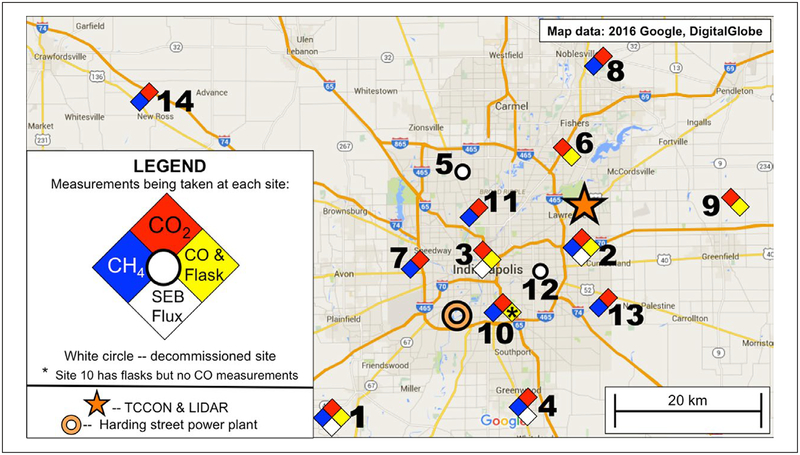
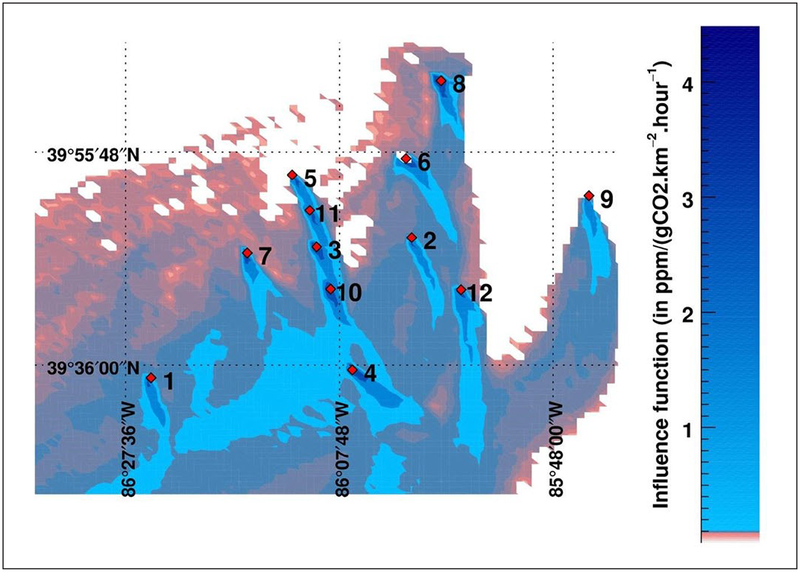
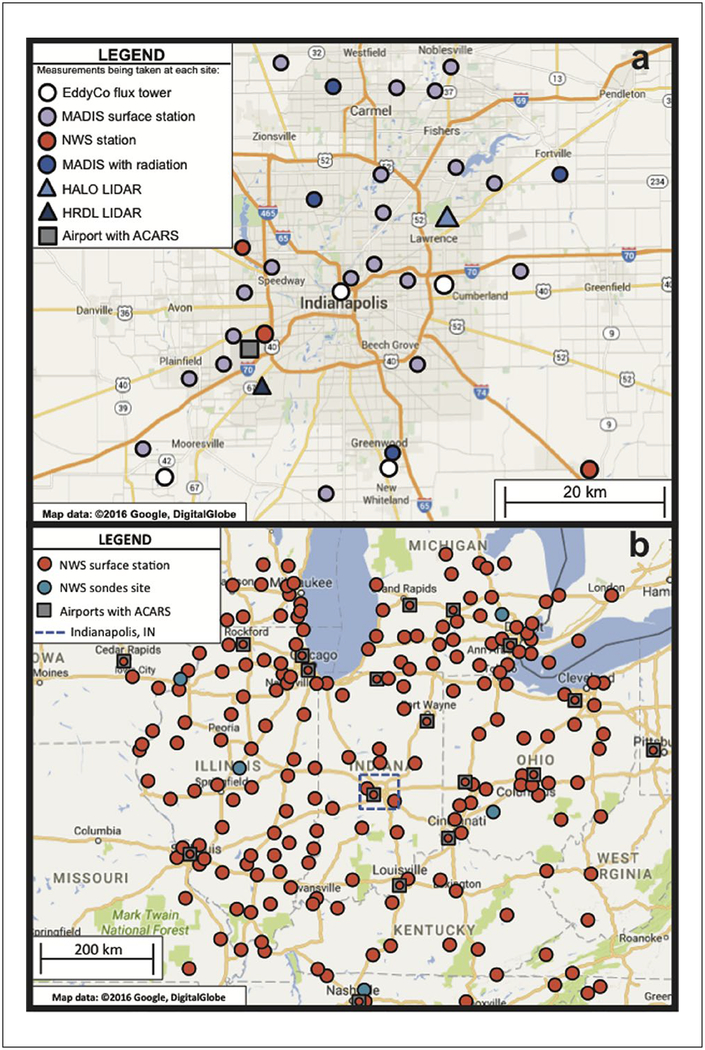
The objective of the Indianapolis Flux Experiment (INFLUX) is to develop, evaluate and improve methods for measuring greenhouse gas (GHG) emissions from cities. INFLUX's scientific objectives are to quantify CO and CH emission rates at 1 km resolution with a 10% or better accuracy and precision, to determine whole-city emissions with similar skill, and to achieve high (weekly or finer) temporal resolution at both spatial resolutions. The experiment employs atmospheric GHG measurements from both towers and aircraft, atmospheric transport observations and models, and activity-based inventory products to quantify urban GHG emissions. Multiple, independent methods for estimating urban emissions are a central facet of our experimental design. INFLUX was initiated in 2010 and measurements and analyses are ongoing. To date we have quantified urban atmospheric GHG enhancements using aircraft and towers with measurements collected over multiple years, and have estimated whole-city CO and CH emissions using aircraft and tower GHG measurements, and inventory methods. Significant differences exist across methods; these differences have not yet been resolved; research to reduce uncertainties and reconcile these differences is underway. Sectorally- and spatially-resolved flux estimates, and detection of changes of fluxes over time, are also active research topics. Major challenges include developing methods for distinguishing anthropogenic from biogenic CO fluxes, improving our ability to interpret atmospheric GHG measurements close to urban GHG sources and across a broader range of atmospheric stability conditions, and quantifying uncertainties in inventory data products. INFLUX data and tools are intended to serve as an open resource and test bed for future investigations. Well-documented, public archival of data and methods is under development in support of this objective.
印第安纳波利斯通量实验(INFLUX)的目标是开发、评估和改进测量城市温室气体(GHG)排放的方法。INFLUX的科学目标是以1公里分辨率、10%或更高的准确度和精密度量化一氧化碳(CO)和甲烷(CH)的排放率,以类似的技术确定全市的排放量,并在两种空间分辨率下实现高(每周或更高)时间分辨率。该实验利用来自高塔和飞机的大气温室气体测量数据、大气传输观测和模型以及基于活动的清单产品来量化城市温室气体排放。多种独立的城市排放估算方法是我们实验设计的核心方面。INFLUX于2010年启动,测量和分析工作仍在进行。到目前为止,我们已经利用多年收集的飞机和高塔测量数据量化了城市大气温室气体增强情况,并利用飞机和高塔的温室气体测量数据以及清单方法估算了全市的CO和CH排放量。不同方法之间存在显著差异;这些差异尚未得到解决;正在开展研究以减少不确定性并协调这些差异。按部门和空间分辨率进行的通量估算以及检测通量随时间的变化也是活跃的研究课题。主要挑战包括开发区分人为CO通量和生物源CO通量的方法,提高我们在接近城市温室气体源以及在更广泛的大气稳定条件下解释大气温室气体测量数据的能力,以及量化清单数据产品中的不确定性。INFLUX数据和工具旨在作为未来调查的开放资源和试验平台。为支持这一目标,正在开发记录完善、可供公众查阅的数据和方法存档。