King's College London, Institute of Psychiatry, Psychology and Neuroscience, Department of Basic and Clinical Neurosciences, De Crespigny Park, London, SE5 8AF, UK.
Parkinson Foundation Centre of Excellence, King's College Hospital, Denmark Hill, London, SE5 9RS, UK.
J Neurol. 2019 Jul;266(7):1736-1742. doi: 10.1007/s00415-019-09325-w. Epub 2019 Apr 17.
To identify associated (non-)motor profiles of Parkinson's disease (PD) patients with hyperhidrosis as a dominant problem.
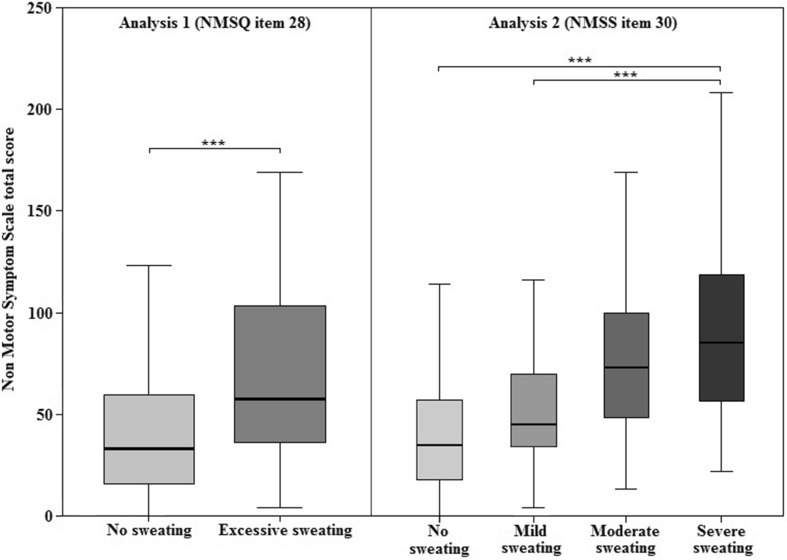
This is a cross-sectional, exploratory, analysis of participants enrolled in the Non-motor Longitudinal International Study (NILS; UKCRN No: 10084) at the Parkinson's Centre at King's College Hospital (London, UK). Hyperhidrosis scores (yes/no) on question 28 of the Non-Motor Symptom Questionnaire were used to classify patients with normal sweat function (n = 172) and excessive sweating (n = 56) (Analysis 1; n = 228). NMS scale (NMSS) question 30 scores were used to stratify participants based on hyperhidrosis severity (Analysis 2; n = 352) using an arbitrary severity grading: absent score 0 (n = 267), mild 1-4 (n = 49), moderate 5-8 (n = 17), and severe 9-12 (n = 19). NMS burden, as well as PD sleep scale (PDSS) scores were then analysed along with other correlates.
No differences were observed in baseline demographics between groups in either analysis. Patients with hyperhidrosis exhibited significantly higher total NMSS burden compared to those without (p < 0.001). Secondary analyses revealed higher dyskinesia scores, worse quality of life and PDSS scores, and higher anxiety and depression levels in hyperhidrosis patients (p < 0.001). Tertiary analyses revealed higher NMSS item scores for fatigue, sleep initiation, restless legs, urinary urgency, and unexplained pain (p < 0.001).
Chronic hyperhidrosis appears to be associated with a dysautonomia dominant subtype in PD patients, which is also associated with sleep disorders and a higher rate of dyskinesia (fluctuation-related hyperhidrosis). These data should prompt the concept of hyperhidrosis being used as a simple clinical screening tool to identify PD patients with autonomic symptoms.
确定以多汗为主要问题的帕金森病(PD)患者的相关(非)运动特征。
这是一项横断面、探索性分析,对参加英国国王学院医院帕金森中心非运动纵向国际研究(NILS;UKCRN 编号:10084)的参与者进行分析。使用非运动症状问卷第 28 题的多汗评分(是/否)将正常出汗功能的患者(n=172)和多汗患者(n=56)进行分类(分析 1;n=228)。使用 NMS 量表(NMSS)第 30 题的评分,根据多汗严重程度将参与者分层(分析 2;n=352),使用任意严重程度分级:无评分 0(n=267),轻度 1-4(n=49),中度 5-8(n=17),重度 9-12(n=19)。然后分析 NMS 负担以及 PD 睡眠量表(PDSS)评分,以及其他相关性。
在两项分析中,各组之间的基线人口统计学特征均无差异。与无多汗的患者相比,多汗患者的 NMSS 总分负担明显更高(p<0.001)。进一步分析显示,多汗患者的异动症评分更高,生活质量和 PDSS 评分更差,焦虑和抑郁水平更高(p<0.001)。进一步分析显示,NMSS 疲劳、睡眠启动、不宁腿、尿急和不明原因疼痛等项目评分更高(p<0.001)。
慢性多汗症似乎与 PD 患者的自主神经功能障碍主导亚型有关,也与睡眠障碍和更高的异动症发生率(波动相关的多汗症)有关。这些数据应该促使人们将多汗症作为一种简单的临床筛查工具,用于识别有自主症状的 PD 患者。