Department of Environmental Health, Emory University Rollins School of Public Health, Atlanta, GA, United States.
Department of Pediatrics, University of North Carolina School of Medicine, Chapel Hill, NC, United States.
Sci Rep. 2019 Apr 19;9(1):6322. doi: 10.1038/s41598-019-42654-4.
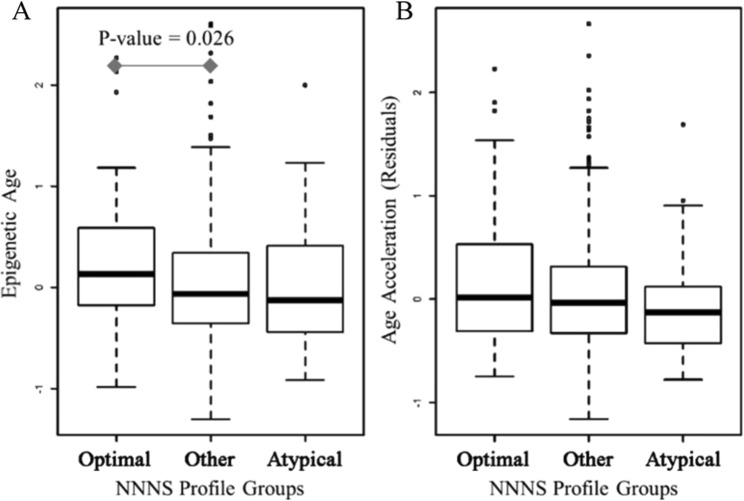
Neonatal molecular biomarkers of neurobehavioral responses (measures of brain-behavior relationships), when combined with neurobehavioral performance measures, could lead to better predictions of long-term developmental outcomes. To this end, we examined whether variability in buccal cell DNA methylation (DNAm) associated with neurobehavioral profiles in a cohort of infants born less than 30 weeks postmenstrual age (PMA) and participating in the Neonatal Neurobehavior and Outcomes in Very Preterm Infants (NOVI) Study (N = 536). We tested whether epigenetic age, age acceleration, or DNAm levels at individual loci differed between infants based on their NICU Network Neurobehavioral Scale (NNNS) profile classifications. We adjusted for recruitment site, infant sex, PMA, and tissue heterogeneity. Infants with an optimally well-regulated NNNS profile had older epigenetic age compared to other NOVI infants (β = 0.201, p-value = 0.026), but no significant difference in age acceleration. In contrast, infants with an atypical NNNS profile had differential methylation at 29 CpG sites (FDR < 10%). Some of the genes annotated to these CpGs included PLA2G4E, TRIM9, GRIK3, and MACROD2, which have previously been associated with neurological structure and function, or with neurobehavioral disorders. These findings contribute to the existing evidence that neonatal epigenetic variations may be informative for infant neurobehavior.
新生儿分子生物标志物可反映神经行为反应(大脑与行为关系的测量指标),与神经行为表现测量指标相结合,可能有助于更好地预测长期发育结果。为此,我们研究了在出生时胎龄不足 30 周(PMA)且参与新生儿神经行为与极低出生体重儿结局研究(NOVI)的队列中,口腔细胞 DNA 甲基化(DNAm)的变异性是否与神经行为特征相关(N=536)。我们检测了个体神经行为评分分类的婴儿之间,是否在表观遗传年龄、年龄加速或个别基因座的 DNAm 水平上存在差异。我们根据招募地点、婴儿性别、PMA 和组织异质性进行了调整。与其他 NOVI 婴儿相比,具有最佳调节的 NNNS 评分特征的婴儿的表观遗传年龄较大(β=0.201,p 值=0.026),但年龄加速没有显著差异。相比之下,具有非典型 NNNS 评分特征的婴儿在 29 个 CpG 位点存在差异甲基化(FDR<10%)。注释到这些 CpG 的一些基因包括 PLA2G4E、TRIM9、GRIK3 和 MACROD2,这些基因先前与神经结构和功能或神经行为障碍有关。这些发现为新生儿表观遗传变异可能对婴儿神经行为有指示作用的现有证据提供了补充。