Fassinou Arsène Jacques Y H, Koukpo Come Z, Ossè Razaki A, Agossa Fiacre R, Assogba Benoit S, Sidick Aboubakar, Sèwadé Wilfrid T, Akogbéto Martin C, Sèzonlin Michel
Cotonou Entomological Research Center (CREC), Cotonou, Benin.
Graduate School of Life Sciences and Earth, FAST - UAC, Abomey-Calavi, Benin.
Trop Med Health. 2019 Apr 11;47:23. doi: 10.1186/s41182-019-0151-z. eCollection 2019.
Several studies have reported the strong resistance of complex species to pyrethroids. The voltage-dependent sodium channel () gene is the main target of pyrethroids and DDT. In Benin, the frequency of the resistant allele () of this gene varies along the north-south transect. Monitoring the evolution of resistance is necessary to better appreciate the genetic structure of vector populations in localities subject to the intensive use of chemicals associated with other control initiatives. The purpose of this study was to map the distribution of pyrethroid insecticide resistance alleles of the gene in malaria vectors in different regions and ecological facies in order to identify the evolutionary forces that might be the basis of anopheline population dynamics.
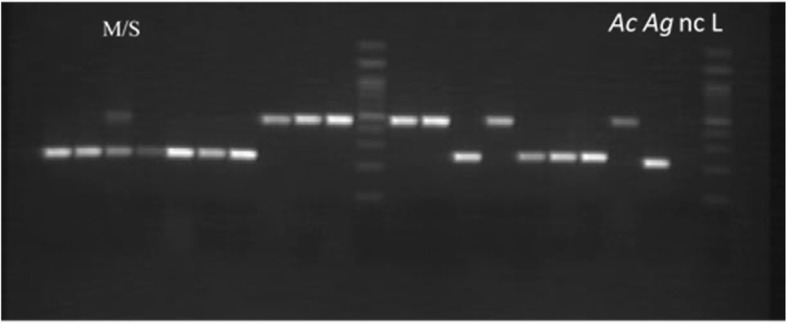
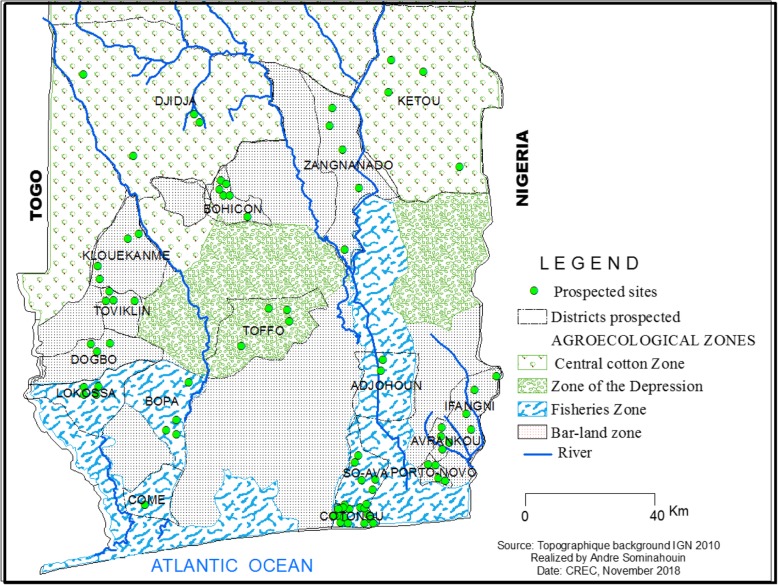
The characterization of populations and resistance mechanisms were performed using adult mosquitoes obtained from larvae collected in the four agroecological zones in southern Benin. Genomic DNA extraction was performed on whole mosquitoes.The extracted genomic DNA from them were used for the molecular identification of species in complex and the identification of genotypes related to pyrethroid resistance as the gene amino acid position 1014 in sodium channel. Molecular speciation and genotyping of resistant alleles (1014) were done using PCR.Genepop software version 4.2 was used to calculate allelic and genotypic frequencies in each agroecological zone. The value of the allelic frequency was determined using the binomial test function in R version 3.3.3. The Hardy-Weinberg equilibrium was checked for each population with Genetics software version 1.3.8.1. The observed heterozygosity and the expected heterozygosity as well as the fixation index and genetic differentiation index within and between populations were calculated using Genepop software version 4.2.
During the study period, was the major species in all agroecological zones while was scarcely represented. Regardless of the species, resistant homozygote individuals () were dominant in all agroecological zones, showing a strong selection of the resistant allele (). All populations showed a deficit of heterozygosity. No genetic differentiation was observed between the different populations of the two species. For , there was a small differentiation among the populations of the central cotton and bar-lands zones. The genetic differentiation was modest among the population of the fisheries zone ( = 0.1295). The genetic differentiation was very high in the population of of the bar-lands zone ( = 0.2408).
This study revealed that the use of insecticides in Benin for years has altered the genetic structure of populations in all agroecological zones of southern Benin. It would be desirable to orientate vector control efforts towards the use of insecticides other than pyrethroids and DDT or combinations of insecticides with different modes of action.
多项研究报告了复杂物种对拟除虫菊酯具有很强的抗性。电压依赖性钠通道()基因是拟除虫菊酯和滴滴涕的主要作用靶点。在贝宁,该基因抗性等位基因()的频率沿南北样带有所变化。监测抗性的演变对于更好地了解在大量使用与其他控制措施相关化学品的地区病媒种群的遗传结构很有必要。本研究的目的是绘制不同地区和生态相的疟疾媒介中该基因拟除虫菊酯类杀虫剂抗性等位基因的分布图,以确定可能作为按蚊种群动态基础的进化驱动力。
使用从贝宁南部四个农业生态区采集的幼虫培育出的成年蚊子,对种群特征和抗性机制进行研究。对整只蚊子进行基因组DNA提取。从提取的基因组DNA中,用于在复杂种群中进行物种的分子鉴定,以及鉴定与拟除虫菊酯抗性相关的基因型,即钠通道中基因氨基酸位置1014。使用聚合酶链反应(PCR)对抗性等位基因(1014)进行分子物种鉴定和基因分型。使用Genepop软件版本4.2计算每个农业生态区的等位基因和基因型频率。使用R版本3.3.3中的二项式检验函数确定等位基因频率的 值。使用Genetics软件版本1.3.8.1检查每个种群的哈迪-温伯格平衡。使用Genepop软件版本4.2计算种群内和种群间的观察杂合度、预期杂合度以及固定指数和遗传分化指数。
在研究期间,是所有农业生态区的主要物种,而的数量很少。无论物种如何,抗性纯合个体()在所有农业生态区都占主导地位,表明抗性等位基因()受到强烈选择。所有种群均表现出杂合度不足。在这两个物种的不同种群之间未观察到遗传分化。对于,中部棉花区和巴兰地区的种群之间存在较小的分化。渔业区种群之间的遗传分化适中(=0.1295)。巴兰地区种群的遗传分化非常高(=0.2408)。
本研究表明,多年来在贝宁使用杀虫剂已经改变了贝宁南部所有农业生态区种群的遗传结构。最好将病媒控制工作转向使用除拟除虫菊酯和滴滴涕之外的杀虫剂,或使用具有不同作用方式的杀虫剂组合。