Lee Sung-Hee, Shin Hyunman, Kim Ju-Hyoung, Ryu Kyoung-Yul, Kim Heung Tae, Cha Byeongjin, Cha Jae-Soon
Bureau of Research & Development, Chungcheongbuk-do Agricultural Research and Extension Services, Cheongju 28130, Korea.
Department of Agro-food Safety and Crop Protection, National Institute of Agricultural Sciences, Rural Development Administration, Wanju 55365, Korea.
Plant Pathol J. 2019 Apr;35(2):156-163. doi: 10.5423/PPJ.OA.07.2018.0123. Epub 2019 Apr 1.
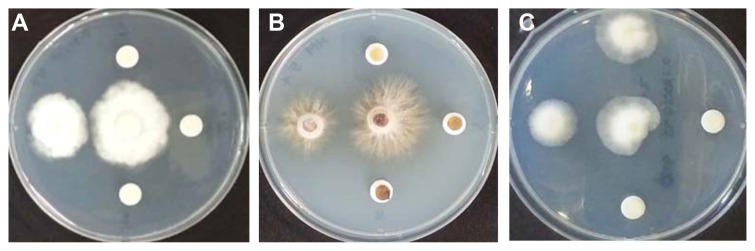
Our study investigated the available chlorine content, contact time and difference among strains of each pathogen for sodium hypochlorite (NaOCl) to control chemically against soil-borne fungal pathogens, such as Phytophthora rot by , violet root rot by , and white root rot by , causing die-back symptom on apple trees. As a result, the colony growth of was inhibited completely by soaking over 5 s in 31.25 ml/l available chlorine content of NaOCl. Those of and were inhibited entirely by soaking over 160 s in 62.5 and 125 ml/l available chlorine content in NaOCl, respectively. Also, inhibition effect on available chlorine in NaOCl among strains of each soil-borne pathogen showed no significant difference and was similar to or better than that of fungicides.
我们的研究调查了次氯酸钠(NaOCl)控制土壤传播真菌病原体(如引起苹果树衰退症状的疫霉根腐病、紫纹羽病和白纹羽病)时的有效氯含量、接触时间以及各病原体菌株之间的差异。结果,在有效氯含量为31.25 ml/l的NaOCl中浸泡超过5秒,完全抑制了[某种病原体名称]的菌落生长。在有效氯含量为62.5和125 ml/l的NaOCl中分别浸泡超过160秒,完全抑制了[另外两种病原体名称]的菌落生长。此外,每种土壤传播病原体菌株对NaOCl中有效氯的抑制效果没有显著差异,且与杀菌剂相似或优于杀菌剂。