Shindell Drew, Faluvegi Greg, Kasibhatla Prasad, Van Dingenen Rita
Nicholas School of the Environment Duke University Durham NC USA.
NASA Goddard Institute for Space Studies and Center for Climate Systems Research Columbia University New York NY USA.
Earths Future. 2019 Feb;7(2):101-112. doi: 10.1029/2018EF001030. Epub 2019 Feb 18.
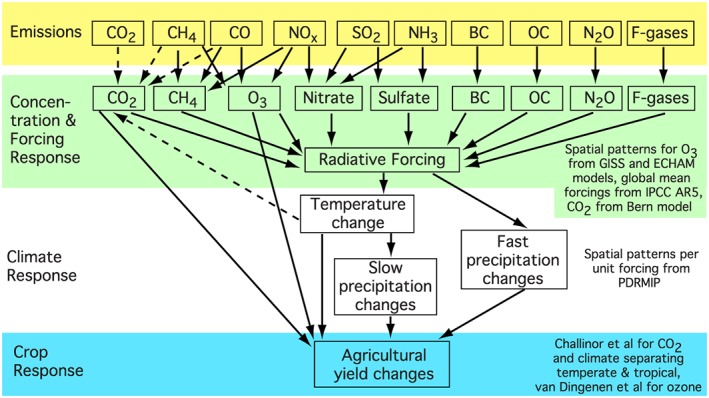
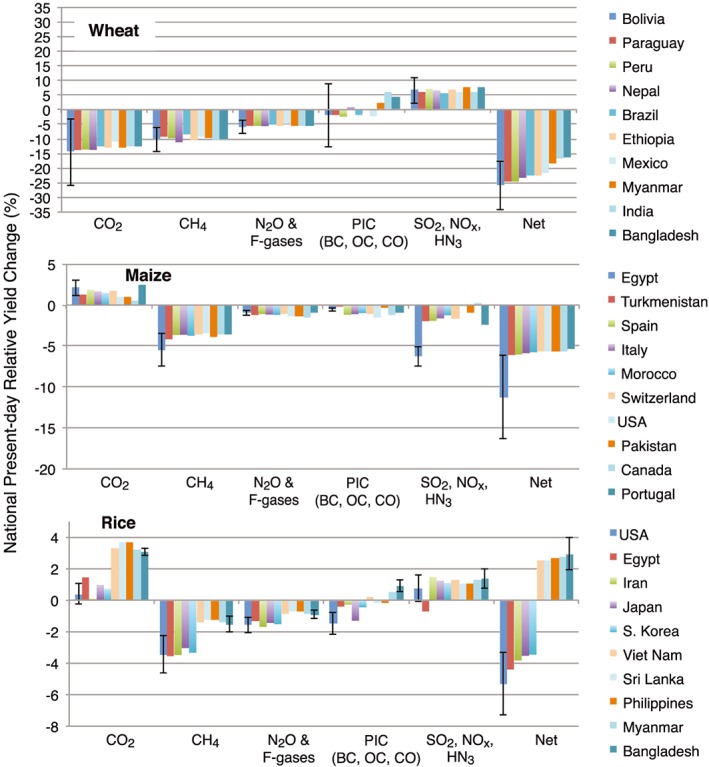
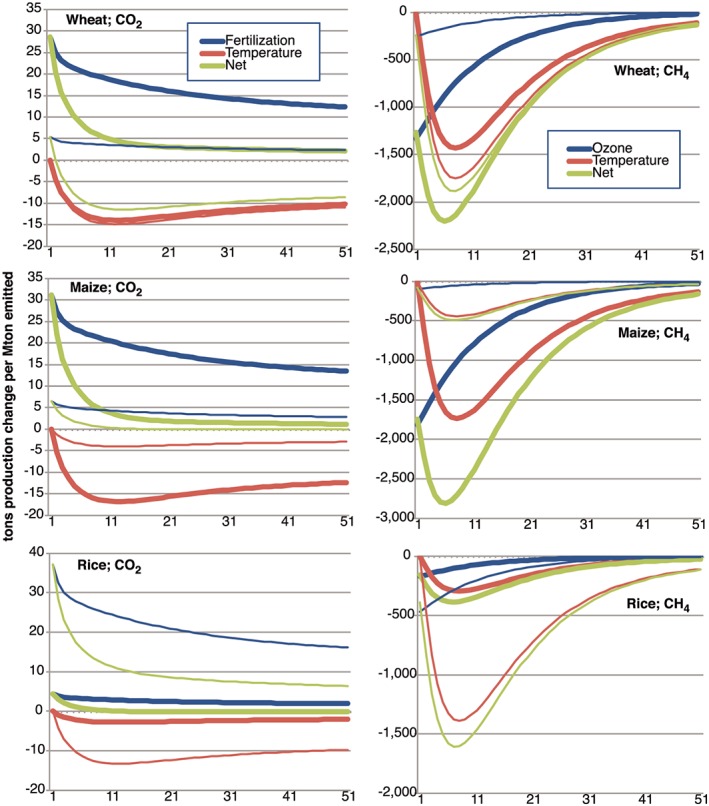
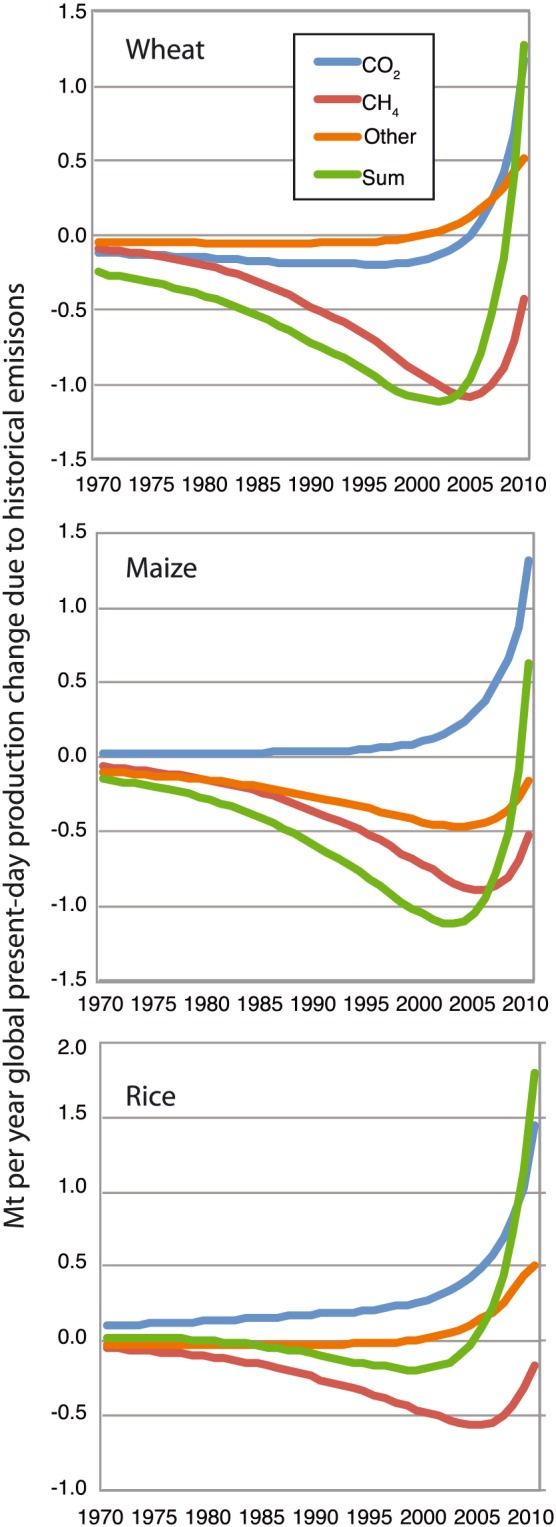
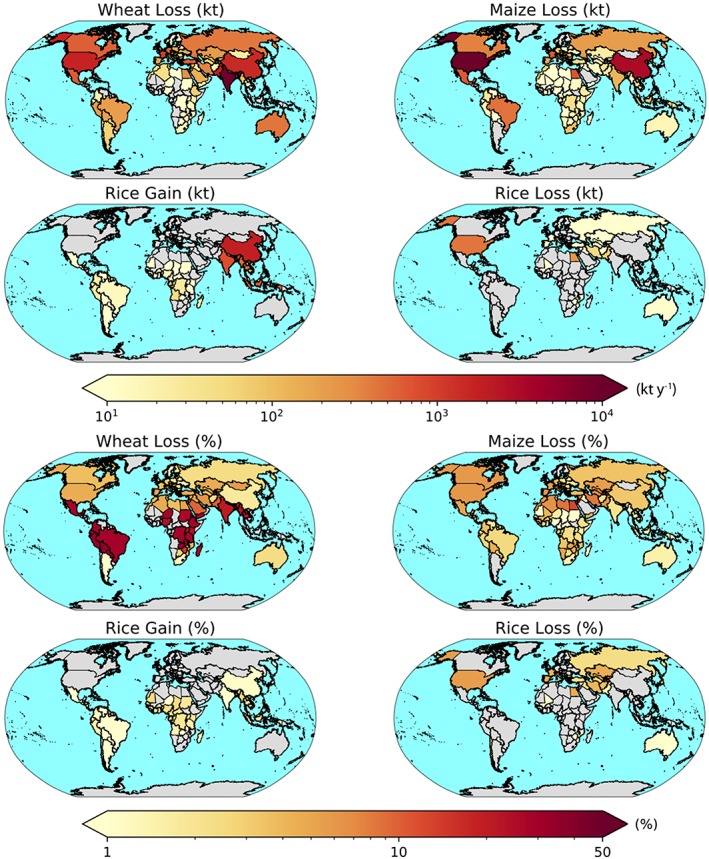
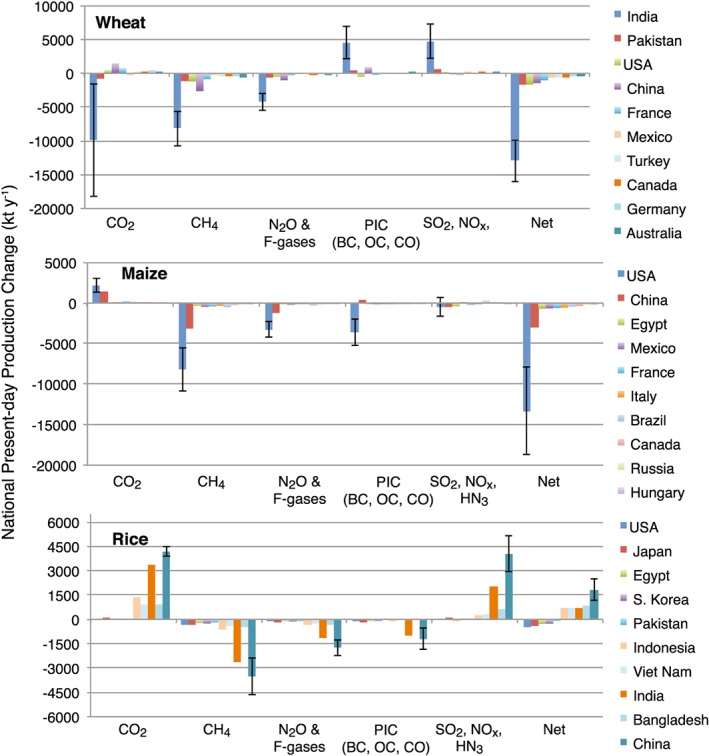
Field measurements and modeling have examined how temperature, precipitation, and exposure to carbon dioxide (CO) and ozone affect major staple crops around the world. Most prior studies, however, have incorporated only a subset of these influences. Here we examine how emissions of each individual pollutant driving changes in these four factors affect present-day yields of wheat, maize (corn), and rice worldwide. Our statistical modeling indicates that for the global mean, climate and composition changes have decreased wheat and maize yields substantially whereas rice yields have increased. Well-mixed greenhouse gasses drive most of the impacts, though aerosol-induced cooling can be important, particularly for more polluted area including India and China. Maize yield losses are most strongly attributable to methane emissions (via both temperature and ozone). In tropical areas, wheat yield losses are primarily driven by CO (via temperature), whereas in temperate zones other well-mixed greenhouse gases dominate. Rice yields increase in tropical countries due to a larger impact from CO fertilization plus aerosol-induced cooling than losses due to CO-induced warming and impacts of non-CO gasses, whereas there are net losses in temperate zones driven largely by methane and other non-CO gasses. Though further work is needed, particularly on the effects of aerosol changes and on nutritional impacts, these results suggest that crop yields over coming decades will be strongly influenced by changes in non-CO greenhouse gasses, ozone precursors, and aerosols and that these should be taking into account in plant-level models and when examining linkages between climate change mitigation and sustainable development.
实地测量和模型研究已探讨了温度、降水以及二氧化碳(CO)和臭氧暴露如何影响全球主要的主食作物。然而,大多数先前的研究仅纳入了这些影响因素中的一部分。在此,我们研究驱动这四个因素变化的每种单一污染物排放如何影响全球范围内小麦、玉米和水稻目前的产量。我们的统计模型表明,就全球平均水平而言,气候和成分变化已大幅降低了小麦和玉米的产量,而水稻产量则有所增加。混合均匀的温室气体产生了大部分影响,不过气溶胶导致的降温也可能很重要,特别是对于包括印度和中国在内污染更严重的地区。玉米产量损失主要归因于甲烷排放(通过温度和臭氧两种途径)。在热带地区,小麦产量损失主要由CO(通过温度)驱动,而在温带地区,其他混合均匀的温室气体起主导作用。在热带国家,由于CO施肥和气溶胶导致的降温影响大于CO导致的变暖影响以及非CO气体的影响,水稻产量增加,而在温带地区,主要由甲烷和其他非CO气体导致净损失。尽管还需要进一步开展工作,特别是关于气溶胶变化的影响以及营养影响方面,但这些结果表明,未来几十年作物产量将受到非CO温室气体、臭氧前体和气溶胶变化的强烈影响,并且在植物层面的模型以及研究气候变化缓解与可持续发展之间的联系时应考虑到这些因素。