Nicholas School of the Environment, Duke University, Durham, NC 27708;
Nicholas School of the Environment, Duke University, Durham, NC 27708.
Proc Natl Acad Sci U S A. 2021 Nov 16;118(46). doi: 10.1073/pnas.2104061118.
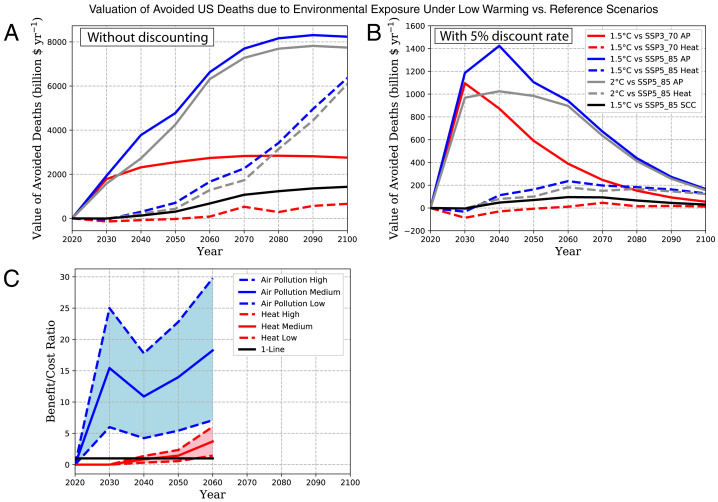
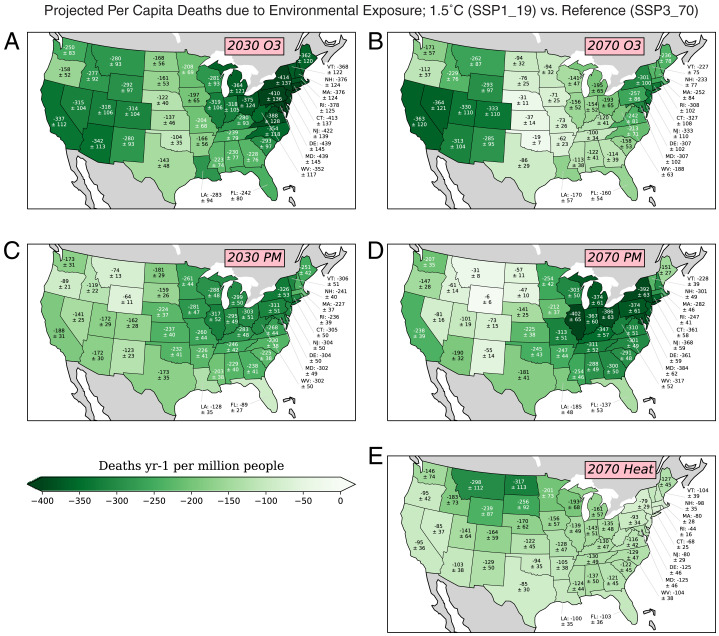
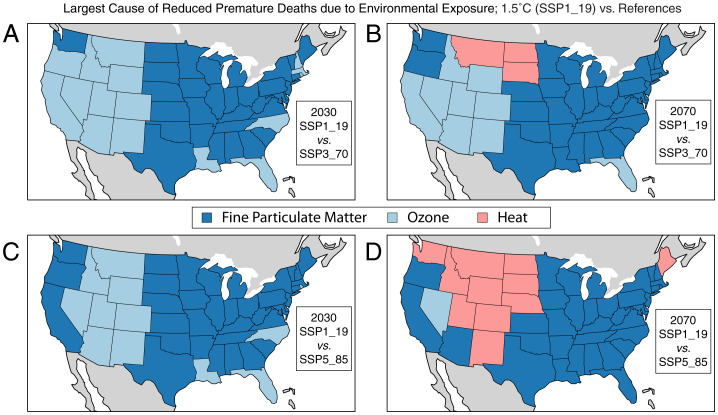
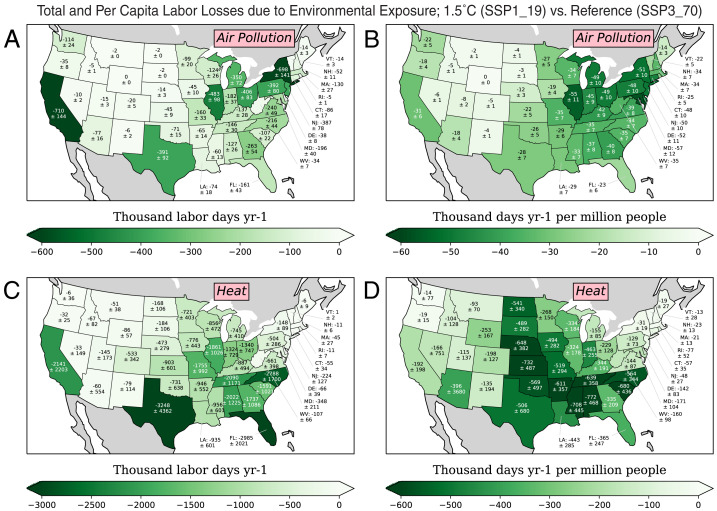
Societal benefits from climate change mitigation accrue via multiple pathways. We examine the US impacts of emission changes on several factors that are affected by both climate and air quality responses. Nationwide benefits through midcentury stem primarily from air quality improvements, which are realized rapidly, and include human health, labor productivity, and crop yield benefits. Benefits from reduced heat exposure become large around 2060, thereafter often dominating over those from improved air quality. Monetized benefits are in the tens of trillions of dollars for avoided deaths and tens of billions for labor productivity and crop yield increases and reduced hospital expenditures. Total monetized benefits this century are dominated by health and are much larger than in previous analyses due to improved understanding of the human health impacts of exposure to both heat and air pollution. Benefit-cost ratios are therefore much larger than in prior studies, especially those that neglected clean air benefits. Specifically, benefits from clean air exceed costs in the first decade, whereas benefits from climate alone exceed costs in the latter half of the century. Furthermore, monetized US benefits largely stem from US emissions reductions. Increased emphasis on the localized, near-term air quality-related impacts would better align policies with societal benefits and, by reducing the mismatch between perception of climate as a risk distant in space and time and the need for rapid action to mitigate long-term climate change, might help increase acceptance of mitigation policies.
从减缓气候变化中获得的社会效益可以通过多种途径实现。我们研究了美国排放变化对受气候和空气质量响应影响的几个因素的影响。到本世纪中叶,全国范围内的效益主要来自空气质量的改善,这一改善是迅速实现的,包括人类健康、劳动生产力和作物产量的提高。到 2060 年左右,因减少热暴露而带来的效益会变得非常大,此后,这些效益通常会超过空气质量改善带来的效益。因避免死亡而产生的货币化效益达数万亿美元,因提高劳动生产力和增加作物产量以及减少医院支出而产生的效益达数十亿美元。本世纪的货币化效益主要由健康效益主导,而且由于对接触热和空气污染对人类健康的影响有了更好的理解,比以前的分析大得多。因此,效益成本比远高于以前的研究,尤其是那些忽略了清洁空气效益的研究。具体来说,清洁空气带来的效益在最初十年就超过了成本,而仅气候因素带来的效益在本世纪后半叶就超过了成本。此外,美国的货币化效益主要源于美国的减排。更多地强调本地化、近期与空气质量有关的影响,将使政策与社会效益更好地保持一致,并通过减少对气候变化作为一个遥远的空间和时间风险的看法与需要采取迅速行动来缓解长期气候变化之间的不匹配,可能有助于提高对缓解政策的接受程度。