
通过多路复用神经码在海马神经元中进行时间模式分离。
Temporal pattern separation in hippocampal neurons through multiplexed neural codes.
机构信息
Department of Neuroscience, University of Wisconsin-Madison, WI, United States of America.
Neuroscience Training Program, University of Wisconsin-Madison, WI, United States of America.
出版信息
PLoS Comput Biol. 2019 Apr 22;15(4):e1006932. doi: 10.1371/journal.pcbi.1006932. eCollection 2019 Apr.
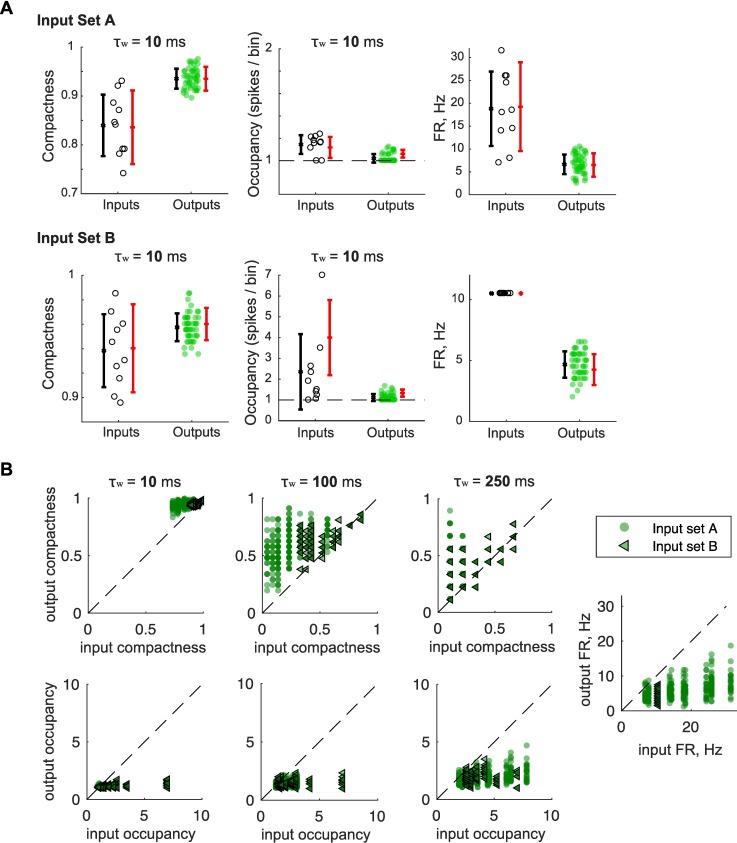
Pattern separation is a central concept in current theories of episodic memory: this computation is thought to support our ability to avoid confusion between similar memories by transforming similar cortical input patterns of neural activity into dissimilar output patterns before their long-term storage in the hippocampus. Because there are many ways one can define patterns of neuronal activity and the similarity between them, pattern separation could in theory be achieved through multiple coding strategies. Using our recently developed assay that evaluates pattern separation in isolated tissue by controlling and recording the input and output spike trains of single hippocampal neurons, we explored neural codes through which pattern separation is performed by systematic testing of different similarity metrics and various time resolutions. We discovered that granule cells, the projection neurons of the dentate gyrus, can exhibit both pattern separation and its opposite computation, pattern convergence, depending on the neural code considered and the statistical structure of the input patterns. Pattern separation is favored when inputs are highly similar, and is achieved through spike time reorganization at short time scales (< 100 ms) as well as through variations in firing rate and burstiness at longer time scales. These multiplexed forms of pattern separation are network phenomena, notably controlled by GABAergic inhibition, that involve many celltypes with input-output transformations that participate in pattern separation to different extents and with complementary neural codes: a rate code for dentate fast-spiking interneurons, a burstiness code for hilar mossy cells and a synchrony code at long time scales for CA3 pyramidal cells. Therefore, the isolated hippocampal circuit itself is capable of performing temporal pattern separation using multiplexed coding strategies that might be essential to optimally disambiguate multimodal mnemonic representations.
模式分离是目前情景记忆理论的核心概念
该计算被认为支持我们避免混淆相似记忆的能力,即将相似的皮质神经活动输入模式转换为不同的输出模式,然后再将其长期存储在海马体中。由于可以定义神经元活动模式及其相似性的多种方式,因此理论上可以通过多种编码策略来实现模式分离。使用我们最近开发的通过控制和记录单个海马神经元的输入和输出尖峰序列来评估离体组织中模式分离的测定方法,我们通过系统测试不同的相似性度量和各种时间分辨率来探索神经代码。我们发现,颗粒细胞(齿状回的投射神经元)可以根据所考虑的神经代码和输入模式的统计结构,表现出模式分离及其相反的计算,即模式收敛。当输入高度相似时,模式分离更有利,并且可以通过短时间尺度(<100ms)的尖峰时间重组以及更长时间尺度上的发放率和爆发性变化来实现。这些模式分离的多路复用形式是网络现象,特别是由 GABA 能抑制控制的,涉及到许多具有输入-输出转换的细胞类型,这些细胞类型以不同的程度和互补的神经代码参与模式分离:齿状快速放电中间神经元的速率码、棘状细胞的爆发性码和 CA3 锥体神经元的长时间尺度同步码。因此,孤立的海马电路本身可以使用多路复用编码策略来执行时间模式分离,这些策略对于最佳地消除多模态记忆表示的歧义可能是必不可少的。




 Zotero 插件