Maestría en Ciencias en Horticultura, Universidad Autónoma Agraria Antonio Narro, Saltillo COA 25315, Mexico.
Centro de Investigación en Química Aplicada, Saltillo COA 25294, Mexico.
Int J Mol Sci. 2019 Apr 20;20(8):1950. doi: 10.3390/ijms20081950.
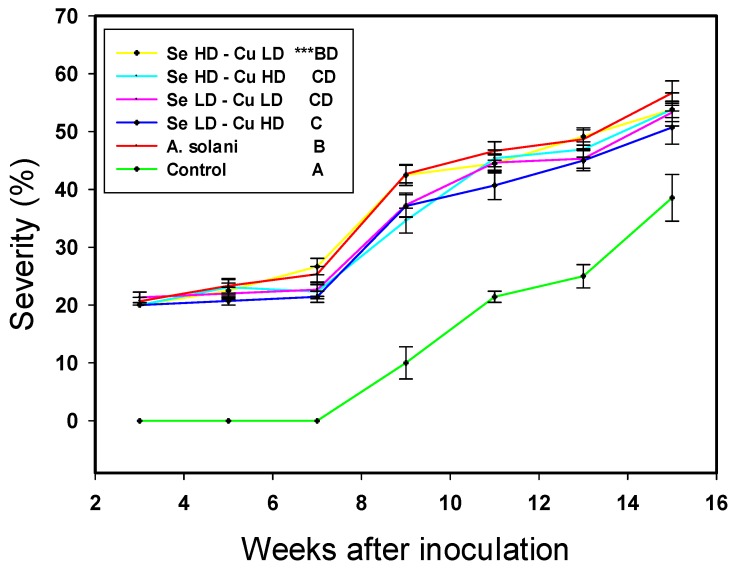
Early blight is a disease that greatly affects Solanaceae, mainly damaging tomato plants, and causing significant economic losses. Although there are methods of biological control, these are very expensive and often their mode of action is slow. Due to this, there is a need to use new techniques that allow a more efficient control of pathogens. Nanotechnology is a new alternative to solve these problems, allowing the creation of new tools for the treatment of diseases in plants, as well as the control of pathogens. The aim of the present investigation was to evaluate the foliar application of selenium and copper in the form of nanoparticles in a tomato crop infested by . The severity of , agronomic variables of the tomato crop, and the changes in the enzymatic and non-enzymatic antioxidant compounds were evaluated. The joint application of Se and Cu nanoparticles decreases the severity of this pathogen in tomato plants. Moreover, high doses generated an induction of the activity of the enzymes superoxide dismutase, ascorbate peroxidase, glutathione peroxidase (GPX) and phenylalanine ammonia lyase in the leaves, and the enzyme GPX in the fruit. Regarding non-enzymatic compounds in the leaves, chlorophyll a, b, and totals were increased, whereas vitamin C, glutathione, phenols, and flavonoids were increased in fruits. The application of nanoparticles generated beneficial effects by increasing the enzymatic and non-enzymatic compounds and decreasing the severity of in tomato plants.
早疫病是一种严重影响茄科植物的疾病,主要损害番茄植株,并造成重大的经济损失。虽然有生物防治的方法,但这些方法非常昂贵,而且其作用模式往往较慢。因此,需要使用新的技术来更有效地控制病原体。纳米技术是解决这些问题的新选择,它允许为植物疾病的治疗以及病原体的控制创造新的工具。本研究的目的是评估叶面施硒和铜纳米粒子在受侵染的番茄作物中的应用。评估了的严重程度、番茄作物的农艺变量以及酶和非酶抗氧化化合物的变化。硒和铜纳米粒子的联合施用可降低番茄植株中这种病原体的严重程度。此外,高剂量会诱导叶片中超氧化物歧化酶、抗坏血酸过氧化物酶、谷胱甘肽过氧化物酶(GPX)和苯丙氨酸解氨酶以及果实中 GPX 酶的活性。关于叶片中的非酶化合物,叶绿素 a、b 和总量增加,而果实中的维生素 C、谷胱甘肽、酚类和类黄酮增加。纳米粒子的应用通过增加酶和非酶化合物并降低番茄植株中早疫病的严重程度产生了有益的效果。