Frey Aline, François Clément, Chobert Julie, Velay Jean-Luc, Habib Michel, Besson Mireille
ESPE de l'académie de Créteil, Université Paris-Est Créteil, Laboratoire CHArt, 94380 Bonneuil-sur-Marne, France.
Laboratoire Parole et Langage, CNRS et Aix Marseille Université, 13640 Aix-en-Provence, France.
Brain Sci. 2019 Apr 21;9(4):91. doi: 10.3390/brainsci9040091.
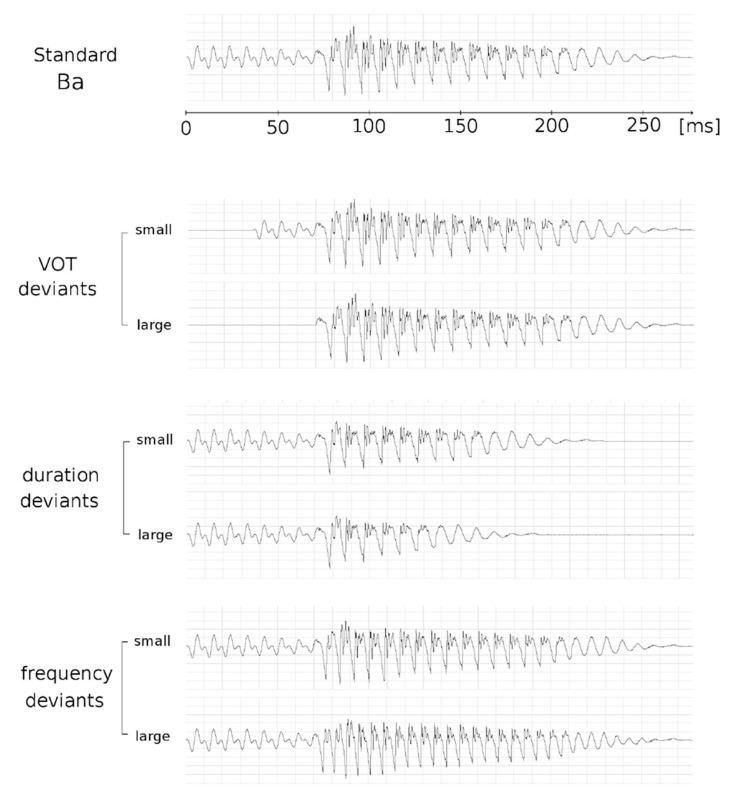
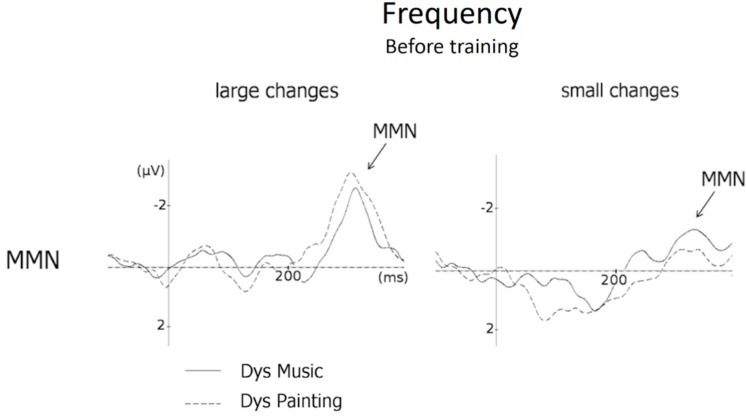
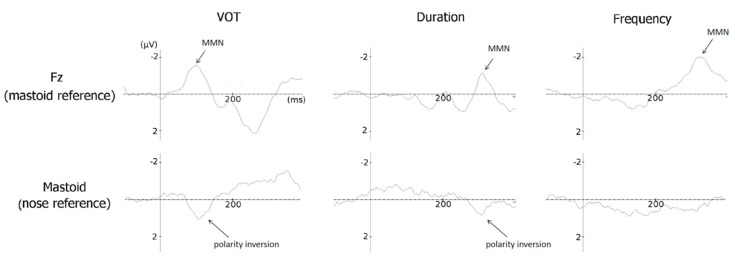
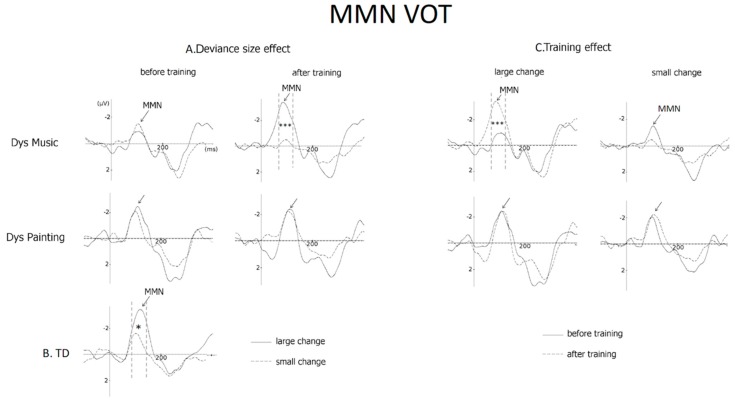
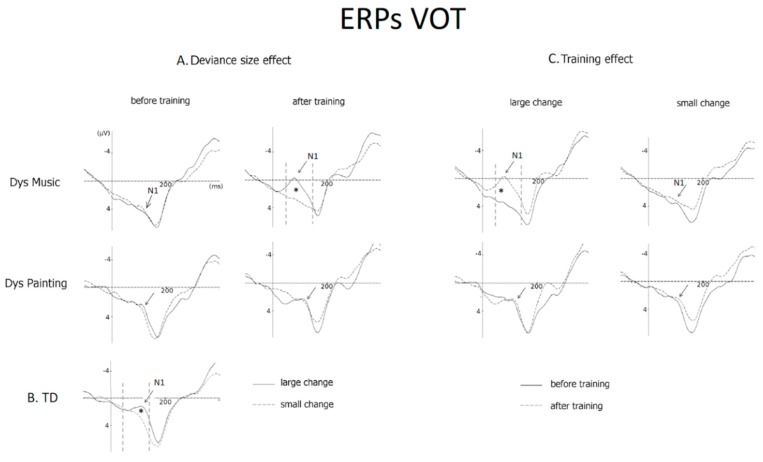
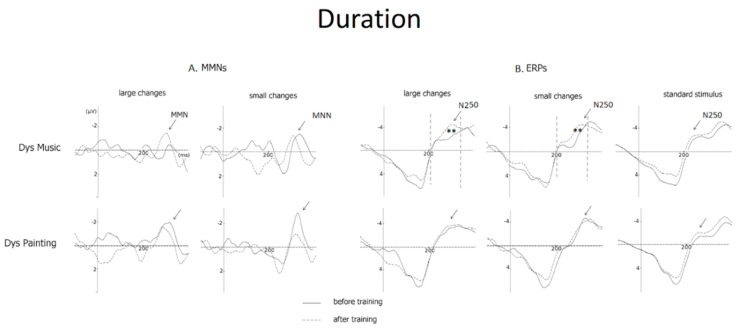
Previous results showed a positive influence of music training on linguistic abilities at both attentive and preattentive levels. Here, we investigate whether six months of active music training is more efficient than painting training to improve the preattentive processing of phonological parameters based on durations that are often impaired in children with developmental dyslexia (DD). Results were also compared to a control group of Typically Developing (TD) children matched on reading age. We used a Test-Training-Retest procedure and analysed the Mismatch Negativity (MMN) and the N1 and N250 components of the Event-Related Potentials to syllables that differed in Voice Onset Time (VOT), vowel duration, and vowel frequency. Results were clear-cut in showing a normalization of the preattentive processing of VOT in children with DD after music training but not after painting training. They also revealed increased N250 amplitude to duration deviant stimuli in children with DD after music but not painting training, and no training effect on the preattentive processing of frequency. These findings are discussed in view of recent theories of dyslexia pointing to deficits in processing the temporal structure of speech. They clearly encourage the use of active music training for the rehabilitation of children with language impairments.
先前的研究结果表明,音乐训练在注意力和前注意水平上对语言能力都有积极影响。在此,我们探究六个月的积极音乐训练是否比绘画训练更有效地改善基于时长的语音参数的前注意加工,而这些时长在发育性阅读障碍(DD)儿童中常常受损。研究结果还与一组阅读年龄匹配的发育正常(TD)儿童的对照组进行了比较。我们采用了测试-训练-重测程序,并分析了事件相关电位的失匹配负波(MMN)以及对在语音起始时间(VOT)、元音时长和元音频率上存在差异的音节的N1和N250成分。结果明确显示,音乐训练后DD儿童对VOT的前注意加工实现了正常化,而绘画训练后则未实现。研究结果还显示,音乐训练而非绘画训练后,DD儿童对时长偏差刺激的N250波幅增加,且对频率的前注意加工没有训练效果。鉴于最近关于阅读障碍的理论指出在处理语音的时间结构方面存在缺陷,对这些研究结果进行了讨论。它们明确鼓励将积极的音乐训练用于语言障碍儿童的康复。