Blom Kristin, Rubin Jenny, Berglund Malin, Jarvius Malin, Lenhammar Lena, Parrow Vendela, Andersson Claes, Loskog Angelica, Fryknäs Mårten, Nygren Peter, Larsson Rolf
Department of Medical Sciences, Division of Cancer Pharmacology and Computational Medicine, Uppsala University, 75185, Uppsala, Sweden.
Department of Immunology, Genetics and Pathology, Uppsala University, 75185, Uppsala, Sweden.
BMC Res Notes. 2019 Apr 22;12(1):234. doi: 10.1186/s13104-019-4273-5.
We recently showed that the anti-helminthic compound mebendazole (MBZ) has immunomodulating activity by inducing a M2 to M1 phenotype switch in monocyte/macrophage models. In the present study we investigated the potential role of protein kinases in mediating this effect.
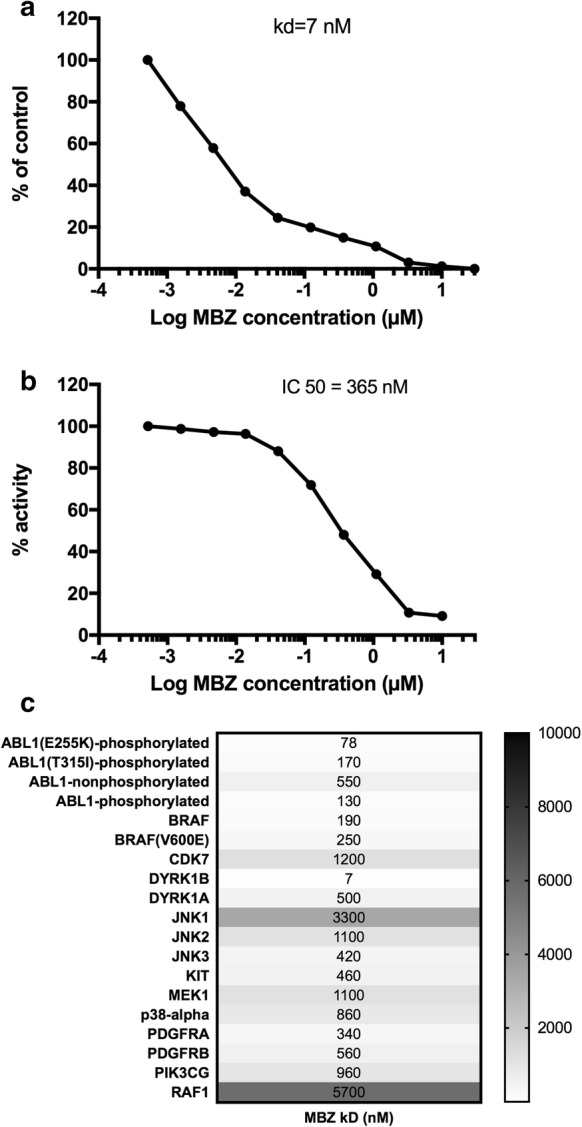
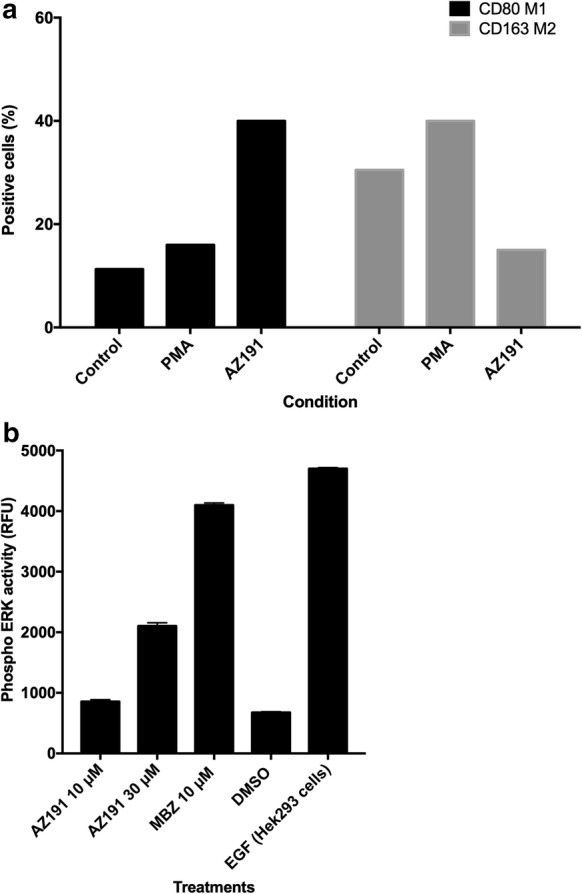
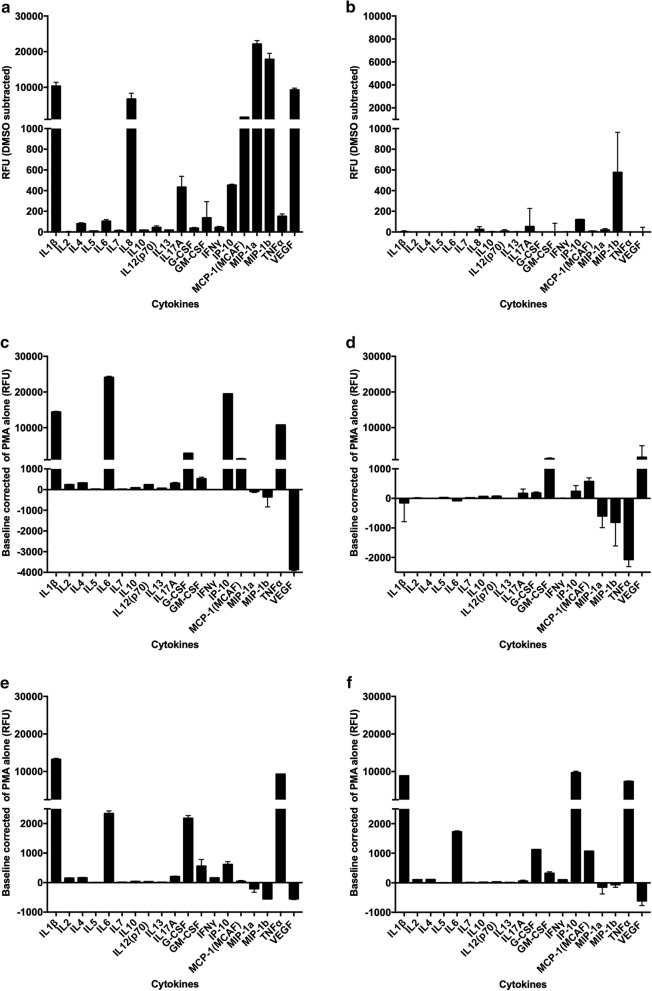
MBZ potently binds and inhibits Dual specificity tyrosine-phosphorylation-regulated kinase 1B (DYRK1B) with a Kd and an IC of 7 and 360 nM, respectively. The specific DYRK1B inhibitor AZ191 did not mimic the cytokine release profile of MBZ in untreated THP-1 monocytes. However, in THP-1 cells differentiated into macrophages, AZ191 strongly induced a pro-inflammatory cytokine release pattern similar to MBZ and LPS/IFNγ. Furthermore, like MBZ, AZ191 increased the expression of the M1 marker CD80 and decreased the M2 marker CD163 in THP-1 macrophages. In this model, AZ191 also increased phospho-ERK activity although to a lesser extent compared to MBZ. Taken together, the results demonstrate that DYRK1B inhibition could, at least partly, recapitulate immune responses induced by MBZ. Hence, DYRK1B inhibition induced by MBZ may be part of the mechanism of action to switch M2 to M1 macrophages.
我们最近发现,抗蠕虫化合物甲苯咪唑(MBZ)在单核细胞/巨噬细胞模型中通过诱导M2向M1表型转换而具有免疫调节活性。在本研究中,我们研究了蛋白激酶在介导这种效应中的潜在作用。
MBZ能有效结合并抑制双特异性酪氨酸磷酸化调节激酶1B(DYRK1B),其解离常数(Kd)和半数抑制浓度(IC)分别为7 nM和360 nM。特异性DYRK1B抑制剂AZ191在未处理的THP-1单核细胞中不能模拟MBZ的细胞因子释放谱。然而,在分化为巨噬细胞的THP-1细胞中,AZ191强烈诱导出与MBZ和LPS/IFNγ相似的促炎细胞因子释放模式。此外,与MBZ一样,AZ191增加了THP-1巨噬细胞中M1标志物CD80的表达,并降低了M2标志物CD163的表达。在该模型中,AZ191也增加了磷酸化ERK的活性,尽管与MBZ相比程度较小。综上所述,结果表明抑制DYRK1B至少可以部分重现MBZ诱导的免疫反应。因此,MBZ诱导的DYRK1B抑制可能是将M2巨噬细胞转换为M1巨噬细胞作用机制的一部分。