Respiratory Health Division, National Institute for Occupational Safety and Health (NIOSH), Centers for Disease Control and Prevention (CDC), Morgantown, WV, USA.
Occupational and Environmental Epidemiology Branch, Division of Cancer Epidemiology and Genetics, National Cancer Institute, Bethesda, MD, USA.
Int J Hyg Environ Health. 2019 Jun;222(5):873-883. doi: 10.1016/j.ijheh.2019.04.001. Epub 2019 Apr 19.
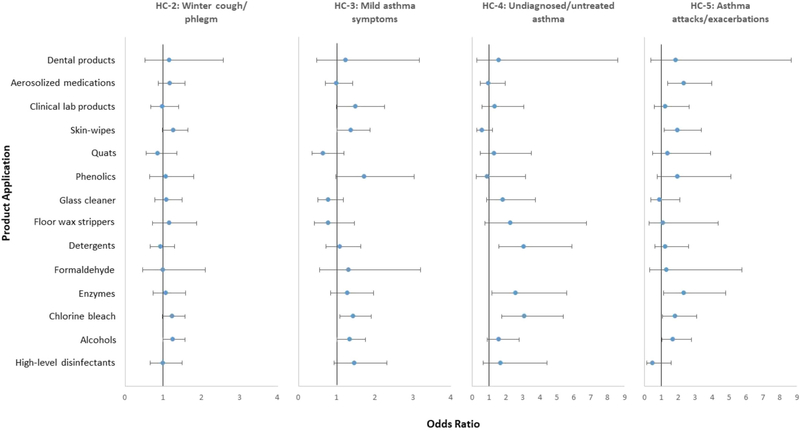
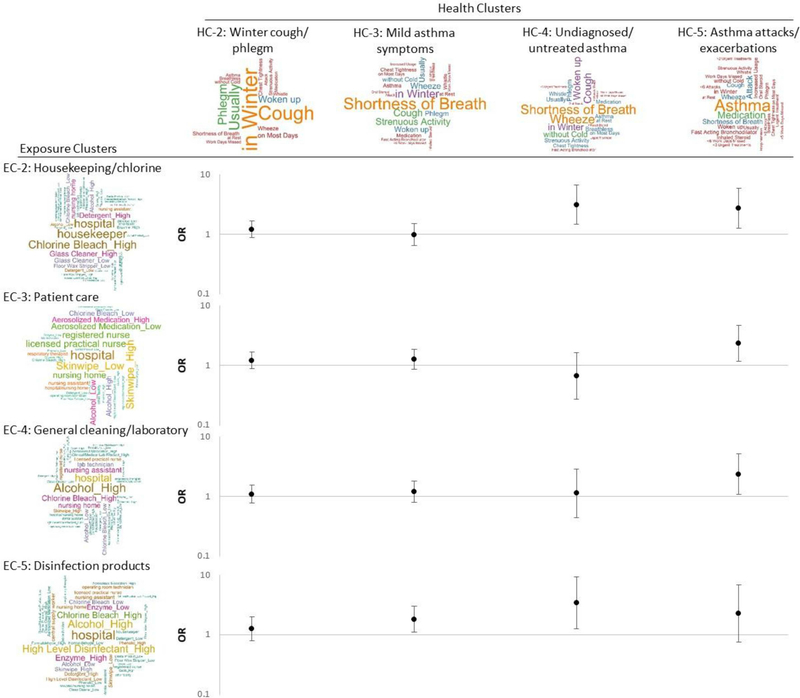
Asthma is a heterogeneous disease with varying severity and subtypes. Recent reviews of epidemiologic studies have identified cleaning and disinfecting activities (CDAs) as important risk factors for asthma-related outcomes among healthcare workers. However, the complexity of CDAs in healthcare settings has rarely been examined. This study utilized a complex survey dataset and data reduction approaches to identify and group healthcare workers with similar patterns of asthma symptoms, and then explored their associations with groups of participants with similar patterns of CDAs. Self-reported information on asthma symptoms/care, CDAs, demographics, smoking status, allergic status, and other characteristics were collected from 2030 healthcare workers within nine selected occupations in New York City. Hierarchical clustering was conducted to systematically group participants based on similarity of patterns of the 27 asthma symptom/care variables, and 14 product applications during CDAs, separately. Word clouds were used to visualize the complex information on the resulting clusters. The associations of asthma health clusters (HCs) with exposure clusters (ECs) were evaluated using multinomial logistic regression. Five HCs were identified (HC-1 to HC-5), labelled based on predominant features as: "no symptoms", "winter cough/phlegm", "mild asthma symptoms", "undiagnosed/untreated asthma", and "asthma attacks/exacerbations". For CDAs, five ECs were identified (EC-1 to EC-5), labelled as: "no products", "housekeeping/chlorine", "patient care", "general cleaning/laboratory", and "disinfection products". Using HC-1 and EC-1 as the reference groups, EC-2 was associated with HC-4 (odds ratio (OR) = 3.11, 95% confidence interval (95% CI) = 1.46-6.63) and HC-5 (OR = 2.71, 95% CI = 1.25-5.86). EC-3 was associated with HC-5 (OR = 2.34, 95% CI = 1.16-4.72). EC-4 was associated with HC-5 (OR = 2.35, 95% CI = 1.07-5.13). EC-5 was associated with HC-3 (OR = 1.81, 95% CI = 1.09-2.99) and HC-4 (OR = 3.42, 95% CI = 1.24-9.39). Various combinations of product applications like using alcohols, bleach, high-level disinfectants, and enzymes to disinfect instruments and clean surfaces captured by the ECs were identified as risk factors for the different asthma symptoms clusters, indicating that prevention efforts may require targeting multiple products. The associations of HCs with EC can be used to better inform prevention strategies and treatment options to avoid disease progression. This study demonstrated hierarchical clustering and word clouds were useful techniques for analyzing and visualizing a complex dataset with a large number of potentially correlated variables to generate practical information that can inform prevention activities.
哮喘是一种具有不同严重程度和亚型的异质性疾病。最近对流行病学研究的综述确定了清洁和消毒活动(CDAs)是医护人员与哮喘相关结局的重要危险因素。然而,医疗环境中 CDAs 的复杂性很少被研究。本研究利用复杂的调查数据集和数据简化方法,确定并分组具有相似哮喘症状模式的医护人员,然后探索他们与具有相似 CDAs 模式的参与者组之间的关联。在纽约市的九个选定职业中,从 2030 名医护人员中收集了关于哮喘症状/护理、CDAs、人口统计学、吸烟状况、过敏状况和其他特征的自我报告信息。基于 27 个哮喘症状/护理变量和 CDAs 期间的 14 种产品应用的相似性,进行了层次聚类。使用词云可视化复杂的聚类结果。使用多项逻辑回归评估哮喘健康聚类(HCs)与暴露聚类(ECs)之间的关联。确定了五个 HCs(HC-1 到 HC-5),根据主要特征标记为:“无症状”、“冬季咳嗽/痰”、“轻度哮喘症状”、“未诊断/未经治疗的哮喘”和“哮喘发作/加重”。对于 CDAs,确定了五个 ECs(EC-1 到 EC-5),标记为:“无产品”、“家政/氯”、“患者护理”、“一般清洁/实验室”和“消毒剂产品”。使用 HC-1 和 EC-1 作为参考组,EC-2 与 HC-4(比值比(OR)=3.11,95%置信区间(95%CI)=1.46-6.63)和 HC-5(OR=2.71,95%CI=1.25-5.86)相关。EC-3 与 HC-5(OR=2.34,95%CI=1.16-4.72)相关。EC-4 与 HC-5(OR=2.35,95%CI=1.07-5.13)相关。EC-5 与 HC-3(OR=1.81,95%CI=1.09-2.99)和 HC-4(OR=3.42,95%CI=1.24-9.39)相关。通过 EC 捕获的各种产品应用组合,如使用酒精、漂白剂、高水平消毒剂和酶来消毒仪器和清洁表面,被确定为不同哮喘症状聚类的危险因素,表明预防措施可能需要针对多种产品。HC 与 EC 的关联可用于更好地为预防策略和治疗选择提供信息,以避免疾病进展。本研究表明,层次聚类和词云是分析和可视化具有大量潜在相关变量的复杂数据集的有用技术,可以生成实用信息,为预防活动提供信息。