Siddique Yasir Hasan, Naz Falaq, Rashid Mohammad
Drosophila Transgenic Laboratory, Section of Genetics, Department of Zoology, Faculty of Life Sciences, Aligarh Muslim University, Aligarh, 202002, Uttar Pradesh, India.
Department of Saidla, Ajmal Khan Tibbiya College, Aligarh Muslim University, Aligarh, 202002, Uttar Pradesh, India.
Heliyon. 2019 Apr 11;5(4):e01483. doi: 10.1016/j.heliyon.2019.e01483. eCollection 2019 Apr.
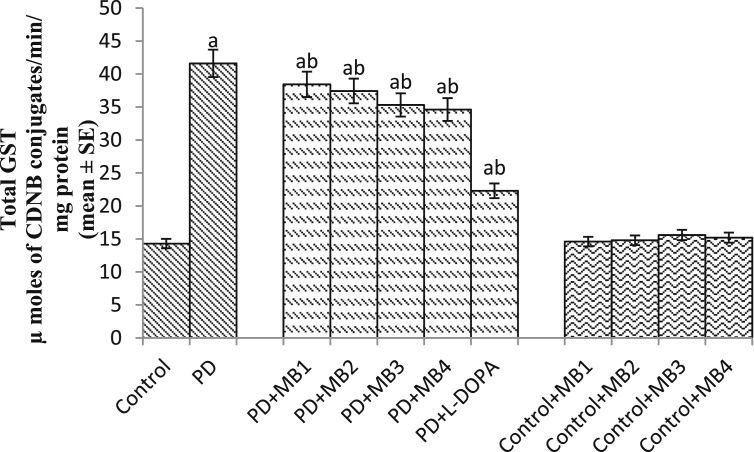
The effect of a poly herbal drug Majun Baladur (MB) was studied on the transgenic expressing human alpha synuclein in the neurons (PD flies). The equivalents of recommended dose for human were established for 20 g of fly food i.e. 0.0014, 0.0028, 0.0042 and 0.0056 g per 20 g of diet. The PD flies were allowed to feed on it for 24 days before performing the assays. The exposure to MB increased the life span and improves the activity of PD flies. The PD flies exposed to 0.0014, 0.0028, 0.042 and 0.0056 g of MB showed a dose dependent significant delay of 1.47, 1.88, 2.52 and 3.05 folds in the climbing ability compared to unexposed PD flies. A dose dependent significant decrease of 1.38, 1.45, 1.48 and 1.65 folds in TBARS; 1.08, 1.11, 1.17 and 1.20 folds in the GST activity; 1.20, 1.28, 1.39 and 1.52 folds in the PC content; 1.43, 1.53, 1.65 and 1.79 folds in the Caspase-9 activity; 1.21, 1.31, 1.53 and 1.64 folds in the activity of Caspase-3 and 1.24, 1.42, 1.50 and 1.79 folds in the activity of catalase; 1.50, 1.63, 1.88 and 2.06 folds in the activity of SOD in PD flies exposed to 0.0014, 0.0028, 0.042 and 0.0056 g of MB, respectively. A significant dose dependent increase of 1.20, 1.29, 1.33 and 1.44 folds in as NPSH content was observed in PD flies exposed to 0.0014, 0.0028, 0.042 and 0.0056 g of MB, respectively. The exposure to MB protects the loss of dopaminergic neurons as is evident by immunohistochemistry. It is concluded that MB is potent in reducing the PD symptoms being mimicked in the transgenic flies.
研究了一种多草药药物马君巴拉杜尔(MB)对在神经元中表达人α-突触核蛋白的转基因果蝇(帕金森病果蝇)的影响。确定了相当于人类推荐剂量的量,即每20克果蝇食物中含0.0014、0.0028、0.0042和0.0056克。在进行实验前,让帕金森病果蝇食用该药物24天。暴露于MB可延长帕金森病果蝇的寿命并改善其活动能力。与未暴露的帕金森病果蝇相比,暴露于0.0014、0.0028、0.042和0.0056克MB的帕金森病果蝇在攀爬能力上呈现剂量依赖性显著延迟,分别延迟了1.47、1.88、2.52和3.05倍。暴露于0.0014、0.0028、0.042和0.0056克MB的帕金森病果蝇中,丙二醛(TBARS)含量分别显著降低了1.38、1.45、1.48和1.65倍;谷胱甘肽S-转移酶(GST)活性分别降低了1.08、1.11、1.17和1.20倍;磷脂酰胆碱(PC)含量分别降低了1.20、1.28、1.39和1.52倍;半胱天冬酶-9(Caspase-9)活性分别降低了1.43、1.53、1.65和1.79倍;半胱天冬酶-3(Caspase-3)活性分别降低了1.21、1.31、1.53和1.64倍;过氧化氢酶活性分别降低了1.24、1.42、1.50和1.79倍;超氧化物歧化酶(SOD)活性分别降低了1.50、1.63、1.88和2.06倍。在暴露于0.0014、0.0028、0.042和0.0056克MB的帕金森病果蝇中分别观察到非蛋白巯基(NPSH)含量显著剂量依赖性增加,分别增加了1.20、1.29、1.33和1.44倍。免疫组织化学表明,暴露于MB可保护多巴胺能神经元的损失。得出的结论是,MB在减轻转基因果蝇模拟的帕金森病症状方面具有效力。