Department of Materials Engineering, School of Engineering, The University of Tokyo, Tokyo 113-8656, Japan.
Sensors (Basel). 2019 Apr 14;19(8):1784. doi: 10.3390/s19081784.
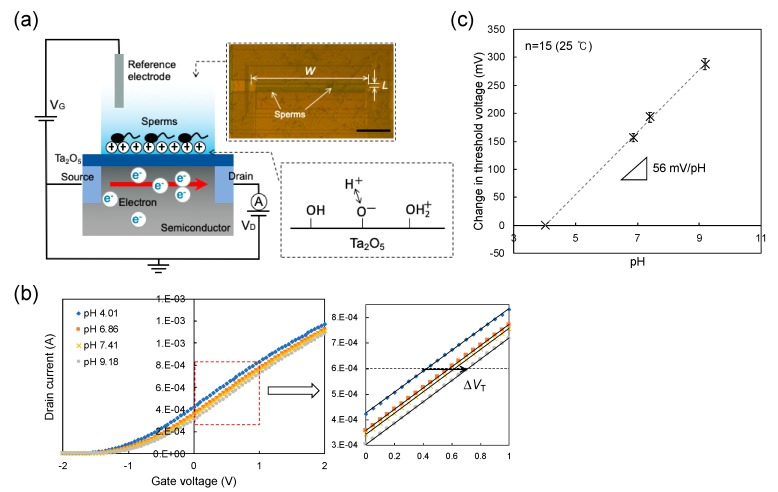
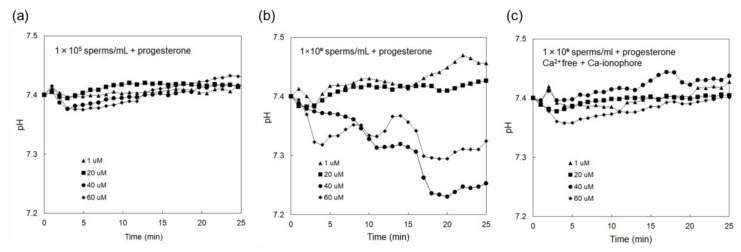
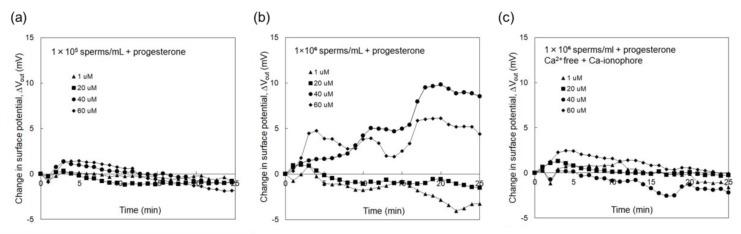
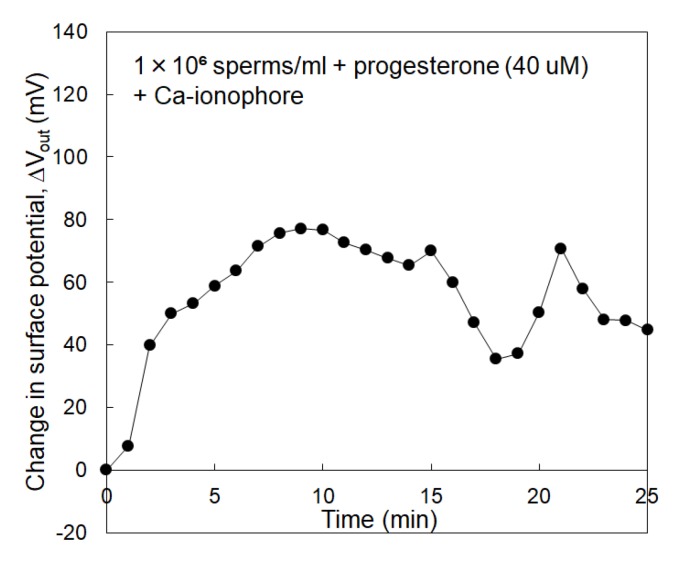
We have successfully monitored the effect of progesterone and Ca on artificially induced sperm capacitation in a real-time, noninvasive and label-free manner using an ion-sensitive field-effect transistor (ISFET) sensor. The sperm activity can be electrically detected as a change in pH generated by sperm respiration based on the principle of the ISFET sensor. Upon adding mouse sperm to the gate of the ISFET sensor in the culture medium with progesterone, the pH decreases with an increasing concentration of progesterone from 1 to 40 μM. This is because progesterone induces Ca influx into spermatozoa and triggers multiple Ca-dependent physiological responses, which subsequently activates sperm respiration. Moreover, this pH response of the ISFET sensor is not observed for a Ca-free medium even when progesterone is introduced, which means that Ca influx is necessary for sperm activation that results in sperm capacitation. Thus, a platform based on the ISFET sensor system can provide a simple method of evaluating artificially induced sperm capacitation in the field of male infertility treatment.
我们已经成功地使用离子敏感场效应晶体管(ISFET)传感器以实时、非侵入性和无标记的方式监测孕酮和 Ca 对人工诱导的精子获能的影响。根据 ISFET 传感器的原理,精子的活动可以通过精子呼吸产生的 pH 值变化来进行电检测。当将老鼠精子添加到含有孕酮的 ISFET 传感器的栅极中时,随着孕酮浓度从 1 到 40 μM 的增加,pH 值会降低。这是因为孕酮诱导 Ca 流入精子,并引发多种 Ca 依赖性生理反应,从而激活精子呼吸。此外,即使引入孕酮,在无 Ca 的培养基中也不会观察到 ISFET 传感器的这种 pH 响应,这意味着 Ca 流入对于导致精子获能的精子激活是必要的。因此,基于 ISFET 传感器系统的平台可以为男性不育治疗领域中人工诱导的精子获能提供一种简单的评估方法。