Department of Materials Engineering, School of Engineering, The University of Tokyo, 7-3-1 Hongo, Bunkyo-ku, Tokyo 113-8656, Japan.
Sensors (Basel). 2019 Aug 2;19(15):3393. doi: 10.3390/s19153393.
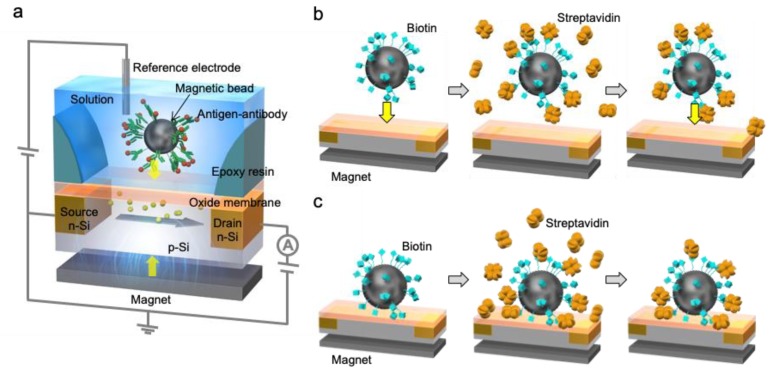
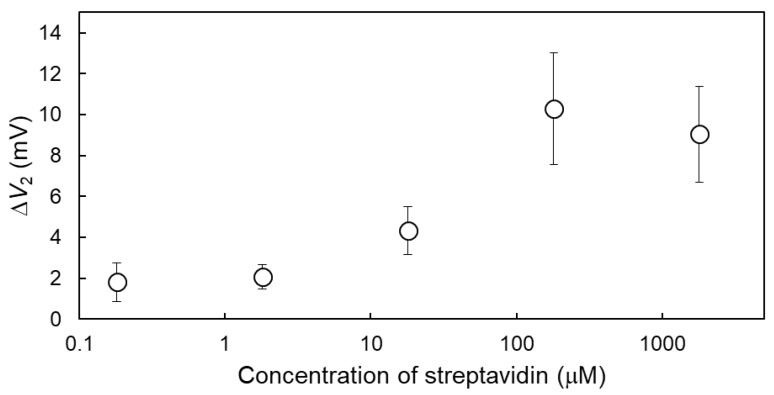
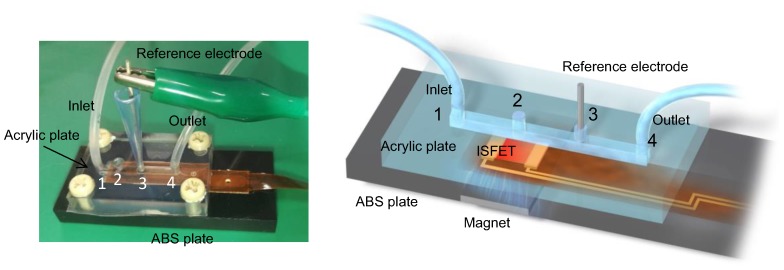
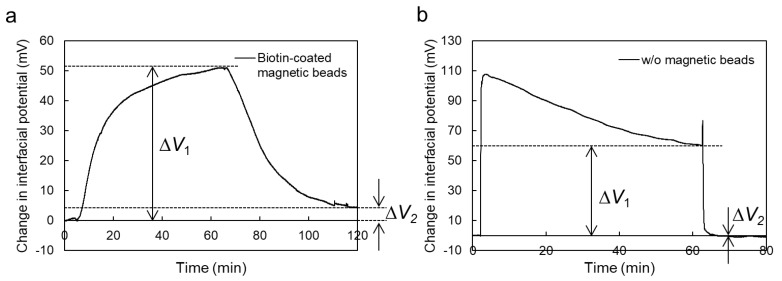
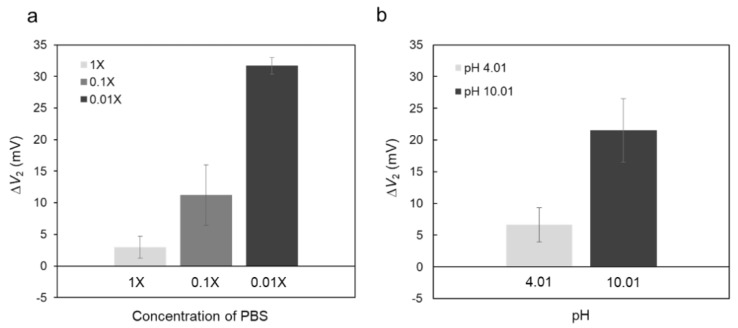
In this paper, we demonstrate the possibility of direct protein sensing beyond the Debye length limit using a molecular-charge-contact (MCC)-based ion-sensitive field-effect transistor (ISFET) sensor combined with a microfluidic device. Different from the MCC method previously reported, biotin-coated magnetic beads are set on the gate insulator of an ISFET using a button magnet before the injection of target molecules such as streptavidin. Then, the streptavidin-a biotin interaction, used as a model of antigen-antibody reaction is expected at the magnetic beads/gate insulator nanogap interface, changing the pH at the solution/dielectric interface owing to the weak acidity of streptavidin. In addition, the effect of the pH or ionic strength of the measurement solutions on the electrical signals of the MCC-based ISFET sensor is investigated. Furthermore, bound/free (B/F) molecule separation with a microfluidic device is very important to obtain an actual electrical signal based on the streptavidin-biotin interaction. Platforms based on the MCC method are suitable for exploiting the advantages of ISFETs as pH sensors, that is, direct monitoring systems for antigen-antibody reactions in the field of in vitro diagnostics.
在本文中,我们展示了使用基于分子电荷接触 (MCC) 的离子敏感场效应晶体管 (ISFET) 传感器与微流控装置,超越德拜长度限制进行直接蛋白质感应的可能性。与之前报道的 MCC 方法不同,在注入目标分子(如链霉亲和素)之前,使用按钮磁铁将生物素涂层的磁性珠设置在 ISFET 的栅极绝缘体上。然后,预计在磁性珠/栅极绝缘体纳米间隙界面处发生链霉亲和素-生物素相互作用,作为抗原-抗体反应的模型,由于链霉亲和素的弱酸性,改变溶液/电介质界面处的 pH 值。此外,还研究了测量溶液的 pH 值或离子强度对基于 MCC 的 ISFET 传感器电信号的影响。此外,使用微流控装置进行结合/游离 (B/F) 分子分离对于基于链霉亲和素-生物素相互作用获得实际电信号非常重要。基于 MCC 方法的平台适用于利用 ISFET 作为 pH 传感器的优势,即体外诊断领域中抗原-抗体反应的直接监测系统。